| Uhunduni | |
|---|---|
| Damal | |
| Amung | |
| Region | Central Papua: central highlands, Paniai Regency, Beoga and Ilaga sub-districts; Asmat, Deiya, Mimika, and Puncak regencies, north and south Puncak Jaya; possibly Lanny Jaya and Nduga regencies. |
| Ethnicity | Amung people, Damal people |
Native speakers | 14,000 (2000)[1] |
Trans–New Guinea
| |
| Language codes | |
| ISO 639-3 | uhn |
| Glottolog | dama1272 |
| ELP | Damal |
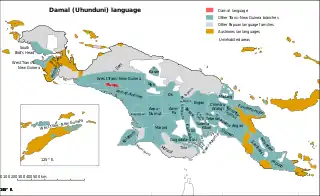 Map: The Amung language of New Guinea
The Amung language
Other Trans–New Guinea languages
Other Papuan languages
Austronesian languages
Uninhabited | |
Uhunduni, also known as Damal (Damal-kal) and Amung (Amung-kal) after two of its dialects, is the language of the Amung people and Damal people. It is a Trans–New Guinea language that forms an independent branch of that family in the classification of Malcolm Ross (2005). However, it is treated as an isolate by Palmer (2018).[2] This language family is also called Ingkipilu in a classification by Anton Moeliono. The word Damal came from the Dani people, while Uhunduni came from the Moni people.[3]
Dialects are Amongme, Amung, Damal, Enggipilu.
Classification
Pawley and Hammarström (2018) do not consider there to be sufficient evidence for Uhunduni to be classified as part of Trans-New Guinea, though they do note the following lexical resemblances between Uhunduni and proto-Trans-New Guinea.[4]
- no- ‘eat’ < *na-
- mo- come’ < *me-
- mini- ‘sit’ < *mVna-
- eme- ‘give’ < *mV-
Pronouns
Ross (2005) lists the pronouns as:
singular dual plural 1 na iru enoŋ 2 a erop 3 na nuŋ
Iru is an inclusive dual.
Vocabulary
The following basic vocabulary words of Damal (Uhunduni) are from the Trans-New Guinea database,[5] citing Voorhoeve (1975).[6]
gloss Damal head niŋok hair niŋatok eye noŋop tooth naik leg dok; nok louse ma dog mitim pig bow bird elato; olem egg olemagam blood nimang bone dok; nok skin nigip tree em man me sun ul water o; uk; ut fire ka; kanelep stone kela name nem eat nowin one amenkak two au; u
Literature
The New Testament in Damal was published in 1988.
- Damal people and CMA. 1988. Haik-A Ongam Kal: Perjanjian Baru Dalam Bahasa Damal [Haik-A Ongam Kal: The New Testament in Damal]. Jakarta: Lembaga Alkitab Indonesia.
References
- ↑ Uhunduni at Ethnologue (18th ed., 2015) (subscription required)
- ↑ Palmer, Bill (2018). "Language families of the New Guinea Area". In Palmer, Bill (ed.). The Languages and Linguistics of the New Guinea Area: A Comprehensive Guide. The World of Linguistics. Vol. 4. Berlin: De Gruyter Mouton. pp. 1–20. ISBN 978-3-11-028642-7.
- ↑ Budhisantoso, S.; Simanulang, Binsar; Guritno, Sri. "Masyarakat Terasing Amungme di Irian Jaya" (PDF). Kemdikbud. p. 31. Retrieved 2022-12-18.
- ↑ Pawley, Andrew; Hammarström, Harald (2018). "The Trans New Guinea family". In Palmer, Bill (ed.). The Languages and Linguistics of the New Guinea Area: A Comprehensive Guide. The World of Linguistics. Vol. 4. Berlin: De Gruyter Mouton. pp. 21–196. ISBN 978-3-11-028642-7.
- ↑ Greenhill, Simon (2016). "TransNewGuinea.org - database of the languages of New Guinea". Retrieved 2020-11-05.
- ↑ Voorhoeve, C.L. 1975. Languages of Irian Jaya Checklist. Canberra: Pacific Linguistics.
- Ross, Malcolm (2005). "Pronouns as a preliminary diagnostic for grouping Papuan languages". In Andrew Pawley; Robert Attenborough; Robin Hide; Jack Golson (eds.). Papuan pasts: cultural, linguistic and biological histories of Papuan-speaking peoples. Canberra: Pacific Linguistics. pp. 15–66. ISBN 0858835622. OCLC 67292782.