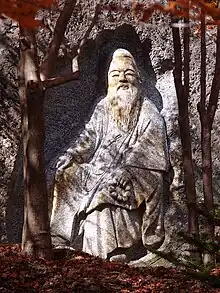
Haneunim or Hanunim (하느님 "Heavenly Lord"/"Lord of Heaven")[lower-alpha 1][1] is the sky God of Cheondoism and Jeungsanism.[1] In the more Buddhist-aligned parts of these religions, he is identified with Indra. In the more Taoist-aligned parts of these religions, he is also known as Okhwang Sangje (Hangul: 옥황상제 / Hanja: 玉皇上帝, "Highest Deity the Jade Emperor") and under that name, he is a deity in the Poncheongyo religion.[2]
Dangun myth
Dangun is traditionally considered to be the grandson of Hwanin, the "Heavenly King", and founder of the Korean nation.[3] Myths similar to that of Dangun are found in Ainu[4] and Siberian cultures.[5]
The myth starts with prince Hwanung ("Heavenly Prince"), son of Hwanin. The prince asked his father to grant him governance over Korea.[6] Hwanin accepted, and Hwanung was sent to Earth bearing three Heavenly Seals and accompanied by three thousand followers.[6] The prince arrived under the Sindansu/ Shindansu (신단수/ Hanja: 神檀樹, "Holy Tree of Sandalwood")[7] on the holy mountain, where he founded his holy city.[6]
At the time of his reign, Ungnyeo or Ungnye (웅녀, 熊女)[7]—who was a bear—and a tiger were living in a cave near the holy city, praying earnestly that their wish to become part of humankind might be fulfilled.[6] Ungnyeo patiently endured weariness and hunger, and after twenty-one days she was transformed into a woman, while the tiger ran away for it could not tolerate the effort.[6] The woman Ungnyeo was overjoyed, and visiting the sandalwood city she prayed that she might become the mother of a child.[6]
Ungnye's wish was fulfilled, so that she became the queen and gave birth to a prince who was given the royal name of Dangun, the "Sandalwood King".[6] Dangun reigned as the first human king of Korea, giving to his kingdom the name of Joseon, "Land of the Morning Calm", in 2333 BC.[6]
According to some scholars, the name Dangun is related to the Turko-Mongol Tengri ("Heaven"),[8] while the bear is a symbol of the Big Dipper (i.e. Ursa Major), itself a symbol of the supreme God in many Eurasian cultures, including Chinese theological thought.[9] Later in the myth, Dangun becomes the Sansin, the "Mountain God" (metaphorically of civilising growth, prosperity).[10]
See also
Counterparts of Haneullim in other Asian cultures
- Amenominakanushi, the Japanese counterpart
- Jade Emperor, the Chinese counterpart
- Indra/Trimurti, the Hindu counterpart
- Śakra/Adi Buddha, the Buddhist counterpart
- Tengri, the Turko-Mongolian counterpart
- Thagyamin, the Burmese Buddhist representation of Śakra, a counterpart of the Jade Emperor
- Yuanshi Tianzun, the Taoist counterpart
- Ông Trời, the Vietnamese counterpart
Notes
- ↑ also spelled Hanallim (하ㄴㆍㄹ님/하날님), Hanullim (한울님), birth name Hwanin (환인/ Hanja: 桓仁 or 桓因), also called Sangje (상제/ Hanja: 上帝, "Highest Deity"), Sangjenim (상제님/ Hanja: 上帝任/ mixed script: 上帝님, "Highest Divine Lord"), or Cheonju (천주/ Hanja: 天主, "Heavenly Lord"/"Lord of Heaven"), or known simply as Haneul (하늘 "Heaven"), Cheon (천/ Hanja: 天, "Heaven", in Sino-Korean), Cheonje (천제/ Hanja: 天帝, "Heavenly Emperor"/"Emperor of Heaven", in Sino-Korean), or Cheon-sin / Cheon-shin (천신/ Hanja: 天神, "God of Heaven")
References
- 1 2 Hong (2009), p. 39.
- ↑ "Okhwangsangje". Encyclopedia Britannica. Retrieved 2023-04-23.
- ↑ Lee (1981), p. 13.
- ↑ Lee (1981), p. 20.
- ↑ Lee (1981), p. 21.
- 1 2 3 4 5 6 7 8 Lee (1981), p. 14.
- 1 2 Lee (2010s), pp. 10–13.
- ↑ Lee (1981), pp. 17–18.
- ↑ Didier (2009), passim but especially Vol. I, pp. 143, 154.
- ↑ Lee (1981), pp. 16–18.
Sources
- Didier, John C. (2009). "In and Outside the Square: The Sky and the Power of Belief in Ancient China and the World, c. 4500 BC – AD 200". Sino-Platonic Papers. Victor H. Mair (192). Volume I: The Ancient Eurasian World and the Celestial Pivot, Volume II: Representations and Identities of High Powers in Neolithic and Bronze China, Volume III: Terrestrial and Celestial Transformations in Zhou and Early-Imperial China.
- Lee, Chi-ran (2010s). "The Emergence of National Religions in Korea" (PDF). Archived from the original (PDF) on 13 April 2014.
- Lee, Jung Young (1981). Korean Shamanistic Rituals. Mouton De Gruyter. ISBN 9027933782.
- Hong, Sung-wook (2009). Naming God in Korea. Wipf & Stock. ISBN 978-1606086261.