ARID1A
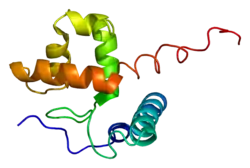
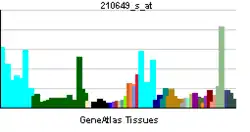
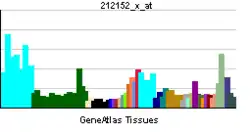
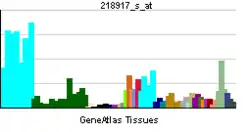
AT-rich interactive domain-containing protein 1A é uma proteína humana que é codificada pelo gene ARID1A.[1][2][3] Este gene codifica uma proteína liga a família SWI/SNF, cujos membros possuem atividade do tipo helicase e ATPase e estão envolvidos na transcrição de determinados genes por meio da alteração da estrutura da cromatina na região que abriga os ditos genes.
| editar |
Estudos do Centro para Câncer Johns Hopkins Kimmel publicados em setembro de 2010 na revista Science demonstraram que está relacionada com o câncer de ovário. Neste caso, impede a formação de tumores.[4]
Notas e referências
- Takeuchi T, Furihata M, Heng HH, Sonobe H, Ohtsuki Y (1998). «Chromosomal mapping and expression of the human B120 gene». Gene. 213 (1-2): 189–93. PMID 9630625. doi:10.1016/S0378-1119(98)00194-2
- Takeuchi T, Chen BK, Qiu Y, Sonobe H, Ohtsuki Y (1998). «Molecular cloning and expression of a novel human cDNA containing CAG repeats». Gene. 204 (1-2): 71–7. PMID 9434167. doi:10.1016/S0378-1119(97)00525-8
- «Entrez Gene: ARID1A AT rich interactive domain 1A (SWI-like)»
- G1. «Estudo nos EUA identifica dois genes ligados ao câncer de ovário». Consultado em 9 de setembro de 2010
- Kato, Hiroyuki; Tjernberg Agneta, Zhang Wenzhu, Krutchinsky Andrew N, An Woojin, Takeuchi Tamotsu, Ohtsuki Yuji, Sugano Sumio, de Bruijn Diederik R, Chait Brian T, Roeder Robert G (2002). «SYT associates with human SNF/SWI complexes and the C-terminal region of its fusion partner SSX1 targets histones». United States. J. Biol. Chem. 277 (7): 5498–505. ISSN 0021-9258. PMID 11734557. doi:10.1074/jbc.M108702200
- Wang, W; Côté J, Xue Y, Zhou S, Khavari P A, Biggar S R, Muchardt C, Kalpana G V, Goff S P, Yaniv M, Workman J L, Crabtree G R (1996). «Purification and biochemical heterogeneity of the mammalian SWI-SNF complex». ENGLAND. EMBO J. 15 (19): 5370–82. ISSN 0261-4189. PMC 452280
 . PMID 8895581
 - Zhao, K; Wang W, Rando O J, Xue Y, Swiderek K, Kuo A, Crabtree G R (1998). «Rapid and phosphoinositol-dependent binding of the SWI/SNF-like BAF complex to chromatin after T lymphocyte receptor signaling». UNITED STATES. Cell. 95 (5): 625–36. ISSN 0092-8674. PMID 9845365. doi:10.1016/S0092-8674(00)81633-5
Leitura de apoio
- Martens JA, Winston F (2003). «Recent advances in understanding chromatin remodeling by Swi/Snf complexes.». Curr. Opin. Genet. Dev. 13 (2): 136–42. PMID 12672490. doi:10.1016/S0959-437X(03)00022-4
- Maruyama K, Sugano S (1994). «Oligo-capping: a simple method to replace the cap structure of eukaryotic mRNAs with oligoribonucleotides.». Gene. 138 (1-2): 171–4. PMID 8125298. doi:10.1016/0378-1119(94)90802-8
- Wang W, Xue Y, Zhou S; et al. (1996). «Diversity and specialization of mammalian SWI/SNF complexes.». Genes Dev. 10 (17): 2117–30. PMID 8804307. doi:10.1101/gad.10.17.2117
- Wang W, Côté J, Xue Y; et al. (1996). «Purification and biochemical heterogeneity of the mammalian SWI-SNF complex.». EMBO J. 15 (19): 5370–82. PMC 452280. PMID 8895581
- Suzuki Y, Yoshitomo-Nakagawa K, Maruyama K; et al. (1997). «Construction and characterization of a full length-enriched and a 5'-end-enriched cDNA library.». Gene. 200 (1-2): 149–56. PMID 9373149. doi:10.1016/S0378-1119(97)00411-3
- Dallas PB, Cheney IW, Liao DW; et al. (1998). «p300/CREB binding protein-related protein p270 is a component of mammalian SWI/SNF complexes.». Mol. Cell. Biol. 18 (6): 3596–603. PMC 108941. PMID 9584200
- Dallas PB, Pacchione S, Wilsker D; et al. (2000). «The human SWI-SNF complex protein p270 is an ARID family member with non-sequence-specific DNA binding activity.». Mol. Cell. Biol. 20 (9): 3137–46. PMC 85608. PMID 10757798. doi:10.1128/MCB.20.9.3137-3146.2000
- Nie Z, Xue Y, Yang D; et al. (2000). «A specificity and targeting subunit of a human SWI/SNF family-related chromatin-remodeling complex.». Mol. Cell. Biol. 20 (23): 8879–88. PMC 86543. PMID 11073988. doi:10.1128/MCB.20.23.8879-8888.2000
- Takeuchi T, Nicole S, Misaki A; et al. (2001). «Expression of SMARCF1, a truncated form of SWI1, in neuroblastoma.». Am. J. Pathol. 158 (2): 663–72. PMC 1850330. PMID 11159203
- Kozmik Z, Machon O, Králová J; et al. (2001). «Characterization of mammalian orthologues of the Drosophila osa gene: cDNA cloning, expression, chromosomal localization, and direct physical interaction with Brahma chromatin-remodeling complex.». Genomics. 73 (2): 140–8. PMID 11318604. doi:10.1006/geno.2001.6477
- Kato H, Tjernberg A, Zhang W; et al. (2002). «SYT associates with human SNF/SWI complexes and the C-terminal region of its fusion partner SSX1 targets histones.». J. Biol. Chem. 277 (7): 5498–505. PMID 11734557. doi:10.1074/jbc.M108702200
- Lemon B, Inouye C, King DS, Tjian R (2002). «Selectivity of chromatin-remodelling cofactors for ligand-activated transcription.». Nature. 414 (6866): 924–8. PMID 11780067. doi:10.1038/414924a
- Hurlstone AF, Olave IA, Barker N; et al. (2002). «Cloning and characterization of hELD/OSA1, a novel BRG1 interacting protein.». Biochem. J. 364 (Pt 1): 255–64. PMC 1222568. PMID 11988099
- Inoue H, Furukawa T, Giannakopoulos S; et al. (2003). «Largest subunits of the human SWI/SNF chromatin-remodeling complex promote transcriptional activation by steroid hormone receptors.». J. Biol. Chem. 277 (44): 41674–85. PMID 12200431. doi:10.1074/jbc.M205961200
- Strausberg RL, Feingold EA, Grouse LH; et al. (2003). «Generation and initial analysis of more than 15,000 full-length human and mouse cDNA sequences.». Proc. Natl. Acad. Sci. U.S.A. 99 (26): 16899–903. PMC 139241. PMID 12477932. doi:10.1073/pnas.242603899
- Nie Z, Yan Z, Chen EH; et al. (2003). «Novel SWI/SNF chromatin-remodeling complexes contain a mixed-lineage leukemia chromosomal translocation partner.». Mol. Cell. Biol. 23 (8): 2942–52. PMC 152562. PMID 12665591. doi:10.1128/MCB.23.8.2942-2952.2003
- Kitagawa H, Fujiki R, Yoshimura K; et al. (2003). «The chromatin-remodeling complex WINAC targets a nuclear receptor to promoters and is impaired in Williams syndrome.». Cell. 113 (7): 905–17. PMID 12837248. doi:10.1016/S0092-8674(03)00436-7
Ligações externas
This article is issued from Wikipedia. The text is licensed under Creative Commons - Attribution - Sharealike. Additional terms may apply for the media files.