Catecol O-Metiltransferase
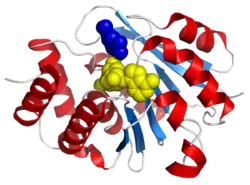
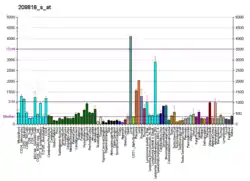
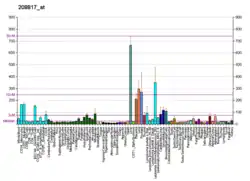
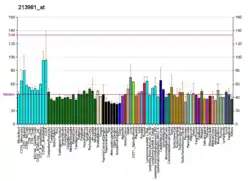
A Catecol O-Metiltransferase, ou simplesmente COMT, é uma das muitas enzimas que degradam catecolaminas (dopamina, epinefrina e norepinefrina).[3]
Referências
- «Drogas que interagem fisicamente com Catechol-O-methyltransferase ver/editar referências no wikidata»
- «Human PubMed Reference:»
- «Test ID: COMT: Catechol-O-Methyltransferase Genotype». www.mayomedicallaboratories.com. Mayo Clinic: Mayo Medical Laboratories. Consultado em 16 de novembro de 2016. Arquivado do original em 18 de setembro de 2008
Leitura adicional
- Trendelenburg U (1991). «The interaction of transport mechanisms and intracellular enzymes in metabolizing systems». Journal of Neural Transmission. Supplementum. 32: 3–18. ISBN 978-3-211-82239-5. PMID 2089098. doi:10.1007/978-3-7091-9113-2_1
- Zhu BT (outubro de 2002). «On the mechanism of homocysteine pathophysiology and pathogenesis: a unifying hypothesis». Histology and Histopathology. 17 (4): 1283–91. PMID 12371153
- Oroszi G, Goldman D (dezembro de 2004). «Alcoholism: genes and mechanisms». Pharmacogenomics. 5 (8): 1037–48. PMID 15584875. doi:10.1517/14622416.5.8.1037
- Fan JB, Zhang CS, Gu NF, Li XW, Sun WW, Wang HY, Feng GY, St Clair D, He L (janeiro de 2005). «Catechol-O-methyltransferase gene Val/Met functional polymorphism and risk of schizophrenia: a large-scale association study plus meta-analysis». Biological Psychiatry. 57 (2): 139–44. PMID 15652872. doi:10.1016/j.biopsych.2004.10.018
- Tunbridge EM, Harrison PJ, Weinberger DR (julho de 2006). «Catechol-O-methyltransferase, cognition, and psychosis: Val158Met and beyond». Biological Psychiatry. 60 (2): 141–51. PMID 16476412. doi:10.1016/j.biopsych.2005.10.024
- Craddock N, Owen MJ, O'Donovan MC (maio de 2006). «The catechol-O-methyl transferase (COMT) gene as a candidate for psychiatric phenotypes: evidence and lessons». Molecular Psychiatry. 11 (5): 446–58. PMID 16505837. doi:10.1038/sj.mp.4001808
- Frank MJ, Moustafa AA, Haughey HM, Curran T, Hutchison KE (outubro de 2007). «Genetic triple dissociation reveals multiple roles for dopamine in reinforcement learning». Proceedings of the National Academy of Sciences of the United States of America. 104 (41): 16311–6. PMC 2042203
 . PMID 17913879. doi:10.1073/pnas.0706111104
 - Greenberg, Gary (7 de novembro de 2018). «What If the Placebo Effect Isn't a Trick?». New York Times Magazine
This article is issued from Wikipedia. The text is licensed under Creative Commons - Attribution - Sharealike. Additional terms may apply for the media files.