Carukiidae
Carukiidae é uma família de medusas da classe Cubozoa. Carukiidae contém as espécies de cubomedusas identificadas como causadoras da chamada síndrome de Irukandji. Antes de Bentlage et al. (2010),[1] os gêneros contidos agora em Carukiidae estavam classificados em Tamoyidae ao lado de Tamoya.[2][3] Atualmente, os Carukiidae conhecidos são apenas na região Indo-Pacífica, variando de Nova Gales do Sul, na Austrália, até Honshu, no Japão, no eixo norte-sul. Muito pouco se sabe sobre os limites leste e oeste da distribuição de Carukiidae. Gershwin e Alderslade (2005)[2] fornecem uma comparação tabular dos gêneros Carukiidae (então chamados Tamoyidae). As diferenças na forma dos chifres ropalianos, os padrões de ramificação dos canais velariais e o número e arranjo das verrugas de nematocistos nas lapelas perradiais são os caracteres morfológicos mais confiáveis para distinguir os gêneros de Carukiidae. Além disso, as contagens e padrões de verrugas de nematocistas no velário podem ser distintas entre os gêneros Carukiidae.[4]
| Carukiidae | |||||||||||||||
|---|---|---|---|---|---|---|---|---|---|---|---|---|---|---|---|
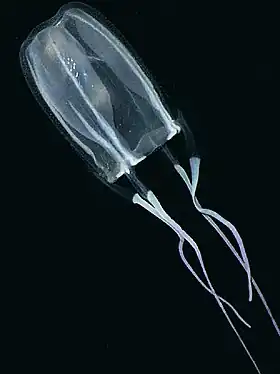 Morbakka virulenta, Mar Interior de Seto, Japão | |||||||||||||||
| Classificação científica | |||||||||||||||
| |||||||||||||||
| Gêneros | |||||||||||||||
| Ver texto | |||||||||||||||
Classificação
- Carukia
- Carukia barnesi (Southcott, 1967)
- Carukia shinju (Gershwin, 2005)
- Gerongia
- Gerongia rifkinae (Gershwin & Alderslade, 2005)[5]
- Malo
- Malo kingi (Gershwin, 2007)
- Malo maximus (Gershwin, 2005)
- Malo filipina (Bentlage & Lewis, 2012)
- Malo bella (Gershwin, 2014)[6]
- Morbakka
- Morbakka fenneri (Gershwin, 2008)
- Morbakka virulenta (Kishinouyea, 1910)
Referências
- Bentlage, B.; Cartwright, P.; Yanagihara, A.A.; Lewis, C.; et al. (2010). «Evolution of Box Jellyfish (Cnidaria: Cubozoa), a Group of Highly Toxic Invertebrates». Proc Biol Sci. 277 (1680): 493-501. PMID 19923131. doi:10.1098/rspb.2009.1707
- Gershwin, Lisa-Ann; Alderslade, Phil (2005). «A new genus and species of box jellyfish (Cubozoa: Carybdeida) from tropical Australian waters». The Beagle, Records of the Museums and Art Galleries of the Northern Territory. 21: 27-36
- Daly, M.; Brugler, M.R.; Cartwright, P.; Collins, A.G.; et al. (2007). «The Phylum Cnidaria: A Review Of Phylogenetic Patterns And Diversity 300 Years After Linnaeus». In: Zhang, Z.-Q. & Shear, W.A. Linnaeus Tercentenary: Progress in Invertebrate Taxonomy. Zootaxa. 1668. Auckland, New Zealand: [s.n.] p. 128-159. doi:10.5281/zenodo.180149
- Bentlage, Bastian; Lewis, Cheryl (2012). «An illustrated key and synopsis of the families and genera of carybdeid box jellyfishes (Cnidaria: Cubozoa: Carybdeida), with emphasis on the "Irukandji family" (Carukiidae)». Journal of Natural History. 46 (41-42): 2595–2620. doi:10.1080/00222933.2012.717645
- Gershwin, Lisa-Ann; Alderslade, Phil (2005). «A new genus and species of box jellyfish (Cubozoa: Carybdeida) from tropical Australian waters». The Beagle, Records of the Museums and Art Galleries of the Northern Territory. 21: 27-36
- Gershwin, Lisa-Ann (2014). «Two new species of box jellies (Cnidaria: Cubozoa: Carybdeida) from the central coast of Western Australia, both presumed to cause Irukandji syndrome». Records of the Western Australian Museum. 29 (1)