Gruimorphae
Gruimorphae[4] é um clado de aves que contém as ordens Charadriiformes (tarambolas, gaivotas e aliados) e Gruiformes (guindastes e trilhos) identificadas por análise molecular.[5] Este agrupamento teve sustentação histórica, pois várias famílias de caradriiformes como as famílias Pedionomidae e Turnicidae foram classificadas como gruiformes .[6][7][8] Também pode ter suporte do registro fóssil desde a descoberta de Nahmavis do início do Eoceno da América do Norte.[9]
| Gruimorphae | |
|---|---|
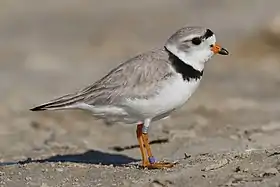 | |
| Piping plover (Charadrius melodus) | |
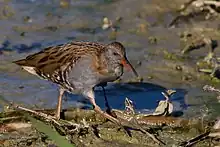 | |
| Water rail (Rallus aquaticus) | |
Classificação científica  | |
| Domínio: | Eukaryota |
| Reino: | Animalia |
| Filo: | Chordata |
| Classe: | Aves |
| Infraclasse: | Neognathae |
| Clado: | Neoaves |
| Clado: | Gruimorphae Bonaparte, 1854 |
| Orders | |
| Sinónimos | |
| |
A relação entre essas aves se deve a características anatômicas e comportamentais semelhantes. Um estudo morfológico foi mais longe ao sugerir que os gruiformes podem ser parafiléticos em relação às aves limícolas, estando os trilhos intimamente relacionados com as codornizes.[10][11]
Referências
- Mourer-Chaviré C. (1995) The Messelornithidae (Aves: Gruiformes) from the Paleogene of France. - Cour. Forsch.-Inst. Senckenberg, 181: 95-105
- Mayr, Gerald (2016). Avian evolution: the fossil record of birds and its paleobiological significance. Topics in Paleobiology. Wiley-Blackwell. p. 306. ISBN 978-1-119-02076-9.
- Kuhl, H.; Frankl-Vilches, C.; Bakker, A.; Mayr, G.; Nikolaus, G.; Boerno, S. T.; Klages, S.; Timmermann, B.; Gahr, M. (2020). «An unbiased molecular approach using 3'UTRs resolves the avian family-level tree of life.». Molecular Biology and Evolution. 38: 108–127. PMC 7783168
 . PMID 32781465. doi:10.1093/molbev/msaa191
 - «TiF Checklist: GRUAE I: Opisthocomiformes & Gruiformes». www.jboyd.net. Consultado em 10 de abril de 2018
- Jarvis, E.D.; et al. (2014). «Whole-genome analyses resolve early branches in the tree of life of modern birds». Science. 346 (6215): 1320–1331. Bibcode:2014Sci...346.1320J. PMC 4405904. PMID 25504713. doi:10.1126/science.1253451
- Huxley T.H. On the classification of birds; and on the taxonomic value of the modifications of certain of the cranial bones observable in that class.
- Lowe P.R. An anatomical review of the ‘waders’ (Telmatomorphæ), with special reference to the families, subfamilies, and genera within the suborders Limicolæ, Grui-Limicolæ and Lari-Limicolæ.
- Lowe P.R. On the relations of the Gruimorphæ to the Charadriimorphæ and Rallimorphæ, with special reference to the taxonomic position of Rostratulidæ, Jacanidæ, and Burhinidæ.
- Musser, G.; Clarke, J.A. (2020), «An Exceptionally Preserved Specimen From the Green River Formation Elucidates Complex Phenotypic Evolution in Gruiformes and Charadriiformes», Frontiers in Ecology and Evolution, 8, doi:10.3389/fevo.2020.559929
- Livezey, B. C.; Zusi, R. L. (2007). «Higher-order phylogeny of modern birds (Theropoda, Aves: Neornithes) based on comparative anatomy. II. Analysis and discussion». Zoological Journal of the Linnean Society. 149 (1): 1–95. PMC 2517308. PMID 18784798. doi:10.1111/j.1096-3642.2006.00293.x
- «Neognathia». www.helsinki.fi. Consultado em 10 de abril de 2018