Estado remanescente
Estado remanescente ou residual é o resquício de um Estado outrora muito maior, deixado com um território reduzido após secessão, anexação, ocupação, descolonização, golpe ou revolução em parte de seu antigo território.[1] Neste último caso, o governo não chega ao exílio porque ainda controla parte de seu antigo território.

Exemplos
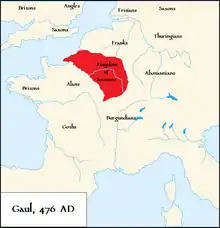
Reino de Soissons, remanescente do Império Romano.
História antiga
- O Estado Xu, na atual China, que originalmente controlava grande parte do vale do rio Huai,[2] foi gradualmente reduzido para a área em torno de sua capital, a partir do século VII a.C.
- O Reino de Soissons sobreviveu às perdas territoriais e subsequente queda do Império Romano do Ocidente no ano 476, sob a liderança de Egídio, que havia sido nomeado para governar a área pelo imperador Majoriano em 458. O reino caiu para o rei dos francos, Clóvis, em 486.[3]
- O Império Selêucida na Síria, depois de perder a maior parte de seu território para o Império Parta.[4]
História medieval
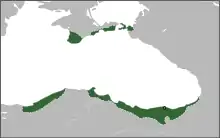
Império de Trebizonda, remanescente do Império Bizantino.
- Depois que a dinastia Jin assumiu o controle sobre o norte da China, um Estado Song violento permaneceu no sul.[5]
- Depois que a dinastia Ming estabeleceu o controle sobre a China, a dinastia Yuan continuou na Mongólia como o Estado remanescente.[6]
- Depois que o Império Qing assumiu o controle sobre a maior parte da China Ming, os Ming do Sul formaram um Estado remanescente entre 1644 e 1659.[7]
- Depois que o Sultanato Madurai assumiu o controle sobre a maior parte do Império Pandia, e que mais tarde foi capturado pelo Império Vijayanagara, os pandias do sul formaram um Estado tumultuado de 1330 a 1422, dominando os distritos modernos de Tirunelveli e Thuthukudi, juntamente com certas regiões do Ghats Ocidental. Eles perderam ainda mais seu território e governaram a região de Tenkasi, que formou um Estado remanescente até 1623.[7]
- Trebizonda, Teodoro e Epiro continuaram como Estados remanescentes do Império Bizantino após a Queda de Constantinopla, até suas conquistas em 1461, 1475 e 1479, respectivamente.[8]
História moderna
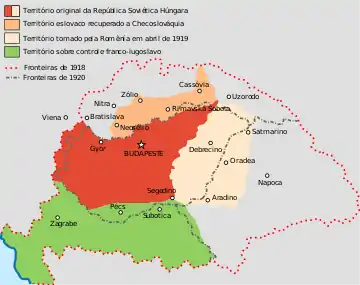
Em vermelho escuro, o território correspondente à República Soviética Húngara.
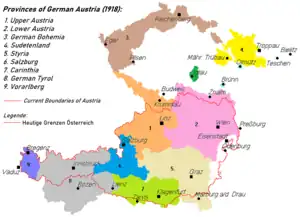
República da Áustria Alemã, remanescente do Império Austro-Húngaro.
- A Comunidade Polaco-Lituana foi deixada como um Estado remanescente após a Primeira Partilha da Polônia pela Rússia, Prússia e Áustria em 1772.[9] O Estado remanescente resultante foi dividido novamente em 1793 e anexado em 1795. Após a vitória de Napoleão na Guerra da Quarta Coalizão em 1807, ele criou um novo Estado remanescente polonês, o Ducado de Varsóvia.[10] Após a derrota de Napoleão, o Congresso de Viena criou a Polônia do Congresso em 1815; não está claro se isto deve ser visto como um Estado remanescente ou um Estado fantoche.[11]
- A República Soviética Húngara[12] foi proclamada em março de 1919, após a renúncia do governo da Primeira República Húngara, quando, após a aliança com os social-democratas, os comunistas assumiram o controle do país. Embora às vezes controlasse apenas cerca de 23% do estado húngaro, após alguns sucessos militares iniciais, no final o exército foi derrotado e o governo caiu por completo em agosto de 1919.
- A República da Áustria Alemã foi criada em 1918 como o Estado remanescente inicial para áreas com população predominantemente de língua alemã dentro do que havia sido o Império Austro-Húngaro.[13]
- A República de Salò (Repubblica Sociale Italiana, 1943-1945), liderada por Benito Mussolini, afirmou ser o sucessor legítimo do Reino da Itália; era de fato um Estado fantoche da Alemanha nazista.[14][15][16]
- A Etiópia foi abandonada pela independência da Eritreia em 1991, após a Guerra de Independência da Eritreia.[17]
- A República Federal da Iugoslávia, ou seja, o nome que a União Estatal da Sérvia e Montenegro usou de 1992 a 2003, era frequentemente vista como o Estado deixado para trás pela República Socialista Federativa da Iugoslávia (1945-1992) quando ela entrou em colapso.[18] Essa visão era sustentada não apenas por seus fundadores, mas também por muitas pessoas antagônicas a eles.[18]
- Desde a secessão do Sudão do Sul em 2011, a porção norte do Sudão formou um Estado remanescente.[19]
Casos disputados
- República da China: Após a vitória do Partido Comunista da China no estabelecimento da República Popular da China na China continental durante a Guerra Civil Chinesa, o governo da República da China fugiu para a ilha de Taiwan e continua a reivindicar autoridade sobre todos da China. Desde então, não há unanimidade sobre o estatuto político de Taiwan: poucos o consideram um Estado remanescente,[20] enquanto outros o consideram um governo no exílio.[21]
Referências
- Tir, Jaroslav (22 de fevereiro de 2005). Keeping the Peace After Secessions: Territorial Conflicts Between Rump and Secessionist States. Annual meeting of the International Studies Association. Hilton Hawaiian Village, Honolulu: Hawaii Online. Consultado em 26 de outubro de 2014
- Shaughnessy (1999), p. 324.
- State, Paul F. A brief history of France. [S.l.]: Facts On File. p. 35. ISBN 9781438133461
- Fattah, Hala Mundhir; Caso, Frank (2009). A Brief History of Iraq. [S.l.: s.n.] p. 277
- Des Forges, Roger V. (2003). Cultural centrality and political change in Chinese history : northeast Henan in the fall of the Ming. [S.l.]: Stanford University Press. p. 6. ISBN 9780804740449
- Seth, Michael J. (2010). A History of Korea: From Antiquity to the Present. [S.l.]: Rowman & Littlefield Publishers. p. 115
- Struve, Lynn A. (1998). «The Ming-Qing Conflict, 1619-1683: A Historiography and Source Guide»: 110-111
- William Miller, Trebizond: The last Greek Empire of the Byzantine Era: 1204-1461, 1926 (Chicago: Argonaut, 1969), pp. 100-106
- Fazal, Tanisha M. (2011). State Death: The Politics and Geography of Conquest, Occupation, and Annexation. [S.l.]: Princeton University Press. p. 110. ISBN 9781400841448
- Lerski, George J. (1996). Historical dictionary of Poland, 966-1945. [S.l.]: Greenwood Press. p. 121. ISBN 9780313260070
- Marcus, Joseph (2011). Social and political history of the Jews in Poland, 1919-1939. [S.l.]: Mouton Publishers. p. 73. ISBN 9783110838688
- John C. Swanson (2017). Tangible Belonging: Negotiating Germanness in Twentieth-Century Hungary. [S.l.]: University of Pittsburgh Press. p. 80. ISBN 9780822981992
- Magocsi, Paul Robert (2018). Historical atlas of Central Europe: Third Revised and Expanded Edition. [S.l.]: University of Toronto Press. p. 128. ISBN 9781487523312
- James Hartfield, Unpatriotic History of the Second World War, ISBN 178099379X, 2012, p. 424
- Eric Morris, Circles of Hell: The War in Italy 1943-1945, ISBN 0091744741, 1993, p. 140
- Neville, Peter (2014). Mussolini 2nd ed. [S.l.]: Routledge. p. 199. ISBN 9781317613046
- Tir, Jaroslav (2005). «Keeping the Peace after Secession: Territorial Conflicts between Rump and Secessionist States». The Journal of Conflict Resolution. 49 (5): 714
- Sudetic, Chuck (24 de outubro de 1991), «Top Serb Leaders Back Proposal To Form Separate Yugoslav State», New York Times, consultado em 7 de março de 2018.
- Beber, Bernd; Roessler, Philip; Scacco, Alexandra (2014). «Intergroup Violence and Political Attitudes: Evidence from a Dividing Sudan». The Journal of Politics. 76 (3): 652
- Krasner, Stephen D. (2001). Problematic Sovereignty: Contested Rules and Political Possibilities. [S.l.]: Columbia University Press. 148 páginas.
For some time the Truman administration had been hoping to distance itself from the rump state on Taiwan and to establish at least a minimal relationship with the newly founded PRC.
- «TIMELINE: Milestones in China-Taiwan relations since 1949». Reuters. Consultado em 4 de março de 2015. Cópia arquivada em 29 de dezembro de 2014.
1949: Chiang Kai-shek's Nationalists lose civil war to Mao Zedong's Communist forces, sets up government-in-exile on Taiwan.
This article is issued from Wikipedia. The text is licensed under Creative Commons - Attribution - Sharealike. Additional terms may apply for the media files.