Grão-Principado da Hungria
Grão-Principado da Hungria, Principado da Hungria[1][2][3][4][5][6] ou Ducado da Hungria[7][8] (em húngaro: Magyar Nagyfejedelemség) foi o mais antigo estado húngaro documentado, fundado por volta do ano 895 ou 896, após a conquista húngara da Planície da Panônia e foi a primeira formação considerada um estado na área da Bacia dos Cárpatos.
| Magyar Nagyfejedelemség Grão-Principado da Hungria | |||||
| |||||
| |||||
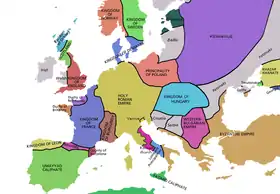 Localização de | |||||
| Continente | Europa | ||||
| Região | Europa Central | ||||
| Capital | Esztergom e Székesfehérvár | ||||
| Língua oficial | húngaro | ||||
| Religião | †Antiga religião húngara | ||||
| Governo | Diarquia (primórdios) Confederação tribal | ||||
| Grão-príncipe | |||||
| • diarcas | Cursanes (?–c. 904) Arpades (c. 895–c. 907) | ||||
| • c. 907–c. 947 | Zaltas | ||||
| • c. 947–c. 955 | Falitzis | ||||
| • c. 955–c. 972 | Taxis | ||||
| • c. 972–997 | Géza | ||||
| • 997–1000 | Estêvão I | ||||
| Período histórico | Idade Média | ||||
| • 895 | Fundação | ||||
| • 1000 | Coroação de Estevão I | ||||
| Atualmente parte de |  Hungria Hungria Roménia Roménia Eslováquia Eslováquia | ||||

.svg.png.webp)
.svg.png.webp)
O seu primeiro governante foi Arpades.
A historiografia húngara chama este período de "a era do principado".[9]
Referências
- Wise Bauer, Susan (2010). The History of the Medieval World: From the Conversion of Constantine to the First Crusade (em inglês). Nova Iorque: W. W. Norton. p. 586. 640 páginas. ISBN 978-0393059755
- Hodos, George H. (1999). «3». The East-Central European Region: An Historical Outline (em inglês). Santa Barbara (CAL): Praeger. p. 19. 168 páginas. ISBN 978-0275954970
- Wieczorek, Alfried; Hinz, Hans-Martin (2000). Europe around the year 1000 (em inglês). Stuttgart: Theiss. p. 372. 631 páginas. ISBN 3806215782
- Ferenc Glatz, ed. (1990). Etudes historiques hongroises 1990: Environment and society in Hungary (em inglês). Budapeste: Institute of History of the Hungarian Academy of Sciences. p. 10
- Bartha, Antal (1975). Hungarian Society in the 9th and 10th Centuries (em inglês). Budapeste: Akadémiai Kiadó. p. 53-84. 147 páginas. ISBN 978-963-05-0308-2
- Buranbaeva, Oksana; Mladineo, Vanja (2011). Culture and Customs of Hungary (em inglês). Santa Barbara (CAL): ABC-CLIO. p. 19. 212 páginas
- Davies, Colin (1969). The emergence of Western society: European history A.D. 300-1200 (em inglês). Londres: Macmillan. p. 181. 403 páginas
- Lawler, Jennifer (2004). Encyclopedia of the Byzantine Empire (em inglês). Jefferson (NC): McFarland & Company. p. 13. 366 páginas. ISBN 978-0786466160
- Acta Orientalia Academiae Scientiarum Hungaricae. Budapeste: Magyar Tudományos Akadémia. 1982. p. 419
Bibliografia
- Madgearu, Alexandru (2008). «The Mission of Hierotheos: Location and Significance». Byzantinoslavica. 66: 119-138
- Madgearu, Alexandru (2017). «Further Considerations on Hierotheos' Mission to the Magyars». Acta Musei Napocensis. 54 (2): 1-16
This article is issued from Wikipedia. The text is licensed under Creative Commons - Attribution - Sharealike. Additional terms may apply for the media files.