Khmer Issarak
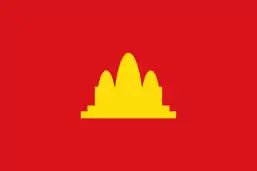
Khmer Issarak (em quemer: ខ្មែរឥស្សរៈ; literalmente Mestres Khmers, também traduzível como Khmers emancipados, Khmers independentes ou Khmers livres) foi um movimento independentista cambojano antifrancês e anticolonial "fracamente estruturado",[1] por vezes rotulado como “amorfo”. [2] O Issarak foi formado por volta de 1945 e era composto por várias facções, cada uma com seu próprio líder. [3] A maioria das facções do movimento lutou ativamente entre o fim da Segunda Guerra Mundial em 1945 e a independência do Camboja em 1953. Os objetivos iniciais do Khmer Issarak eram lutar contra os franceses para obter a independência. Mais tarde, derrubar o governo cambojano tornou-se a agenda de algumas facções do Issarak. [1] [4] Embora o termo "Issarak" originalmente se referia a grupos que não eram comunistas, no início dda década de 1950 os guerrilheiros próximos ao Việt Minh se autodenominavam Issaraks com o objetivo de unificar outras forças não comunistas. [4]
Referências
- Murashima, Eiji (1 de novembro de 2005). «Opposing French colonialism Thailand and the independence movements in Indo-China in the early 1940s». South East Asia Research. 13 (3): 333–383. doi:10.5367/000000005775179702
- Becker 1998, p. 51.
- Grant, Edited by Jonathan S.; Moss, Laurence A. G.; Unger, Jonathan (1971). Cambodia: the widening war in Indochina. New York: Washington Square Press. p. 314. ISBN 0671481142
- Becker 1998, p. 70.
Fontes
- Becker, E. (1998). When the war was over: Cambodia and the Khmer rouge revolution. New York: Public Affairs.
- Chandler, D. P. (1991). The tragedy of Cambodian history: Politics, war, and revolution since 1945. New Haven: Yale University Press.
- Chandler, D. P. (2008). A history of Cambodia. Boulder, Colo: Westview Press.
- Dommen, A. J. (2001). The Indochinese experience of the French and the Americans: Nationalism and communism in Cambodia, Laos, and Vietnam. Bloomington: Indiana University Press.
- Grant, J. S., Moss, L. A. G., & Unger, J. (1971). Cambodia; the widening war in Indochina. New York: Washington Square Press.
- Kiernan, B. (2004). How pol pot came to power. New Haven, Conn; London: Yale University Press.
- McHale, Shawn (2013). «Ethnicity, violence, and khmer-vietnamese relations: The significance of the lower mekong delta, 1757–1954» (PDF). The Journal of Asian Studies. 72 (2): 367. doi:10.1017/s0021911813000016
- Murashima, E. (2005). Opposing French colonialism Thailand and the independence movements in Indo-china in the early 1940s. South East Asia Research, 13(3), 333-383. doi:10.5367/000000005775179702
- Tully, J. A. (2002). France on the Mekong: A history of the protectorate in Cambodia, 1863-1953. Lanham, MD: University Press of America.
- Vickery, M. (1984). Cambodia 1975-1982. Hemel Hempstead; North Sydney: Allen and Unwin in association with South End.