Mãe-de-taoca-de-cara-branca
O mãe-de-taoca-de-cara-branca[2][3] (Rhegmatorhina gymnops), também conhecido como formigueiro de Santarém na tradução em outros idiomas, é uma espécie de ave passeriforme insetívora da família Thamnophilidae. É endêmica no Brasil. Seu habitat natural é de florestas subtropicais ou tropicais úmidas de baixa altitude.
| Mãe-de-taoca-de-cara-branca | |||||||||||||||
|---|---|---|---|---|---|---|---|---|---|---|---|---|---|---|---|
.jpg.webp) | |||||||||||||||
| Estado de conservação | |||||||||||||||
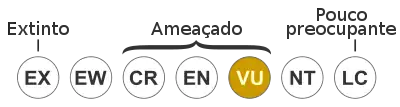 Vulnerável (IUCN 3.1) [1] | |||||||||||||||
| Classificação científica | |||||||||||||||
| |||||||||||||||
| Nome binomial | |||||||||||||||
| Rhegmatorhina gymnops Ridgway, 1888 | |||||||||||||||
O mãe-de-taoca-de-cara-branca foi formalmente descrito pelo ornitólogo americano Robert Ridgway em 1888 e recebeu o nome Rhegmatorhina gymnops.[4][5][6]
Referências
- BirdLife International (2012). «Rhegmatorhina gymnops». Lista Vermelha de Espécies Ameaçadas. 2012
- «Rhegmatorhina gymnops (mãe-de-taoca-de-cara-branca) - Distribuição e classificação - Táxeus | listas de espécies»
- «Rhegmatorhina gymnops (Mãe-de-taoca-de-cara-branca) - Avibase»
- Ridgway (1887). «Descriptions of new species and genera of birds from the Lower Amazon». Proceedings of the United States National Museum: 516–528 [525] Although the title page gives the year as 1887, the volume was not published until 1888.
- del Hoyo; Elliott; Sargatal; Christie; de Juana, eds. (2018). «Typical Antbirds (Thamnophilidae)»
 . Lynx Edicions
 - Willis (1969). «On the behavior of five species of Rhegmatorhina, ant-following antbirds of the Amazon basin» (PDF). Wilson Bulletin. 81: 362–395
This article is issued from Wikipedia. The text is licensed under Creative Commons - Attribution - Sharealike. Additional terms may apply for the media files.