Mingulay
Mingulay (Miughalaigh ou Miùghlaigh em gaélico escocês)[1] é a maior das Ilhas Barra nas Hébridas Exteriores, na Escócia. Está abandonada desde 1912,[2] e é conhecida pelas suas numerosas populações de aves marinhas, especialmente de papagaio-do-mar (Fratercula arctica), arau-comum (Uria aalge), corvo-marinho-de-crista (Phalacrocorax aristotelis), fulmar (Fulmarus sp.) e torda-mergulheira (Alca torda)
| Mingulay Miughalaigh, Miùghlaigh | |
|---|---|
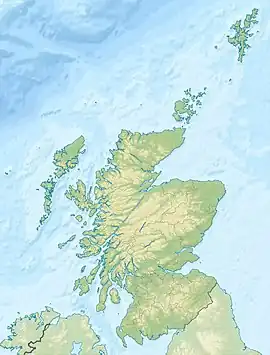 .svg.png.webp) Mingulay |
|
| Coordenadas: | |
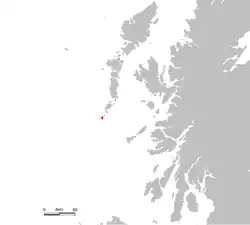 Localização de Mingulay | |
| Geografia física | |
| País | Escócia |
| Arquipélago | Hébridas Exteriores |
| Ponto culminante | 273 m (Càrnan) |
| Área | 6.4 km² |
| Geografia humana | |
| População | 0 |
| Densidade | 0 hab./km² |
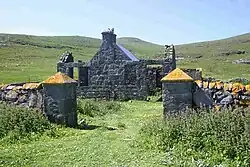 Escola abandonada na ilha | |
A National Trust for Scotland é proprietária da ilha desde 2000.[2]
Referências
- «Goireasan cànain / Language Resources». www.parliament.scot. 24 de junho de 2014. Consultado em 8 de janeiro de 2019
- Buxton (1995) Mingulay: An Island and Its People.
Bibliografia
- Buxton, Ben. (1995) Mingulay: An Island and Its People. Edinburgh. Birlinn. ISBN 1-874744-24-6
- Darling, F. Fraser & Boyd, J.M. (1969) Natural History in the Highlands and Islands. London. Bloomsbury. ISBN 1-870630-98-X
- Martin, Martin (1703) A Description of the Western Isles of Scotland including A Voyage to St. Kilda Retrieved 8 October 2008.
- Murray, W.H. (1973) The Islands of Western Scotland. London. Eyre Methuen. SBN 413303802
- Neat, Timothy (2000) When I was Young: Voices from Lost Communities in Scotland – The Islands. Edinburgh. Birlinn. ISBN 1-84158-039-2
- Haswell-Smith, Hamish. (2004) The Scottish Islands. Edinburgh. Canongate. ISBN 1-84195-454-3
- Storey, Liza (Lisaidh Dhonnchaidh Mhoir). (2008) Miughalaigh. Inverness. CLAR. ISBN 978-1-900901-14-7

This article is issued from Wikipedia. The text is licensed under Creative Commons - Attribution - Sharealike. Additional terms may apply for the media files.