Muhammad Abduh
Muhammad Abduh foi um reformador e apologista muçulmano egípcio. Foi pupilo de al-Afghani. Embora profundamente influenciado por ele, envolvia-se menos com o activismo político, e mais com as reformas dos sistemas: religioso, legal e educativo.[1][2][3]
| Muhammad Abduh | |
|---|---|
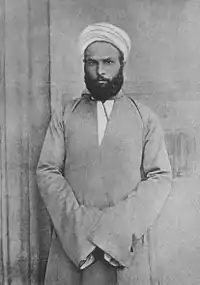 Muhammad Abduh | |
| Nascimento | 1849 Shubra Khit (Império Otomano) |
| Morte | 11 de julho de 1905 (55–56 anos) Alexandria (Império Otomano) |
| Cidadania | Império Otomano |
| Alma mater | |
| Ocupação | jurista, teólogo, juiz, jornalista de opinião, político, advogado, escritor, filósofo, journal editor, jornalista, journal editor |
| Empregador(a) | Universidade de Alazar |
| Obras destacadas | Tafsir al-Manar |
| Religião | Islamismo, sunismo |
| Causa da morte | cancro do rim |
Referências
- von Kügelgen, Anke (2007). «ʿAbduh, Muḥammad». In: Fleet, Kate; Krämer, Gudrun; Matringe, Denis; Nawas, John; Rowson, Everett K. Encyclopaedia of Islam, THREE. 3. Leiden and Boston: Brill Publishers. ISBN 9789004161641. ISSN 1873-9830. doi:10.1163/1573-3912_ei3_COM_0103
- Richard Netton, Ian (2008). «'Abduh, Muhammad (1849–1905)». Encyclopedia of Islamic Civilisation and Religion. Abingdon, Oxon: Routledge. 6 páginas. ISBN 978-0-7007-1588-6.
.. [Abduh became] a member of the Council of al-Azhar in 1895 and Chief Mufti (Legal Official) in 1899.
- E. Campo, Juan (2009). Encyclopedia of Islam. New York: Facts On File, Inc. pp. 5–6. ISBN 978-0-8160-5454-1
| Controle de autoridade |
|
|---|

This article is issued from Wikipedia. The text is licensed under Creative Commons - Attribution - Sharealike. Additional terms may apply for the media files.