Quatro guarnições de Anxi
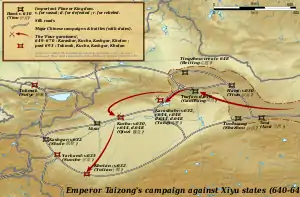
As Quatro guarnições de Anxi foram guarnições militares chinesas instaladas pela Império Tangue entre 648 e 658. Estavam estacionadas nas cidades-estado indo-europeias de Qiuci (Cuçar), Yutian (Hotã), Shule (Cascar) e Yanqi (Caraxare). O Protectorado Geral para Pacificar o Oeste foi sediado em Qiuci.[1]
| Quatro guarnições de Anxi | |||||||||
|---|---|---|---|---|---|---|---|---|---|
| Chinês tradicional: | 安西四鎮 | ||||||||
| Chinês simplificado: | 安西四镇 | ||||||||
| |||||||||
História
O Protectorado de Anxi foi criado na Prefeitura de Xi (Gaochang) após a dinastia Tangue ter anexado com sucesso o reino em 640.[2] O protectorado foi mudado para Qiuci em 648 após a dinastia Tangue ter derrotado Cucha.[3] Porém, devido à inquietação popular local com o apoio do Grão-Canato Túrquico Occidental, o protector-geral Tangue foi assassinado e o protectorado foi transladado novamente para a Prefeitura de Xi em 651.[3] Quando a dinastia Tangue derrotou o Grão-Canato Túrquico Occidental em 658, a sede do protectora foi mudada outra vez para Qiuci.[4] O estabelecimento completo das Quatro Guarnições e com eles um protectorado formal militar Tangue sob a bacia do Tarim, é por conseguinte datada de 658, depois da derrota de Axina Helu.[5]
Após o declínio da hegemonia túrquica sobre a região, o Império Tibetano tornou-se no rival primário pelo poder com a dinastia Tangue. O Império Tibetano invadiu várias vezes a bacia do Tarim e os reinos vizinhos. As regiões occidentais eram muito cobiçadas e mudaram de mãos intermitentemente entre o Império Tibetano e a dinastia Tangue.[6] Durante este período a sede do protectorado foi deslocada para Suiye, também conhecida como Suyab. Os Tangues alcançaram bastante estabilidade depois de 692 e moveram a sede do protectorado outra vez para Qiuci, onde iria permanecer até à queda do protectorado na década de 790.[1][3][7][8]
Wu Zetian criou o Protectorado de Beiting em 702 e garantiu-lhe o controlo da Prefeitura de Ting (Condado de Jimsar), da Prefeitura de Yi (Cumul) e da Prefeitura de Xi.[9]
O Império Tibetano continuou a atacar o Protectora de Anxi mas foram incapazes de tomar território até à ocorrência da rebelião de An Lushan em 755. A dinastia Tangue chamara para as Dezoito Províncias a maioria das tropas das suas guarnições, dando uma oportunidade aos tibetanos para invadir o território Tangue sem resistência. Em 763 um grande exército tibetano conseguiu ocupar a capital Tangue de Changan por um pequeno período de tempo antes de serem obrigados a bater em retirada.[10] No mesmo ano o Império Tibetano ocupou Yanqi.[11]
O vizinhos Corredor de Hexi e Protectorado de Beiting foram invadidos igualmente. Sob Hexi Jiedushi, os Tangues perderam a Prefeitura de Liang em 764,[12] as prefeituras de Gan[13] e Su em 766,[14] a Prefeitura de Gua em 776[14] e a Prefeitura de Sha em 787.[15][16] O Protectora de Beiting perdeu a Prefeitura de Yi em 781, a Prefeitura de Ting em 790 e a Prefeitura de Xi em 792.[11]
O Protectorado de Anxi perdeu Qiuci em 787 e Yutian em 792. Não se sabe ao certo o que aconteceu com Shule.[17][11]
Referências
- Xue, p. 596-598.
- Xiong 2008, p. 590.
- Xiong 2008, p. 45.
- Zhang 1995, p. 144-147.
- Xiong 2008, p. 433.
- Wang, p. 69-89, 294-295
- Bregel 2003, p. 17.
- Bregel 2003, p. 16.
- Xiong 2008, p. 58.
- Xiong 2008, p. cxii.
- Bregel 2003, p. 21.
- Xiong 2008, p. 310.
- Xiong 2008, p. 170.
- Beckwith 1987, p. 149.
- Beckwith 1987, p. 152.
- Xiong 2008, p. 485.
- Wang, p. 207-210, 296-300
- Shanghai, Royal Asiatic Society of Great Britain and Ireland North China Branch; Society, China Branch of the Royal Asiatic; Branch, Royal Asiatic Society of Great Britain and Ireland China; Society, Shanghai Literary and Scientific (1905). Journal of the North China Branch of the Royal Asiatic Society (em inglês). [S.l.]: Kelly & Walsh.
Bibliografia
- Andrade, Tonio (2016), The Gunpowder Age: China, Military Innovation, and the Rise of the West in World History, ISBN 978-0-691-13597-7, Princeton University Press.
- Asimov, M.S. (1998), History of civilizations of Central Asia Volume IV The age of achievement: A.D. 750 to the end of the fifteenth century Part One The historical, social and economic setting, UNESCO Publishing
- Barfield, Thomas (1989), The Perilous Frontier: Nomadic Empires and China, Basil Blackwell
- Barrett, Timothy Hugh (2008), The Woman Who Discovered Printing, ISBN 978-0-300-12728-7, Great Britain: Yale University Press (alk. paper)
- Beckwith, Christopher I (1987), The Tibetan Empire in Central Asia: A History of the Struggle for Great Power among Tibetans, Turks, Arabs, and Chinese during the Early Middle Ages, Princeton University Press
- Bregel, Yuri (2003), An Historical Atlas of Central Asia, Brill
- Chen, Guocan. "Anxi Sizhen" ("Four Garrisons of Anxi"). Encyclopedia of China (Chinese History Edition), 1st ed.
- Drompp, Michael Robert (2005), Tang China And The Collapse Of The Uighur Empire: A Documentary History, Brill
- Ebrey, Patricia Buckley (1999), The Cambridge Illustrated History of China, ISBN 0-521-66991-X, Cambridge: Cambridge University Press (paperback).
- Ebrey, Patricia Buckley; Walthall, Anne; Palais, James B. (2006), East Asia: A Cultural, Social, and Political History, ISBN 0-618-13384-4, Boston: Houghton Mifflin
- Golden, Peter B. (1992), An Introduction to the History of the Turkic Peoples: Ethnogenesis and State-Formation in Medieval and Early Modern Eurasia and the Middle East, OTTO HARRASSOWITZ · WIESBADEN
- Graff, David A. (2002), Medieval Chinese Warfare, 300-900, ISBN 0415239559, Warfare and History, London: Routledge
- Graff, David Andrew (2016), The Eurasian Way of War Military Practice in Seventh-Century China and Byzantium, ISBN 978-0-415-46034-7, Routledge.
- Guy, R. Kent (2010), Qing Governors and Their Provinces: The Evolution of Territorial Administration in China, 1644-1796, ISBN 9780295990187, Seattle: University of Washington Press
- Haywood, John (1998), Historical Atlas of the Medieval World, AD 600-1492, Barnes & Noble
- Latourette, Kenneth Scott (1964), The Chinese, their history and culture, Volumes 1-2, Macmillan
- Lorge, Peter A. (2008), The Asian Military Revolution: from Gunpowder to the Bomb, ISBN 978-0-521-60954-8, Cambridge University Press
- Millward, James (2009), Eurasian Crossroads: A History of Xinjiang, Columbia University Press
- Needham, Joseph (1986), Science & Civilisation in China, ISBN 0-521-30358-3, V:7: The Gunpowder Epic, Cambridge University Press
- Perry, John C.; L. Smith, Bardwell, Essays on T'ang Society: The Interplay of Social, Political and Economic Forces, ISBN 90 04 047611, Leiden, The Netherlands: E. J. Brill
- Rong, Xinjiang (2013), Eighteen Lectures on Dunhuang, Brill
- Shaban, M. A. (1979), The ʿAbbāsid Revolution, ISBN 0-521-29534-3, Cambridge: Cambridge University Press
- Sima, Guang (2015), Bóyángbǎn Zīzhìtōngjiàn 54 huánghòu shīzōng 柏楊版資治通鑑54皇后失蹤, ISBN 957-32-0876-8, Yuǎnliú chūbǎnshìyè gǔfèn yǒuxiàn gōngsī
- Skaff, Jonathan Karam (2012), Sui-Tang China and Its Turko-Mongol Neighbors: Culture, Power, and Connections, 580-800 (Oxford Studies in Early Empires), Oxford University Press
- Mackintosh-Smith, Tim (2014), Two Arabic Travel Books, Library of Arabic Literature
- Twitchett, D. (1979), Cambridge History of China, Sui and T'ang China 589-906, Part I, ISBN 0-521-21446-7, vol.3, Cambridge University Press
- Wang, Xiaofu (1992), History of the Political Relationship Between the Tang, Tibetans, and Arabs, Beijing daxue chubanshe
- Wang, Zhenping (2013), Tang China in Multi-Polar Asia: A History of Diplomacy and War, University of Hawaii Press
- Wilkinson, Endymion (2015). Chinese History: A New Manual, 4th edition. Cambridge, MA: Harvard University Asia Center distributed by Harvard University Press. ISBN 9780674088467
- Wriggins, Sally Hovey (2004), The Silk Road Journey With Xuanzang, Westview Press
- Xiong, Victor Cunrui (2000), Sui-Tang Chang'an: A Study in the Urban History of Late Medieval China (Michigan Monographs in Chinese Studies), ISBN 0892641371, U OF M CENTER FOR CHINESE STUDIES
- Xiong, Victor Cunrui (2009), Historical Dictionary of Medieval China, ISBN 0810860538, United States of America: Scarecrow Press, Inc.
- Xu, Elina-Qian (2005), HISTORICAL DEVELOPMENT OF THE PRE-DYNASTIC KHITAN, Institute for Asian and African Studies 7
- Xue, Zongzheng (1992), Turkic peoples, 中国社会科学出版社
- Yuan, Shu (2001), Bóyángbǎn Tōngjiàn jìshìběnmò 28 dìèrcìhuànguánshídài 柏楊版通鑑記事本末28第二次宦官時代, ISBN 957-32-4273-7, Yuǎnliú chūbǎnshìyè gǔfèn yǒuxiàn gōngsī
- Zhang, Guangda (1995), Xiyu shidi conggao chubian (Collected Drafts on the Historical Geography of the Western Regions, Vol. 1), Shanghai guji chubanshe