Tomahawk (geometria)
O tomahawk é uma ferramenta em geometria para a trissecção do ângulo, o problema de dividir um ângulo em três partes iguais. Os limites de sua forma incluem um semicírculo e dois segmentos de reta, dispostos de uma forma que se assemelha a um tomahawk, um machado de nativos americanos.[1][2] A mesma ferramenta também tem sido chamado de faca de sapateiro,[3] mas esse nome é mais geralmente usado em geometria para se referir a uma forma diferente, o arbelos (um triângulo curvilíneo delimitado por três semicírculos mutuamente tangentes).[4]
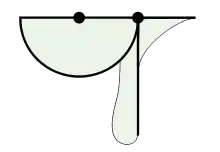
Um tomahawk, com sua alça e espigão engrossado.
Referências
- Yates, Robert C. (1941), «The Trisection Problem, Chapter III: Mechanical trisectors», National Mathematics Magazine, 15 (6): 278–293, JSTOR 3028413, MR 1569903.
- Gardner, Martin (1975), Mathematical Carnival: from penny puzzles, card shuffles and tricks of lightning calculators to roller coaster rides into the fourth dimension, Knopf, pp. 262–263.
- Dudley, Underwood (1996), The Trisectors, ISBN 9780883855140, MAA Spectrum 2nd ed. , Cambridge University Press, pp. 14–16.
- Alsina, Claudi; Nelsen, Roger B. (2010), «9.4 The shoemaker's knife and the salt cellar», Charming Proofs: A Journey Into Elegant Mathematics, ISBN 9780883853481, Dolciani Mathematical Expositions, 42, Mathematical Association of America, pp. 147–148.
This article is issued from Wikipedia. The text is licensed under Creative Commons - Attribution - Sharealike. Additional terms may apply for the media files.