William Galbraith
William Galbraith (Greenlaw, Berwickshire, 1786 – 27 de outubro de 1850) foi um matemático escocês. Lecionou matemática e astronomia náutica em Edimburgo.[1]
| William Galbraith | |
|---|---|
| Nascimento | 1786 |
| Morte | 1850 (63–64 anos) |
| Alma mater | |
| Ocupação | matemático |
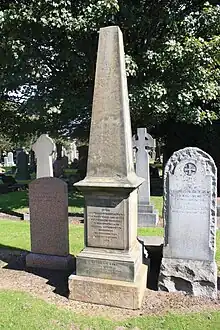
Sepultura de William Galbraith, Grange Cemetery
Vida
Nasceu em Greenlaw, Berwickshire.[2]
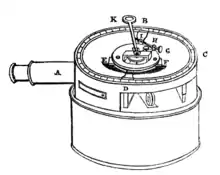
Galbraith's pocket-box circle, an invention for portable surveying.
Galbraith foi sepultado com sua mulher na seção noroeste do Cemitério de Grange em Edimburgo.[3]
Obras
- Mathematical and Astronomical Tables (1827)[4] Review.[5]
- Trigonometrical Surveying, Levelling, and Railway Engineering (1842)[6]
Editou o trabalho sobre agrimensura de John Ainslie de 1812 (1849),[7] e revisou com William Rutherford Algebra, de John Bonnycastle.[8]
Referências
- http://articles.adsabs.harvard.edu/full/1851MNRAS..11...86.
- https://archive.org/stream/monumentsmonumen01rogeiala#page/152/mode/2up
- William Galbraith (1827). Mathematical and Astronomical Tables. [S.l.: s.n.] Consultado em 4 de maio de 2012
- Robert Jameson; Sir William Jardine; Henry Darwin Rogers (1827). The Edinburgh new philosophical journal: exhibiting a view of the progressive discoveries and improvements in the sciences and the arts. [S.l.]: A. and C. Black. pp. 404–. Consultado em 4 de maio de 2012
- https://archive.org/stream/trigonometrical00galbgoog#page/n6/mode/2up
- https://archive.org/details/atreatiseonland00ainsgoog
-
 «Rutherford, William». Dictionary of National Biography. Londres: Smith, Elder & Co. 1885–1900
Ligações externas
This article is issued from Wikipedia. The text is licensed under Creative Commons - Attribution - Sharealike. Additional terms may apply for the media files.