William Lipscomb
William Nunn Lipscomb (Cleveland, 9 de dezembro de 1919 — Cambridge, 14 de abril de 2011) foi um químico estadunidense.
| William Lipscomb | |
|---|---|
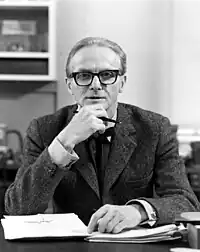 William Lipscomb | |
| Nascimento | 9 de dezembro de 1919 Cleveland |
| Morte | 14 de abril de 2011 (91 anos) Cambridge |
| Nacionalidade | Estadunidense |
| Alma mater | Instituto de Tecnologia da Califórnia |
| Prêmios | Prêmio Peter Debye (1973), Prêmio Remsen (1976),  Nobel de Química (1976) Nobel de Química (1976) |
| Orientador(es)(as) | Linus Pauling |
| Orientado(a)(s) | Roald Hoffmann, Russell Mosher Pitzer, Thomas Steitz |
| Instituições | Universidade de Minnesota, Universidade Harvard |
| Campo(s) | Estrutura química |
| Tese | 1946: I. Electron Diffraction Investigations of Vanadium-Tetrachloride, Dimethylketene Dimer, Tetrachloroethylene, and Trichloroethylene. II. The Crystal Structure of Methylammonium-Chloride |
Foi agraciado com o Nobel de Química de 1976 devido aos seus estudos sobre a estrutura dos problemas de iluminação dos boranos nas ligações químicas.[1]
Ligações externas
- William Lipscomb (em inglês) no Mathematics Genealogy Project
- «Perfil no sítio oficial do Nobel de Química 1976» (em inglês)
| Precedido por John Cornforth e Vladimir Prelog |
Nobel de Química 1976 |
Sucedido por Ilya Prigogine |
| Controle de autoridade |
|---|

This article is issued from Wikipedia. The text is licensed under Creative Commons - Attribution - Sharealike. Additional terms may apply for the media files.