É
See also: Appendix:Variations of "e"
| ||||||||||
Galician
Pronunciation
- IPA(key): /ɛ/
Hungarian
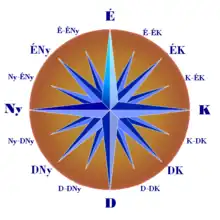
Compass rose
Etymology 1
Abbreviation of észak (“north”).
Pronunciation
- IPA(key): [ˈeːsɒk]
Declension
Lua error: attempt to perform arithmetic on local 'h' (a nil value)
| Possessive forms of É | ||
|---|---|---|
| possessor | single possession | multiple possessions |
| 1st person sing. | É-om | — |
| 2nd person sing. | É-od | — |
| 3rd person sing. | É-ja | — |
| 1st person plural | É-unk | — |
| 2nd person plural | É-otok | — |
| 3rd person plural | É-juk | — |
Coordinate terms
(compass points) égtájak;
| északnyugat (ÉNy) | Lua error in Module:utilities at line 142: attempt to perform arithmetic on local 'h' (a nil value) | északkelet (ÉK) |
| nyugat (Ny) |  |
kelet (K) |
| délnyugat (DNy) | dél (D) | délkelet (DK) |
Pronunciation
- (phoneme): IPA(key): [ˈeː]
- (letter name): IPA(key): [ˈeː]
Letter
É (upper case, lower case é)
Declension
Lua error: attempt to perform arithmetic on local 'h' (a nil value)
| Possessive forms of É | ||
|---|---|---|
| possessor | single possession | multiple possessions |
| 1st person sing. | É-m | É-im |
| 2nd person sing. | É-d | É-id |
| 3rd person sing. | É-je | É-i |
| 1st person plural | É-nk | É-ink |
| 2nd person plural | É-tek | É-itek |
| 3rd person plural | É-jük | É-ik |
Icelandic
See also
- Lua error in Module:utilities at line 142: attempt to perform arithmetic on local 'h' (a nil value)
Kashubian
Etymology
The Kashubian orthography is based on the Latin alphabet. No earlier script is known. See the Kashubian alphabet article on Wikipedia for more, and Lua error in Module:utilities at line 142: attempt to perform arithmetic on local 'h' (a nil value) for development of the glyph itself.
Letter
É (upper case, lower case é)
See also
- Lua error in Module:utilities at line 142: attempt to perform arithmetic on local 'h' (a nil value)
Luxembourgish
Pronunciation
- IPA(key): /e/, /ə/
Usage notes
- /e/ is strictly speaking an allophone of /ə/ occurring before /k/ and /ŋ/. The spelling reflects this alternation by using É instead of Ë before these latter sounds. In unstressed syllables, simple E is used. (Unstressed É does occur in French borrowings.)
- For historical reasons, É also replaces Ë in the diphthong éi and before ch, although the pronunciation is now generally [ə] in these cases.
Mandarin
Noon
Pronunciation
- IPA(key): /e̘/
Portuguese
Pronunciation
- IPA(key): /ɛ/
- The syllable with this letter is always stressed.
Slovene
Pronunciation
- (sound): IPA(key): /éː/, /èː/
- (letter name): IPA(key): /òːski èː/, /òːski éː/ (ozki e)
- Rhymes: -eː
Letter
É (upper case, lower case é)
- Additional letter, used to denote the long stress on close-mid E.
Pronunciation
- (Resian, sound): IPA(key): /ɛ/
Welsh
Pronunciation
- (phoneme): IPA(key): /ˈɛ/
Letter
É (lower case é)
- The letter E, marked for its short pronunciation when in a stressed final syllable of a polysyllabic word.
This article is issued from Wiktionary. The text is licensed under Creative Commons - Attribution - Sharealike. Additional terms may apply for the media files.