βοῦς
Ancient Greek
Etymology
From Proto-Hellenic *gʷous (compare Mycenaean Greek 𐀦𐀃 (qo-o)), from Proto-Indo-European *gʷṓws. Cognates include Old English cū (English cow), Irish bó, Latin bōs, and Sanskrit गो (gó).
Pronunciation
- (5th BCE Attic) IPA(key): /bûːs/
- (1st CE Egyptian) IPA(key): /bus/
- (4th CE Koine) IPA(key): /βus/
- (10th CE Byzantine) IPA(key): /vus/
- (15th CE Constantinopolitan) IPA(key): /vus/
Noun
βοῦς • (boûs) m or f (genitive βοός); third declension
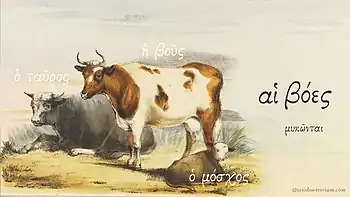
- cow, ox, cattle
- shield
- 800 BCE – 600 BCE, Homer, Iliad 7.238–239:
- οἶδ’ ἐπὶ δεξιά, οἶδ’ ἐπ’ ἀριστερὰ νωμῆσαι βῶν
ἀζαλέην, τό μοι ἔστι ταλαύρινον πολεμίζειν·- oîd’ epì dexiá, oîd’ ep’ aristerà nōmêsai bôn
azaléēn, tó moi ésti talaúrinon polemízein; - I know on the right, and I know on the left how to wield my dried
shield, which to me seems sturdy in fighting:
- oîd’ epì dexiá, oîd’ ep’ aristerà nōmêsai bôn
- οἶδ’ ἐπὶ δεξιά, οἶδ’ ἐπ’ ἀριστερὰ νωμῆσαι βῶν
Usage notes
- The sense 'shield' is explained in a scholium to Iliad 7.238 as follows:
- ὅτι ἐκ βοείων ἐστι δερμάτων συνεκδοχικῶς τὸ ὅπλον ('because the shield is made of successive bovine skins')
Inflection
Lua error: attempt to perform arithmetic on local 'h' (a nil value) Lua error: attempt to perform arithmetic on local 'h' (a nil value)
Synonyms
(shield): αἰγίς (aigís), ἀσπίδιον (aspídion), ἀσπίς (aspís), βοάγριον (boágrion), κρίγδανον (krígdanon), πέλτη (péltē), ῥῑνός (rhīnós), σάκος (sákos), σκοῦτα (skoûta)
Hyponyms
Derived terms
- βοάνθεμον (boánthemon)
- βόϊνος (bóïnos)
- βούγλωσσον (boúglōsson)
- βούγλωσσος (boúglōssos)
- βουδόρος (boudóros)
- βουθυσία (bouthusía)
- βουθυτέω (bouthutéō)
- βούθυτος (boúthutos)
- Βουκέφαλος (Bouképhalos)
- βουκολέω (boukoléō)
- βουκολία (boukolía)
- βουκόλιον (boukólion)
- βουκόλος (boukólos)
- βούκολος (boúkolos)
- βουκόρῡζᾰ (boukórūza)
- βουνομέω (bounoméō)
- βούνομος (boúnomos)
- βουστροφηδόν (boustrophēdón)
- βούσῡκον (boúsūkon)
- βούτης (boútēs)
- βούτρᾰγος (boútragos)
- βούτῡρον (boútūron)
- βούτῡρος (boútūros)
- βούφθαλμον (boúphthalmon)
- βούφονος (boúphonos)
- βουφορβέω (bouphorbéō)
- βουφόρβια (bouphórbia)
- βουφορβός (bouphorbós)
- βοῶπις (boôpis)
- ἑκατόμβη (hekatómbē)
- ἐπιβουκόλος (epiboukólos)
- πρέσβῠς (présbus)
Descendants
- Greek: βόδι (vódi), βόιδι (vóidi)
- Tsakonian: βου (vou)
- Latin: butyrum
- English: butter, bucolic, hecatomb, boustrophedon, bulimia nervosa
- Translingual: Bucephala
References
- “βοῦς”, in Liddell & Scott (1940) A Greek–English Lexicon, Oxford: Clarendon Press
- “βοῦς”, in Liddell & Scott (1889) An Intermediate Greek–English Lexicon, New York: Harper & Brothers
- “βοῦς”, in Autenrieth, Georg (1891) A Homeric Dictionary for Schools and Colleges, New York: Harper and Brothers
- βοῦς in Bailly, Anatole (1935) Le Grand Bailly: Dictionnaire grec-français, Paris: Hachette
- Bauer, Walter et al. (2001) A Greek–English Lexicon of the New Testament and Other Early Christian Literature, Third edition, Chicago: University of Chicago Press
- βοῦς in Cunliffe, Richard J. (1924) A Lexicon of the Homeric Dialect: Expanded Edition, Norman: University of Oklahoma Press, published 1963
- βοῦς in the Diccionario Griego–Español en línea (2006–2024)
- “βοῦς”, in Slater, William J. (1969) Lexicon to Pindar, Berlin: Walter de Gruyter
- G1016 in Strong, James (1979) Strong’s Exhaustive Concordance to the Bible
- Woodhouse, S. C. (1910) English–Greek Dictionary: A Vocabulary of the Attic Language, London: Routledge & Kegan Paul Limited.
- Mycenaean Greek Word List
This article is issued from Wiktionary. The text is licensed under Creative Commons - Attribution - Sharealike. Additional terms may apply for the media files.