خيزران
Arabic
Etymology
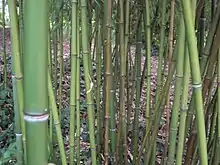
Originally attested in Pre-Islamic poetry, like that of an-Nābighah (c.535–c.604), as being abundant in the land of the Byzantines. Although of uncertain identification, it was a kind of plant with pliable twigs or roots that were deemed desirable for spear-making, later being applied to bamboo. Compare Hebrew חָזַר (chazár, “to return, to bounce back”), Akkadian 𒄑𒋗𒌨 (ḫinzūru, “apple tree, apricot tree”), Ugaritic 𐎈𐎏𐎗 (ḥḏr, “apple tree”), Akkadian 𒆹 (ḫazru, “flooded area, swamp, reed marsh”); perhaps ultimately derived from Sumerian 𒄑 (gidru, “scepter, cane”).
Pronunciation
- IPA(key): /xaj.zu.raːn/
Noun
خَيْزُرَان • (ḵayzurān) m (collective, singulative خَيْزُرَانَة f (ḵayzurāna), plural خَيَازِر (ḵayāzir), paucal خَيْزُرَانَات (ḵayzurānāt))
Declension
Lua error: attempt to perform arithmetic on local 'h' (a nil value)
Descendants
- → Catalan: galzeran
- → Ottoman Turkish: هزارن
- → Turkish: hezaren
References
- Löw, Immanuel (1928) Die Flora der Juden (in German), volume 1, Wien und Leipzig: R. Löwit, pages 690–692
- Wehr, Hans; Kropfitsch, Lorenz (1985), “خيزران”, in Arabisches Wörterbuch für die Schriftsprache der Gegenwart (in German), 5th edition, Wiesbaden: Otto Harrassowitz, published 2011, →ISBN, page 332
- Lane, Edward William (1863), “خيزران”, in Arabic-English Lexicon, London: Williams & Norgate, page 732
- Olmo Lete, Gregorio del; Sanmartín, Joaquín; Watson, Wilfred G. E. (2015), “ḥḏrṯ”, in A Dictionary of the Ugaritic Language in the Alphabetic Tradition (Handbook of Oriental Studies; 112), 3rd edition, Leiden: Brill, →ISBN, page 357
- Black, Jeremy; George, Andrew; Postgate, Nicholas (2000), “ḫinzūru”, in A Concise Dictionary of Akkadian, 2nd corrected edition, Wiesbaden: Otto Harrassowitz Verlag, page 117
- Black, Jeremy; George, Andrew; Postgate, Nicholas (2000), “ḫazru”, in A Concise Dictionary of Akkadian, 2nd corrected edition, Wiesbaden: Otto Harrassowitz Verlag, page 113
- The Pennsylvania Sumerian Dictionary, University of Pennsylvania, 2006