はりぼて
Japanese
| Alternative spellings |
|---|
| 張りぼて 張ぼて |
Etymology
Compound of 張り (hari, “stretching; gluing; covering”, the 連用形 (ren'yōkei, “continuative or stem form”) of verb 張る (haru, “to stretch something; to glue something flat onto something else; to cover something with something flat”)) + ぼて (bote, “woven bamboo basket”).[1][2][3]
First cited to a publication dated 1814–1846.[1]
Noun
はりぼて or ハリボテ • (haribote)
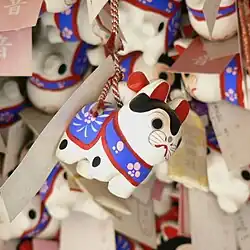
- [from roughly 1814] a papier-mâché creation, such as a toy or a theater prop
- Synonym: 張り子 (hariko)
- [date uncertain] something created as a fake, a mock-up of something
- ようこそ!ハリボテの城へ!
- Yōkoso! Haribote no shiro e!
- Welcome to the fake castle!
- ようこそ!ハリボテの城へ!
- [date uncertain] (figurative) a sham, an illusion, an attempt to fake something, often for sugarcoating a problem
Derived terms
- (short) ぼて (bote)
References
- 1988, 国語大辞典(新装版) (Kokugo Dai Jiten, Revised Edition) (in Japanese), Tōkyō: Shogakukan
- 1995, 大辞泉 (Daijisen) (in Japanese), Tōkyō: Shogakukan, →ISBN
- 2006, 大辞林 (Daijirin), Third Edition (in Japanese), Tōkyō: Sanseidō, →ISBN
This article is issued from Wiktionary. The text is licensed under Creative Commons - Attribution - Sharealike. Additional terms may apply for the media files.