暈
| ||||||||
| ||||||||
Translingual
Han character
暈 (Kangxi radical 72, 日+9, 13 strokes, cangjie input 日月十十 (ABJJ) or X日月十十 (XABJJ), four-corner 60506, composition ⿱日軍)
Derived characters
- 𣜸 𥣐 𦅿 𠪷 𦾥
Further reading
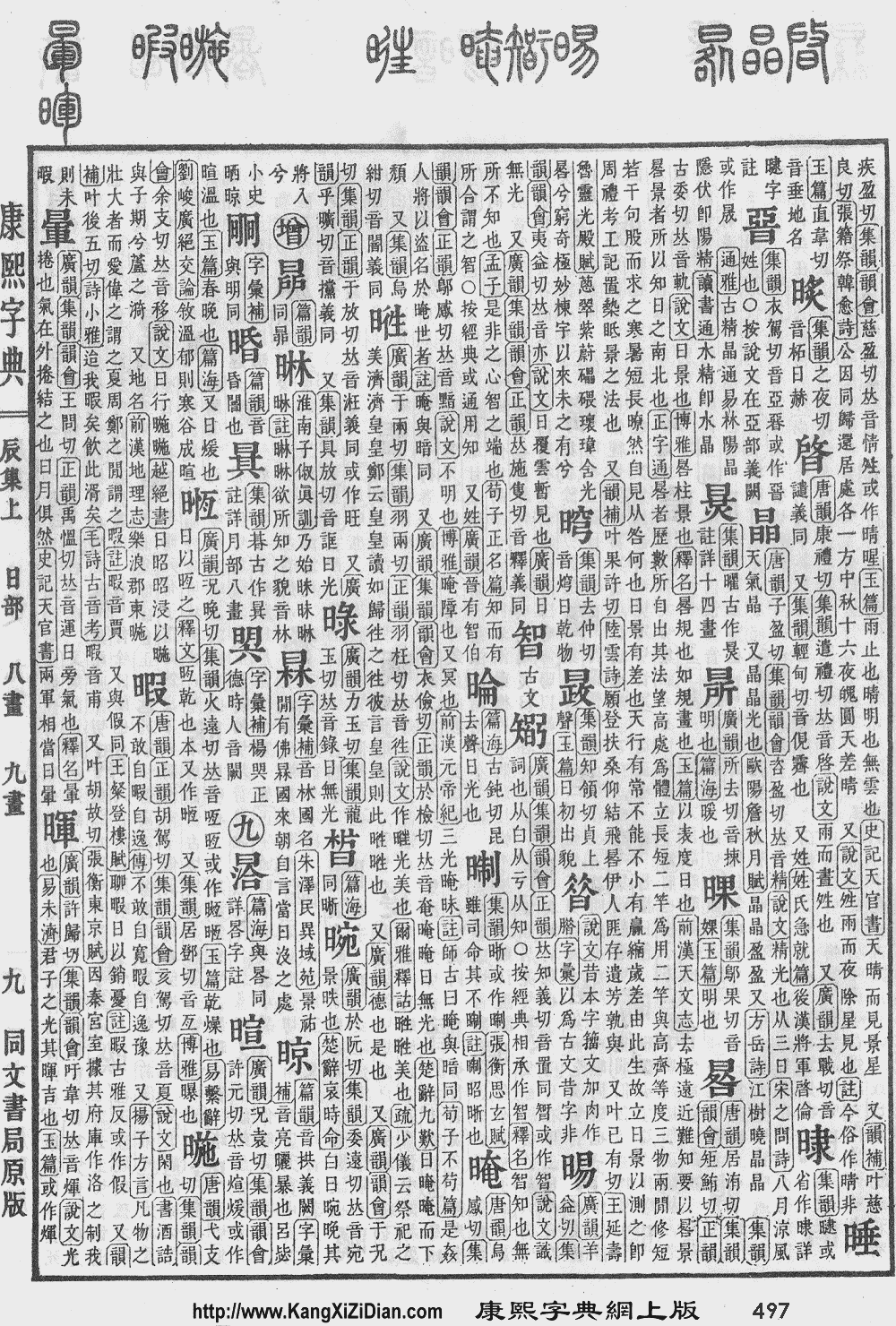
- Kangxi Dictionary: page 497, character 37
- Dai Kanwa Jiten: character 14037
- Dae Jaweon: page 865, character 28
- Hanyu Da Zidian (first edition): volume 2, page 1527, character 1
- Unihan data for U+6688
- Unihan data for U+F9C5
Chinese
Lua error in Module:utilities at line 142: attempt to perform arithmetic on local 'h' (a nil value)
Glyph origin
| Historical forms of the character 暈 | |
|---|---|
| Shang | Shuowen Jiezi (compiled in Han) |
| Oracle bone script | Small seal script |
 |
 |
| Old Chinese | |
|---|---|
| 揮 | *qʰul |
| 輝 | *qʰul |
| 翬 | *qʰul |
| 暉 | *qʰul |
| 煇 | *qʰul, *ɡuːn, *ɡuːnʔ |
| 楎 | *qʰul, *ɡuːn |
| 瀈 | *qʰul |
| 韗 | *qʰons, *ɢuns |
| 褌 | *kuːn |
| 鶤 | *kuːn, *ɢuns |
| 緷 | *kuːnʔ, *ɡuːnʔ, *ɢuns |
| 睴 | *kuːns, *ɡuːnʔ |
| 璭 | *kuːns |
| 瘒 | *ŋɡuːn |
| 顐 | *ŋɡuːn, *ŋɡuːns, *ɡuːn |
| 諢 | *ŋɡuːns |
| 餫 | *ɡuːn, *ɢuns |
| 渾 | *ɡuːn, *ɡuːnʔ |
| 琿 | *ɡuːn |
| 鼲 | *ɡuːn |
| 堚 | *ɡuːn |
| 鯶 | *ɡuːnʔ |
| 軍 | *kun |
| 皸 | *kun, *kuns |
| 齳 | *ŋɡunʔ |
| 喗 | *ŋɡunʔ |
| 葷 | *qʰun |
| 惲 | *qunʔ |
| 賱 | *qunʔ |
| 運 | *ɢuns |
| 暈 | *ɢuns |
| 鄆 | *ɢuns |
Originally a pictogram (象形) – the sun (日) surrounded by lines on all sides – halo.
Now phono-semantic compound (形聲/形声, OC *ɢuns) : semantic 日 (“Sun”) + phonetic 軍 (OC *kun).
Etymology
Same word as 運 (OC *ɢuns, “to revolve; to move”) (Schuessler, 2007). See there for more.
Pronunciation 1
Definitions
暈
- (astronomy) halo (around the Sun or the Moon)
- ring of light or colour, or a blurred area surrounding a luminous or coloured object; halo around a light or colour
- blush; slight redness
- † ring-shaped pattern
- † bull's eye
- to spread; to proliferate; to seep through
- † to apply (colour, especially makeup)
Compounds
Pronunciation 2
Compounds
Pronunciation 3
Definitions
暈
- dizzy; giddy; lightheaded
- to faint; to pass out; to black out; to swoon
- (neologism, slang) to be overwhelmed (by something) and on the verge of passing out
- (Sichuanese) to savour; to enjoy slowly and thoroughly
Synonyms
- (dizzy):
Lua error in Module:utilities at line 142: attempt to perform arithmetic on local 'h' (a nil value)
Compounds
References
- “暈”, in 漢語多功能字庫 (Multi-function Chinese Character Database), 香港中文大學 (the Chinese University of Hong Kong), 2014–
Japanese
Kanji
- blur, haze
- mental haze or senility
- intentional blurring or gradation
Readings
Lua error in Module:utilities at line 142: attempt to perform arithmetic on local 'h' (a nil value)
Etymology 1
| Kanji in this term |
|---|
| 暈 |
| かさ Hyōgaiji |
| kun’yomi |
Korean
Hanja
- This term needs a translation to English. Please help out and add a translation, then remove the text
{{rfdef}}.
References
Vietnamese
Han character
暈: Hán Việt readings: vựng[1][2][3], vận (
暈: Nôm readings: vầng[1][2][3][5][4][6][7], vừng[1][2][3][4][6][7], quầng[3][5][4][6][7], vựng[1][4][5]
References
- Nguyễn (2014).
- Nguyễn et al. (2009).
- Trần (2004).
- Bonet (1899).
- Hồ (1976).
- Génibrel (1898).
- Taberd & Pigneau de Béhaine (1838).