玉蜀黍
Chinese
Lua error in Module:utilities at line 142: attempt to perform arithmetic on local 'h' (a nil value)
Pronunciation
Synonyms
Lua error in Module:utilities at line 142: attempt to perform arithmetic on local 'h' (a nil value)
Descendants
Others:
Japanese
| Kanji in this term | ||
|---|---|---|
| 玉 | 蜀 | 黍 |
| とうもろこし | ||
| Grade: 1 | Hyōgaiji | Hyōgaiji |
| jukujikun | ||
Etymology
/taumorokoɕi/ → /tɔːmorokoɕi/ → /toːmorokoɕi/
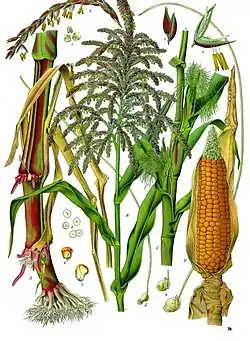
Originally a compound of 唐 (tō, “Tang Dynasty; China in general; (by extension) foreign”) + もろこし (morokoshi, “sorghum”),[1] from the visual similarities between the sorghum and maize plants.
The spelling is jukujikun (熟字訓) from Chinese,[1] and appears to be a compound of 玉 (yù, “jade, jewel”) + 蜀黍 (shǔshǔ, “sorghum”, literally “Shu millet”). Compare modern Mandarin 玉蜀黍 (yùshǔshǔ, “maize”).
Usage notes
More common usage of the term is in katakana (トウモロコシ) or hiragana (とうもろこし) and perhaps never in kanji (玉蜀黍). For loose-kernel corn, the more common term in Japanese is コーン (kōn).
References
- 1988, 国語大辞典(新装版) (Kokugo Dai Jiten, Revised Edition) (in Japanese), Tōkyō: Shogakukan
- 2006, 大辞林 (Daijirin), Third Edition (in Japanese), Tōkyō: Sanseidō, →ISBN