顔
| ||||||||
Translingual
| Traditional | 顏 |
|---|---|
| Shinjitai | Lua error in Module:utilities at line 142: attempt to perform arithmetic on local 'h' (a nil value) |
| Simplified | 颜 |
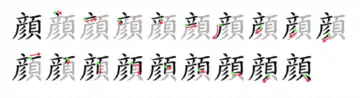
| Stroke order (Japan) | |||
|---|---|---|---|
 | |||
Han character
顔 (Kangxi radical 181, 頁+9, 18 strokes, cangjie input XXX卜竹 (XXXYH) or 卜竹一月金 (YHMBC), composition ⿰彦頁)
Related characters
- 顏 (Orthodox traditional form used in Taiwan, Hong Kong and Macau)
- 颜 (Simplified Chinese)
References
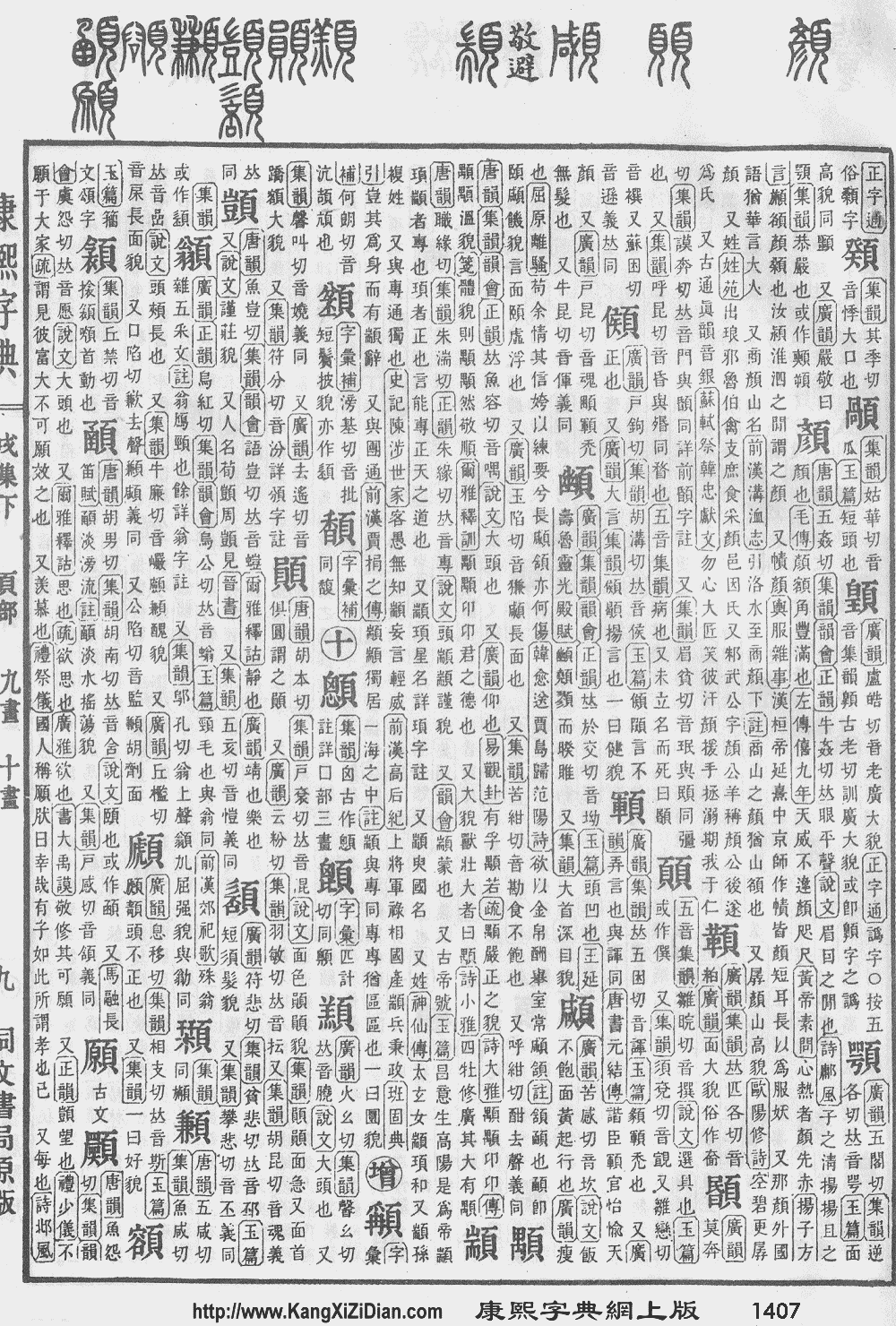
- Kangxi Dictionary: not present, would follow page 1407, character 17
- Dai Kanwa Jiten: character 43591
- Dae Jaweon: page 1925, character 1
- Hanyu Da Zidian (first edition): volume 7, page 4383, character 9
- Unihan data for U+9854
Usage notes
This character is the preferred form used in Japan, Korea, Vietnam as well as mainland China (when used as a traditional character).
Chinese
Glyph origin
| Historical forms of the character 顔 | ||
|---|---|---|
| Western Zhou | Shuowen Jiezi (compiled in Han) | Liushutong (compiled in Ming) |
| Bronze inscriptions | Small seal script | Transcribed ancient scripts |
 |
 |
 |
Variant form of 顏 (彥 → 彦).
Definitions
Lua error in Module:utilities at line 142: attempt to perform arithmetic on local 'h' (a nil value)
Usage notes
This character is considered the traditional form of 颜 in mainland China based on the standardized form of characters (Xin Zixing) in use since 1965.
Japanese
| Lua error in Module:utilities at line 142: attempt to perform arithmetic on local 'h' (a nil value) | |
| 顏 |
Readings
Lua error in Module:utilities at line 142: attempt to perform arithmetic on local 'h' (a nil value)
Compounds
Descendants
- ⇒ Korean: 가오 (gao, “face; reputation”)
Etymology 2
| Kanji in this term |
|---|
| 顔 |
| がん Grade: 2 |
| on’yomi |
| Alternative spelling |
|---|
| 顏 (kyūjitai) |
From Middle Chinese 顏 (MC ngaen).
Pronunciation
- IPA(key): [ɡã̠ɴ]
References
- “顔”, in 漢字ぺディア (Kanjipedia) (in Japanese), 日本漢字能力検定協会, 2015–2024
- 1974, 新明解国語辞典 (Shin Meikai Kokugo Jiten), Second Edition (in Japanese), Tōkyō: Sanseidō
- 1998, NHK日本語発音アクセント辞典 (NHK Japanese Pronunciation Accent Dictionary) (in Japanese), Tōkyō: NHK, →ISBN
Korean
Etymology
From Middle Chinese 顏 (MC ngaen). Recorded as Middle Korean 안 (an) (Yale: an) in Hunmong Jahoe (訓蒙字會 / 훈몽자회), 1527.
Compounds
Miyako
Kanji
- Lua error in Module:utilities at line 142: attempt to perform arithmetic on local 'h' (a nil value)
Pronunciation
- IPA(key): [mipana]