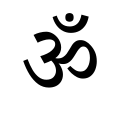
ॐ
 | ||||||||
 | ||||||||
Translingual
Hindi
Alternative forms
- ओम् (om)
Etymology
From Sanskrit ॐ (oṃ)
Pronunciation
- (Delhi Hindi) IPA(key): /oːm/, [õːm]
Interjection
ॐ • (om) (Urdu spelling اوم)
Sanskrit
Alternative scripts
- ᬒᬁ (Balinese script)
- ওঁ (Assamese script)
- ওঁ (Bengali script)
- 𑰌𑰼 (Bhaiksuki script)
- 𑀑𑀁 (Brahmi script)
- 𑍐 (Grantha script)
- ૐ (Gujarati script)
- ੴ (Gurmukhi script)
- ꦎꦴꦀ (Javanese script)
- ឱំ (Khmer script)
- ಓಂ (Kannada script)
- ໂອໍ (Lao script)
- ഓമ് (Malayalam script)
- 𑘌𑘦𑘿 (Modi script)
- ᢀᠣᠸᠠ (Mongolian script)
- ᢀᠣ (Manchu script)
- ဥုံ (Burmese script)
- 𑦬𑧞 (Nandinagari script)
- 𑑉 (Newa script)
- ଓମ୍ (Odia script)
- 𑆏𑆀 (Sharada script)
- 𑖌𑖼 (Siddham script)
- ඕම් (Sinhalese script)
- ௐ (Tamil script)
- ఓం (Telugu script)
- โอํ (Thai script)
- ཨོཾ (Tibetan script)
- 𑓇 (Tirhuta script)
Etymology
Etymology disputed.
- A. Parpola proposes borrowing from Dravidian, ultimately from Proto-Dravidian *ām (“let it be so, it is so, yes”), a contraction of *ākum, cognate with Tamil ஆம் (ām, “yes”).
- M. Blumfield proposes derivation from Proto-Indo-European *au (introductory particle) via *ō >* ōṃ > ōm, cognate with Ancient Greek αὖ (aû).
- The Upaniṣads propose multiple Sanskrit etymologies, including: from आम् (ām, “yes”); from एवम् (evam, “that, thus, yes”); and from आप् (āp, “to attain”) or अव् (av, “to urge”).
Interjection
ॐ • (oṃ)
Descendants
- Bengali: ওঁ (ō̃)
- Burmese: ဥုံ
- Chinese: 唵 (ǎn)
- English: om
- Hindi: ॐ (om)
- Japanese: 唵 (on)
- Malayalam: ഓം (ōṁ)
- Kannada: ಓಂ (ōṃ)
- Tamil: ௐ
- Telugu: ఓం (ōṁ)
- Thai: โอม (oom)
- Tibetan: ཨོཾ (oṃ)
- Sundanese: ᮃᮅᮙ᮪ (aum)
| Text style | Emoji style |
|---|---|
| 🕉︎ | 🕉️ |
| Note: Character's appearance may be different on each system. Text style is forced with ︎ and emoji style with ️ | |
This article is issued from Wiktionary. The text is licensed under Creative Commons - Attribution - Sharealike. Additional terms may apply for the media files.