𡅏
| ||||||||
Translingual
Han character
𡅏 (Kangxi radical 30, 口+18, 21 strokes, cangjie input 口戈火廿 (RIFT), composition ⿰口禮)
References
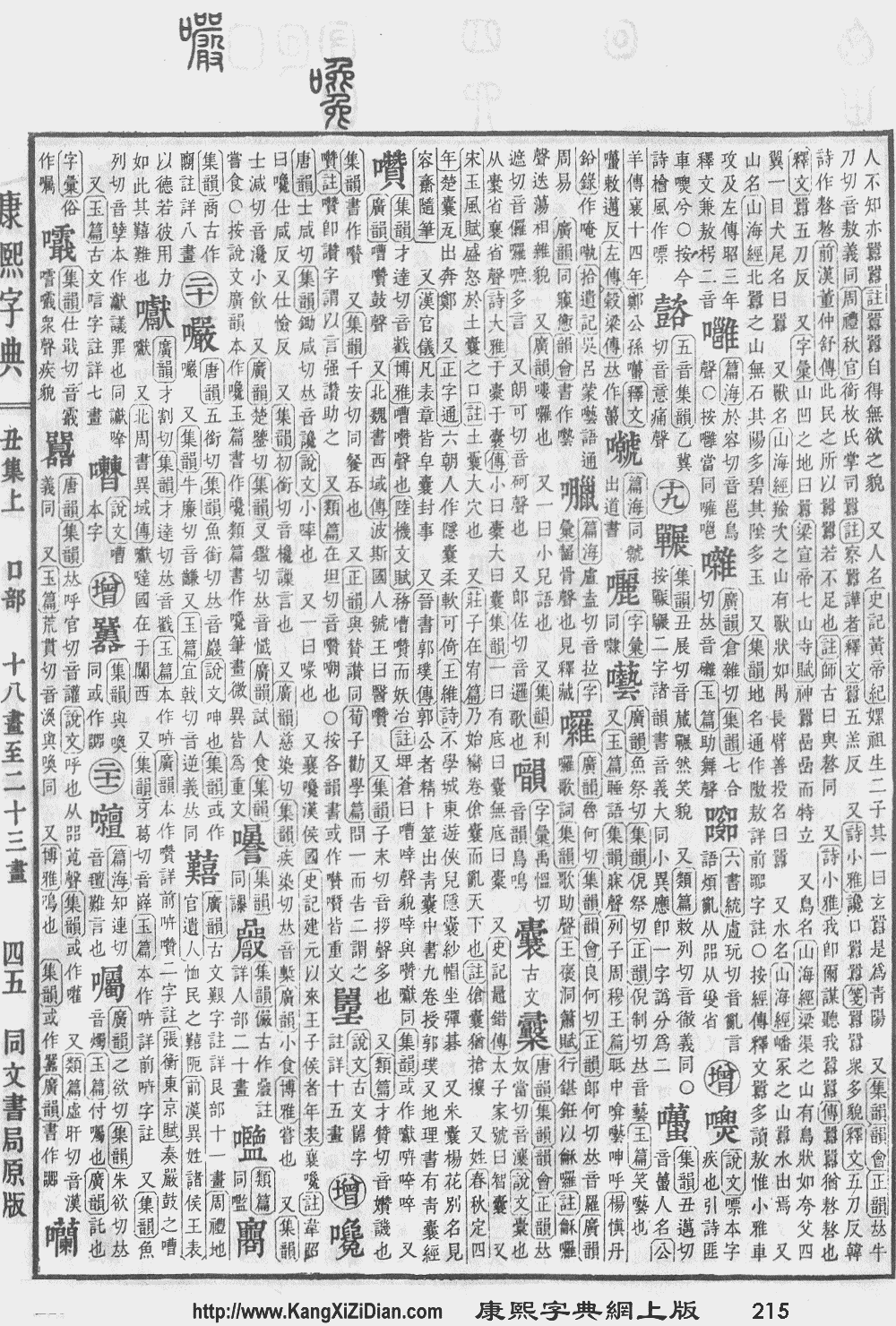
- Kangxi Dictionary: not present, would follow page 215, character 5
- Unihan data for U+2114F
Chinese
Lua error in Module:utilities at line 142: attempt to perform arithmetic on local 'h' (a nil value)
Glyph origin
Phono-semantic compound (形聲/形声) : semantic 口 + phonetic 禮 (lā̤).
Pronunciation
Definitions
𡅏 (Min Dong)
- Particle placed before a verb to indicate progressive aspect: to be ...-ing
- Particle placed after a verb to indicate continuous aspect: to be ...-ing
- 坐𡅏 [Min Dong] ― sô̤i lā̤ / [sɔy²⁴² l̃ɛ³³] [Bàng-uâ-cê / IPA] ― to be sitting
- Particle placed after a verb to indicate perfective aspect.
- to the extent that
- Particle placed between a verb or adjective and the main verb to indicate the state: -ly
- Particle placed after an adverb for emphasis.
- Modal particle used to indicate emphasis or exaggeration.
- Placed after a noun to indicate location.
Usage notes
- In the now-obsolete 简化字总表, 禮-礼 is listed in the first table in which non-analogizable pairs of simplified and traditional Chinese characters are collected. In the current standard 通用规范汉字表, neither 𡅏 nor 𠲥 is listed. Therefore, 𠲥 is a nonstandard simplified form. However, it is still widely used in Min Dong language dictionaries published in Mainland China.
Synonyms
Lua error in Module:utilities at line 142: attempt to perform arithmetic on local 'h' (a nil value) Lua error in Module:utilities at line 142: attempt to perform arithmetic on local 'h' (a nil value)
Vietnamese
Han character
𡅏: Nôm readings: lể[1][2], lẫy[1][2]
- This term needs a translation to English. Please help out and add a translation, then remove the text
{{rfdef}}.
References
- Nguyễn (2014).
- Trần (2004).
This article is issued from Wiktionary. The text is licensed under Creative Commons - Attribution - Sharealike. Additional terms may apply for the media files.