Scherflein
German
Etymology
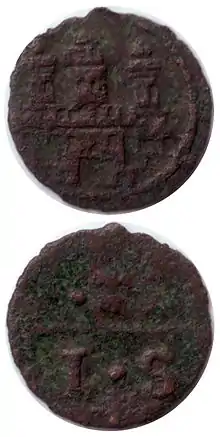
Diminutive of Scherf, from Middle High German scherf, scherpf (“a coin of small value, esp. a halfpenny”), from Old High German scerf, ultimately from Proto-Germanic *skrapōną (“to scratch”).[1]
Related to modern Scherbe (“shard”) and Middle High German scharben (“to notch, to nick”) (from Old High German scarbōn, cognate with Old English sceorfan (“to gnaw, to bite”)), because the coins were originally notched so they could be broken up for payment when needed.
Introduced by Luther as a translation for the Ancient Greek λεπτόν (leptón, “small coin”) in Mark 12:42.
Pronunciation
- IPA(key): /ˈʃɛɐ̯flaɪ̯n/
Audio (file)
Noun
Lua error in Module:utilities at line 142: attempt to perform arithmetic on local 'h' (a nil value)
- widow's mite, i.e. a small donation or contribution, esp. of monetary kind.
- 1798, Johann Wolfgang von Goethe, Hermann und Dorothea:
- schon von dem ersten bericht so groszer leiden gerühret,/ schickten wir eilend ein scherflein von unserm überflusz, dasz nur/ einige würden gestärkt, und schienen uns selber beruhigt.
- (please add an English translation of this quotation)
Usage notes
- In contemporary usage, mostly used in the idiomatic expression sein/ihr Scherflein (zu etwas) beitragen ("to contribute one's mite (to something)").
Declension
Lua error in Module:utilities at line 142: attempt to perform arithmetic on local 'h' (a nil value)
References
- Cf. 'Scherf' in Grimm's Dictionary. http://woerterbuchnetz.de/cgi-bin/WBNetz/wbgui_py?sigle=DWB&mode=Vernetzung&lemid=GS07009#XGS07009
Further reading
- “Scherflein” in Duden online
- Kroonen, Guus (2013), “skrepan”, in Etymological Dictionary of Proto-Germanic (Leiden Indo-European Etymological Dictionary Series; 11), Leiden, Boston: Brill, →ISBN