Straße
See also: Strasse
German
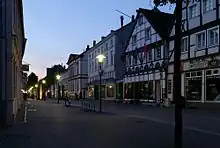
eine Straße

eine Straße
Alternative forms
- Strasse (Switzerland and Liechtenstein)
Etymology
From Middle High German strāze, from Old High German strāza, from Proto-West Germanic *strātu (“street”), from Latin (via) strata.
The sense “strait” is a calque of Middle Low German strâte, itself a phono-semantic matching of Middle English streit, from Old French estreit (“narrow”), from unrelated Latin strictus.
Pronunciation
- IPA(key): /ˈʃtʁaːsə/
audio (Germany) [ˈʃtʁäːsɘ] (file) audio (Berlin) [ˈʃtʁäːsə] (file) audio (Austria) [d̥i ˈʃtɾɑːsə] (file) - Rhymes: -aːsə
Noun
Lua error in Module:utilities at line 142: attempt to perform arithmetic on local 'h' (a nil value)
- street; road (a way wide enough to be passable for vehicles, generally paved, in or outside a settlement)
- Das Kind überquerte die Straße.
- The child crossed the street.
- Diese Straße führt nach Kirchdorf.
- This road goes to Kirchdorf.
- Die Straße ist für den Verkehr gesperrt.
- The street is closed for traffic.
- carriageway (the part of a road or street used by vehicles, excluding the pavement, etc.)
- (figuratively) public, any area accessible to anyone
- (figuratively) general public, using the locale to describe people not part of a specific group
- the streets, areas or groups of people of no income or criminal affiliation, or the leading of a life associated with these
- strait (channel of water)
- (poker) straight
Usage notes
- Ways too narrow for vehicles to pass are usually called Weg, if between houses also Gasse. In old cities, narrow paths may still be called Straße, particularly if the word is part of the names of these streets.
- The prepositional use is different from, and in some cases the opposite of, that in English. In most or all contexts, auf is possible. It is the only common preposition when referring specifically to the space between the houses (pavement and carriageway): Die Kinder spielen auf der Straße. (“The children are playing in the street.”) When a street is used as a geographical location, however, in is more common: Das Auto steht in der Straße an der Kirche. (“The car is parked in the street by the church.”) Der Laden ist in der Weberstraße. (“The shop is on Weber Street.”) In the latter example, which refers to a house, an is possible as a third alternative.
Declension
Lua error in Module:utilities at line 142: attempt to perform arithmetic on local 'h' (a nil value)
Synonyms
- Str. (abbreviation)
Hyponyms
- Anliegerstraße
- Anwohnerstraße
- Ausfallstraße
- Bergstraße
- Bundesstraße
- Dorfstraße
- Einfallstraße
- Einkaufstraße
- Europastraße
- Fußgängerstraße
- Hauptstraße
- Hauptverkehrsstraße
- Kantonalstraße
- Kreisstraße
- Landstraße
- Magellanstraße
- Milchstraße
- Nebenstraße
- Ortsstraße
- Parallelstraße
- Prachtstraße
- Privatstraße
- Querstraße
- Sammelstraße
- Schotterstraße
- Seidenstraße
- Seitenstraße
- Verbindungsstraße
- Wasserstraße
- Wohnstraße
- Zubringerstraße
Derived terms
- Sträßchen, Sträßlein
- straßenartig, straßenförmig
- straßenlos
Related terms
- Panierstraße
- Straßenampel
- Straßenarbeiter
- Straßenbahn
- Straßenbau
- Straßenbeleuchtung
- Straßenbild
- Straßenkämpfer
- Straßenkreuzung
- Straßenkünstler
- Straßenkurve
- Straßenlampe
- Straßenleuchte
- Straßenmaler
- Straßenmusiker
- Straßenpflaster
- Straßenpflasterer
- Straßenräuber
- Straßenschild
- Straßenseite
- Straßenverkehr

This article is issued from Wiktionary. The text is licensed under Creative Commons - Attribution - Sharealike. Additional terms may apply for the media files.