Vascones
See also: vascones
Latin
Etymology
According to Antonio Tovar, the name could have been from an exonym of entirely Proto-Indo-European origin given to the Basques by earlier Indo-Europeans inhabiting Basque country, based on the name ba(r)scunes found inscribed on coins matching the territory and period. The name would have been comprised of:
- the root Proto-Indo-European *bʰers- (“tip, point, top”)
- the suffix *-kon-
- the consonant stem suffix *-es indicating the name as a nominative plural
Thus, the name would have meant something like "the high (proud) people."[1]
Probably unrelated to the Basque endonym Euskara, despite the similarity.
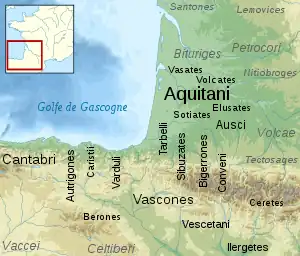
Location of the Vascones in Hispania
Pronunciation
- (Classical) IPA(key): /ˈu̯as.ko.neːs/, [ˈu̯äs̠kɔneːs̠]
- (modern Italianate Ecclesiastical) IPA(key): /ˈvas.ko.nes/, [ˈväskones]
Proper noun
Vasconēs m pl (genitive Vasconum); third declension
Declension
Lua error in Module:utilities at line 142: attempt to perform arithmetic on local 'h' (a nil value)
Descendants
- Galician: Bascuas (place name)
References
- “Vascones”, in Charlton T. Lewis and Charles Short (1879) A Latin Dictionary, Oxford: Clarendon Press
- Vascones in Charles du Fresne du Cange’s Glossarium Mediæ et Infimæ Latinitatis (augmented edition with additions by D. P. Carpenterius, Adelungius and others, edited by Léopold Favre, 1883–1887)
- Vascones in Gaffiot, Félix (1934) Dictionnaire illustré latin-français, Hachette
- “Vascones”, in Harry Thurston Peck, editor (1898) Harper's Dictionary of Classical Antiquities, New York: Harper & Brothers
- “Vascones”, in William Smith, editor (1854, 1857) A Dictionary of Greek and Roman Geography, volume 1 & 2, London: Walton and Maberly
- Trask, R. L. (2013). The History of Basque. United Kingdom: Taylor & Francis.
This article is issued from Wiktionary. The text is licensed under Creative Commons - Attribution - Sharealike. Additional terms may apply for the media files.