Zirkel
German
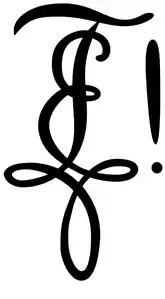
Zirkel (monogram), comprised of E, F, V.
Etymology
From Middle High German zirkel, from Old High German zirkil, from Latin circinus (“pair of compasses”), from Ancient Greek κίρκινος (kírkinos). The Old High German -il is due to either alteration after the Germanic tool suffix *-ilaz, or confluence with Latin circulus (“circle”); the -k- speaks in favour of the latter explanation. The sense “circle”, which appears in Middle High German, is at any rate borrowed from circulus. Both Latin words ultimately go back to Ancient Greek κίρκος (kírkos).
Pronunciation
- IPA(key): /ˈtsɪrkəl/, [ˈt͡sɪʁ.kl̩], [ˈt͡sɪɐ̯-], [-kəl]
Audio (file)
Noun
Lua error in Module:utilities at line 142: attempt to perform arithmetic on local 'h' (a nil value)
Declension
Lua error in Module:utilities at line 142: attempt to perform arithmetic on local 'h' (a nil value)
Derived terms
- zirkeln, zirkulär, zirkulieren
Related terms
- Geheimzirkel, Lesezirkel, Literaturzirkel, Quintenzirkel, Stechzirkel
- Zirkelbeweis, Zirkelkasten, Zirkelkonstruktion, Zirkelschluss
- Zirkus
This article is issued from Wiktionary. The text is licensed under Creative Commons - Attribution - Sharealike. Additional terms may apply for the media files.