bus
English
Etymology
Clipping of omnibus. Formerly often spelt 'bus. The electrical sense is derived from figurative application of the automotive sense.
Pronunciation
- IPA(key): /bʌs/, enPR: bŭs
- (Northern England, Ireland) IPA(key): /bʊs/
- (General Australian, New Zealand, Scotland, Mid-Atlantic) IPA(key): /bɐs/
- (Northern Cities Vowel Shift, Ireland) IPA(key): /bɔs/
Audio (UK) (file) Audio (US) (file) - Homophones: Buss, buss
- Rhymes: -ʌs
Noun
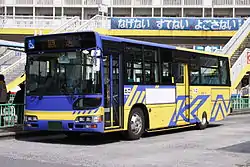
- (automotive) A motor vehicle for transporting large numbers of people along roads; by extension, the driver of said vehicle
- An electrical conductor or interface serving as a common connection for two or more circuits or components.
- Part of a MIRV missile, having on-board motors used to deliver the warhead to a target.
- (medical industry, slang) An ambulance.
- (military slang, 1910s–1940s) An aeroplane.[1]
Synonyms
- (electrical conductor): electrical bus, busbar, digit trunk
- (vehicle): autobus, coach, loser cruiser, motorbus, multibus, omnibus, Shillibeer (obsolete)
Hyponyms
Derived terms
- Airbus
- airbus
- and then everyone on the bus clapped
- articulated bus
- baht bus
- banana bus
- bangbus
- battle bus
- battlebus
- bendy bus
- bookbus
- Boris bus
- busable
- bus bar
- busbar
- bus boy
- bus bridge
- bus buddy
- bus bulb
- bus captain
- bus conductor
- bus conductress
- bus driver
- bus duct
- bus factor
- bus fare
- busful
- bus girl
- busgirl
- busjacking
- bus lane
- busless
- buslike
- busload
- busman
- bus mastering
- busmate
- bus mile
- bus ministry
- bus pass
- bus rapid transit
- bus replacement service
- bus route
- bus shelter
- bussick
- bus stand
- bus station
- bus stop
- bus stop chicane
- bus-stop flight
- bussy
- bustaurant
- bustitute
- bustitution
- bus topology
- bus trap
- busway
- catch the bus
- cheese bus
- chicken bus
- city bus
- citybus
- commuter bus
- corporation bus
- data bus
- double-decker bus
- drive the porcelain bus
- e-bus
- electric bus
- enterprise service bus
- face like the back end of a bus
- frontside bus
- front-side bus
- gyrobus
- helibus
- horse bus
- how do I get to the bus station
- kneeling bus
- like the back end of a bus
- metrobus
- microbus
- minibus
- miss the bus
- national school bus chrome
- on the other bus
- open-top bus
- park the beef bus in tuna town
- park the bus
- party bus
- pedibus
- playbus
- porcelain bus
- railbus
- ride the short bus
- satellite bus
- school bus
- school bus yellow
- shuttle bus
- spacecraft bus
- splitter bus
- stage bus
- straddling bus
- struggle bus
- superbus
- taxibus
- telebus
- the wheels came off the bus
- the wheels fell off the bus
- throw under a bus
- throw under the bus
- tour bus
- transit bus
- trolley bus
- trolleybus
- walking bus
- walking school bus
- water bus
- waterbus
- where does this bus go
Descendants
- → Arabic: بَاص (bāṣ)
- ⇒ Burmese: ဘတ်စ်ကား (bhatcka:)
- → Cantonese: 巴士
- → Mandarin: 巴士 (bāshì)
- → German: Bus m
- → Hindi: बस (bas)
- → Irish: bus
- → Japanese: バス (basu)
- → Korean: 버스 (beoseu)
- → Malay: bas
- → Pashto: بس
- ⇒ Sanskrit: बसयान (basayāna)
- → Scottish Gaelic: bus
- → Thai: บัส (bát)
- → Tibetan: འབའ་སེ ('ba' se)
- → Urdu: بس
- → Welsh: bws
Translations
Verb
bus (third-person singular simple present busses or buses, present participle bussing or busing, simple past and past participle bussed or bused)
- (transitive, automotive, transport) To transport via a motor bus.
- (transitive, automotive, transport, chiefly US) To transport students to school, often to a more distant school for the purposes of achieving racial integration.
- 1966, Phil Ochs, “Love Me, I'm a Liberal”, in Phils Ochs in Concert:
- But if you ask me to bus my children / I hope the cops take down your name
- 2008, Ashley R. Holm, Racial Differences in Student Engagement and Attainment: A Study of Topeka High School, 1939--1984, ProQuest, →ISBN, page 23:
- ...to strike down Detroit's federal court order to bus students across school district lines for the purpose of desegregation and therefore nullify many busing programs throughout the country.
- (intransitive, automotive, transport) To travel by bus.
- (transitive, US, food service) To clear meal remains from.
- He bussed tables as the restaurant emptied out.
- 2019, Colson Whitehead, The Nickel Boys, Fleet, page 13:
- He was hired to bus tables, but after a few incidents they moved him to the kitchen.
- (intransitive, US, food service) To work at clearing the remains of meals from tables or counters; to work as a busboy.
- He’s been bussing for minimum wage.
Usage notes
The Canadian Oxford Dictionary only presents the spellings buses, busing, and bused, implying that these are the predominant forms in Canada.
Derived terms
- (clear meal remains): busboy
Translations
References
- Lighter, Jonathan (1972), “The Slang of the American Expeditionary Forces in Europe, 1917-1919: An Historical Glossary”, in American Speech, volume 47, issue 1/2, page 26
Afar
Pronunciation
- IPA(key): /ˈbus/, [ˈbʊs]
- Hyphenation: bus
Declension
| Declension of bús | ||||||||||||||||||
|---|---|---|---|---|---|---|---|---|---|---|---|---|---|---|---|---|---|---|
| absolutive | bús | |||||||||||||||||
| predicative | búsu | |||||||||||||||||
| subjective | bús | |||||||||||||||||
| genitive | bustí | |||||||||||||||||
| ||||||||||||||||||
References
- E. M. Parker; R. J. Hayward (1985), “bus”, in An Afar-English-French dictionary (with Grammatical Notes in English), University of London, →ISBN
Catalan
Etymology 1
Cognate to Spanish buso (“underwater snail”) and Portuguese búzio (“underwater snail”), from Latin būcina (“horn”).
Derived terms
Noun
bus m (plural bussos)
- (archaic) a large sailing ship used in the 12th and 13th centuries, broad of beam and with two or three masts
Usage notes
- Only found in the phrase fer lo bus (“to kiss up”).
Etymology 4
Clipping of autobús.
Further reading
- “bus” in Diccionari de la llengua catalana, segona edició, Institut d’Estudis Catalans.
Cimbrian
References
- Patuzzi, Umberto, ed., (2013) Luserna / Lusérn: Le nostre parole / Ünsarne börtar / Unsere Wörter [Our Words], Luserna, Italy: Comitato unitario delle isole linguistiche storiche germaniche in Italia / Einheitskomitee der historischen deutschen Sprachinseln in Italien
Czech
Pronunciation
- IPA(key): [ˈbus]
Noun
bus m inan
Declension
Pronunciation
- IPA(key): [ˈbas]
Danish
Etymology
Shortening of omnibus, from French omnibus, from Latin omnibus (“for all”), dative plural of omnis (“all”).
Pronunciation
- IPA(key): /bus/, [b̥us]
Dutch
Pronunciation
- IPA(key): /bʏs/
audio (file) - Hyphenation: bus
- Rhymes: -ʏs
- Homophone: Bus
Etymology 1
Shortening of omnibus, from Latin omnibus (“for everything/all”); dative plural of omnis (“all”).
Noun
Derived terms
Descendants
Etymology 2
From Middle Dutch busse, from Old Dutch *bussa, from Proto-West Germanic *buhsā.
Noun
Derived terms
- beschuitbus
- brievenbus
- broodbus
- busdokter
- busgeschut
- buskruit
- busmeester
- collectebus
- donderbus
- drinkbus
- geldbus
- haakbus
- koffiebus
- melkbus
- postbus
- schoolbus
- schrootbus
- stembus
- suikerbus
- ziekenbus
Related terms
Etymology 3
See the etymology of the corresponding lemma form. Related to etymology 2.
French
Etymology 1
Clipping of omnibus.
Derived terms
Etymology 2
Inflected forms.
Further reading
- “bus”, in Trésor de la langue française informatisé [Digitized Treasury of the French Language], 2012.
Indonesian
Etymology 1
Internationalism, borrowed from Dutch bus, from Latin omnibus (“for everything/all”); dative plural of omnis (“all”).
Pronunciation
- (standard) IPA(key): [ˈbʊs]
- (dialect) IPA(key): [ˈbɪs], [ˈbəs], [ˈbas], [ˈbɘs]
- Rhymes: -bʊs, -ʊs, -s
- Hyphenation: bus
Noun
bus (plural bus-bus, first-person possessive busku, second-person possessive busmu, third-person possessive busnya)
- bus: a motor vehicle for transporting large numbers of people along roads.
Etymology 2
Onomatopoeic, related to embus.
Pronunciation
- IPA(key): /ˈbʊs/
- Hyphenation: bus
Noun
bus (first-person possessive busku, second-person possessive busmu, third-person possessive busnya)
Further reading
- “bus” in Kamus Besar Bahasa Indonesia, Jakarta: Language Development and Fostering Agency — Ministry of Education, Culture, Research, and Technology of the Republic Indonesia, 2016.
Irish
Declension
Derived terms
- bus altach (“bendy bus”)
- bus dhá stór (“double decker bus”)
- bus dhá urlár (“double decker bus”)
- bus scoile (“school bus”)
- bus tralaí (“trolleybus”)
- busáras (“bus station”)
- buslána (“bus lane”)
- lána bus (“bus lane”)
- líne busanna (“bus line”)
- pas bus (“bus pass”)
- scáthlán bus (“bus shelter”)
- stad bus (“bus-stop”)
- stiúrthóir bus (“bus conductor”)
- tairseach bus (“platform of bus”)
- tiománaí bus (“bus-driver”)
Mutation
| Irish mutation | ||
|---|---|---|
| Radical | Lenition | Eclipsis |
| bus | bhus | mbus |
| Note: Some of these forms may be hypothetical. Not every possible mutated form of every word actually occurs. | ||
References
- Finck, F. N. (1899) Die araner mundart (in German), volume II, Marburg: Elwert’sche Verlagsbuchhandlung, page 48
Further reading
- Ó Dónaill, Niall (1977), “bus”, in Foclóir Gaeilge–Béarla, Dublin: An Gúm, →ISBN
- “bus”, in New English-Irish Dictionary, Foras na Gaeilge, 2013–2024
- Entries containing “bus” in English-Irish Dictionary, An Gúm, 1959, by Tomás de Bhaldraithe.
Lithuanian
(This etymology is missing or incomplete. Please add to it, or discuss it at the Etymology scriptorium.)
Pronunciation
- IPA(key): [bʊs]
Lombard
Pronunciation
- IPA(key): /byːs/
Middle Irish
Etymology
From Proto-Celtic *bussus, from Proto-Indo-European *bʰew- (“to swell, bulge”).
Further reading
- G. Toner, M. Ní Mhaonaigh, S. Arbuthnot, D. Wodtko, M.-L. Theuerkauf, editors (2019), “4 bus”, in eDIL: Electronic Dictionary of the Irish Language
- Matasović, Ranko (2009), “*bussu-”, in Etymological Dictionary of Proto-Celtic (Leiden Indo-European Etymological Dictionary Series; 9), Leiden: Brill, →ISBN, page 84
Norman
Polish
Pronunciation
- IPA(key): /bus/
Audio (file) - Rhymes: -us
- Syllabification: bus
Noun
bus m anim or m inan (diminutive busik)
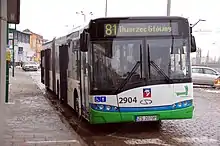
- (colloquial) bus (motor vehicle for transporting large numbers of people along roads)
Declension
Romagnol
Pronunciation
- IPA(key): /bus/
Noun
bus m
- hole
- September 2012, Daniela Cortesi, Bônanòta in la Ludla, il Papiro, page 15:
- un sorg e’ cor in priscia int e’ su bus.
- a mouse runs hastily towards its hole.
- un sorg e’ cor in priscia int e’ su bus.
- September 2012, Daniela Cortesi, Bônanòta in la Ludla, il Papiro, page 15:
Scottish Gaelic
Etymology 1
From Middle Irish bus.
Pronunciation
- IPA(key): /pus̪/
Noun
Pronunciation
- IPA(key): /pəs̪/
Somali
Spanish
Pronunciation
- IPA(key): /ˈbus/ [ˈbus]
- Rhymes: -us
- Syllabification: bus
Usage notes
- In Spain, bus is a colloquial word and in Latin America it is a formal word.
Derived terms
Further reading
- “bus”, in Diccionario de la lengua española, Vigésima tercera edición, Real Academia Española, 2014
Swedish
Etymology
From the verb busa (“make mischief, prank”).
Pronunciation
- IPA(key): /bʉːs/, [bʉ͍ːs]
- Rhymes: -ʉːs
Noun
bus n (uncountable)
Usage notes
Associated with mischief and pranks by children, with ironic extensions to adults fooling around and criminality.
Declension
| Declension of bus | ||||
|---|---|---|---|---|
| Uncountable | ||||
| Indefinite | Definite | |||
| Nominative | bus | buset | — | — |
| Genitive | bus | busets | — | — |
Related terms
- busa (“make mischief, prank”)
References
Anagrams
Tagalog
Pronunciation
- Hyphenation: bus
- (common) IPA(key): /ˈbus/, [ˈbus]
- (Taglish) IPA(key): /ˈbas/, [ˈbas]
Usage notes
- The pronunciation /bas/ is commonly used in Taglish speech, especially by younger speakers.
Derived terms
- ibus
- magbus
- pambus
References
- “bus”, in Pambansang Diksiyonaryo | Diksiyonaryo.ph, Manila, 2018
Tok Pisin
Pronunciation
- IPA(key): /bus/
Noun
bus
- bush (remote rural areas)
Derived terms
West Flemish
Etymology 1
From Middle Dutch busch, variant of bosch, from Old Dutch *busc, from Proto-Germanic *buskaz.
Etymology 2
(This etymology is missing or incomplete. Please add to it, or discuss it at the Etymology scriptorium. Particularly: “Same as Dutch "bus", but is it derived from that or shortened from "omnibus" independently?”)