kaza
English
Alternative forms
Etymology
From Ottoman Turkish قضا (kaza, “division of a sanjak”), from Arabic قَضَاء (qaḍāʔ, “jurisdiction, court circuit”), from قَضَى (qaḍā, “to decide, to judge”).
Pronunciation
- IPA(key): /ˈkaza/
Audio (Southern England) (file)
Noun
kaza (plural kazas)
- (politics) A subdistrict, particularly (historical) a third-level administrative division of the Ottoman Empire.
Synonyms
- kaymakamlik
Translations
|
References
- “kaza, n.”, in OED Online
 , Oxford, Oxfordshire: Oxford University Press, 2020.
Albanian
Etymology
From Ottoman Turkish قضا (kaza, “division of a sanjak”), from Arabic قَضَاء (qaḍāʔ, “jurisdiction, court circuit”), from قَضَى (qaḍā, “to decide, to judge”).
Noun
kaza f
- (politics) kaza, particularly (historical) as a former second-level administrative division of Albania
Declension
Hausa
Etymology
Of unclear origin. Clear cognates of the same meaning within Chadic (e.g. Karekare kyéézì, Bade kâzá, Ngizim gā̂za, Ngamo gā̀zâ, Bole gājà, Duwai kīzhìya) may be the result of diffusion, rather than inheritance. Perhaps borrowed from Kanuri kájì (“guinea fowl”) or a Berber language, e.g. Tamasheq ékăz (“rooster”).
See also
- zakara (“rooster”)
References
- Kossmann, Maarten (2005) Berber Loanwords in Hausa (Berber Studies; 12), Köln: Rüdiger Köppe Verlag, →ISBN, →ISSN
Ladino
Latvian
Etymology
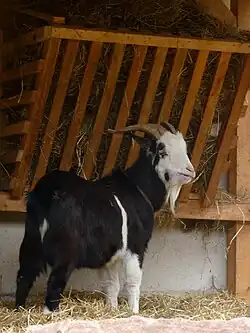
Apparently borrowed from Russian коза́ (kozá): note that the words for “male goat” and “female goat” in Latvian are non-cognate (āzis and Lua error in Module:utilities at line 142: attempt to perform arithmetic on local 'h' (a nil value)), unlike other Baltic languages (Lithuanian ožỹs, ožkà; Old Prussian wosux ([vōzuks]), wosee ([vōzē])), which suggests that an earlier Latvian term, perhaps *āze (apparently present in place names like Āzes), was replaced by the borrowed Lua error in Module:utilities at line 142: attempt to perform arithmetic on local 'h' (a nil value).[1]
Pronunciation
- IPA(key): [kaza]
| (file) |
Noun
kaza f (4th declension)
Declension
| singular (vienskaitlis) | plural (daudzskaitlis) | |
|---|---|---|
| nominative (nominatīvs) | Lua error in Module:utilities at line 142: attempt to perform arithmetic on local 'h' (a nil value) | kazas |
| accusative (akuzatīvs) | kazu | kazas |
| genitive (ģenitīvs) | kazas | kazu |
| dative (datīvs) | kazai | kazām |
| instrumental (instrumentālis) | kazu | kazām |
| locative (lokatīvs) | kazā | kazās |
| vocative (vokatīvs) | Lua error in Module:utilities at line 142: attempt to perform arithmetic on local 'h' (a nil value) | kazas |
References
- Karulis, Konstantīns (1992), “kaza”, in Latviešu Etimoloģijas Vārdnīca (in Latvian), Rīga: AVOTS, →ISBN
Swahili
Pronunciation
Audio (Kenya) (file)
Conjugation
Lua error in Module:utilities at line 142: attempt to perform arithmetic on local 'h' (a nil value)
Turkish
Etymology
From Ottoman Turkish قضا (kaza), from Arabic قَضَاء (qaḍāʔ).
Pronunciation
- IPA(key): [kɑˈzɑː]
Audio (file) - Hyphenation: ka‧za
Declension
Lua error: attempt to perform arithmetic on local 'h' (a nil value)
References
- Kélékian, Diran (1911), “قضا”, in Dictionnaire turc-français, Constantinople: Mihran, page 963b
- Nişanyan, Sevan (2002–), “kaza”, in Nişanyan Sözlük