tanzen
See also: Tänzen
German
tanzen
Etymology
From Lua error in Module:utilities at line 142: attempt to perform arithmetic on local 'h' (a nil value), from Old French dancer; the adapted onset t- in Upper German dialects (and standard German) proves that the word was not borrowed directly from the French word, but via Middle Low German or Middle Dutch dansen and Central German.
Pronunciation
- IPA(key): /ˈtan(t)sən/, [-t͡sn̩], [-sn̩]
audio (Austria) (file) Audio (file)
Verb
tanzen (weak, third-person singular present tanzt, past tense tanzte, past participle getanzt, auxiliary haben or sein)
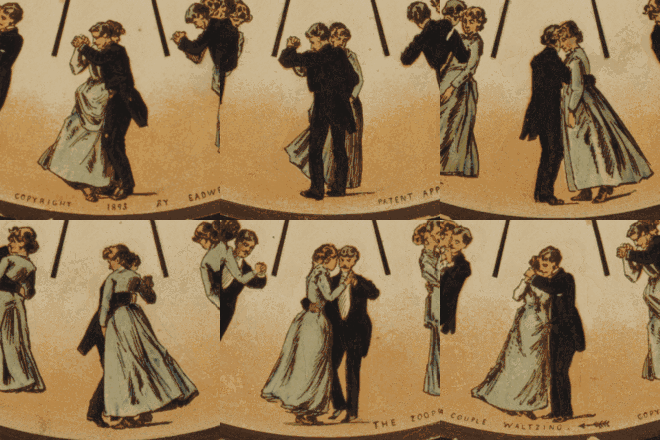
- to dance
Usage notes
- The perfect auxiliary is normally haben, but sein is used when there is a movement from place to place. For example: Wir haben auf der Straße getanzt. (“We danced in the street.”). But: Wir sind durch die Straße getanzt. (“We danced through the street”, i.e. from one end to another.)
Conjugation
Lua error in Module:utilities at line 142: attempt to perform arithmetic on local 'h' (a nil value)
Related terms
- tänzeln
- Tanzbein
- Tanzverbot
Further reading
- “tanzen” in Digitales Wörterbuch der deutschen Sprache
- “tanzen” in Deutsches Wörterbuch von Jacob und Wilhelm Grimm, 16 vols., Leipzig 1854–1961.
- “tanzen” in Duden online
- “tanzen” in OpenThesaurus.de
This article is issued from Wiktionary. The text is licensed under Creative Commons - Attribution - Sharealike. Additional terms may apply for the media files.