tapi'ira
Old Tupi
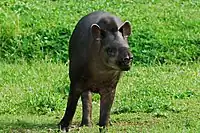
tapi'ira (sense 1)
.jpg.webp)
tapi'ira (sense 2)
Pronunciation
- IPA(key): /ta.piˈʔi.ɾa/
- Rhymes: -iɾa
- Hyphenation: ta‧pi‧'i‧ra
Usage notes
- This word began being used to refer to cows and oxen after these were brought by the Portuguese, thus the terms tapi'ireté (literally “true tapir”) and tapi'irusu (literally “great tapir”) were created as a way to differentiate between them. The same happened with îagûara and taîasu.
Derived terms
- tapi'ikaba
- tapi'ira'yrusu
- tapi'irapekũ
- tapi'irapé
- tapi'iraraîygûera
- tapi'irarepanakũ
- tapi'irarõana
- tapi'irerekoara
- tapi'iresá
- tapi'ireté
- tapi'irusu
Descendants
References
- Pe. Antônio Lemos Barbosa (1956) Curso de Tupi Antigo: Gramática, Exercícios, Textos (in Portuguese), Rio de Janeiro: Livraria São José
- Eduardo de Almeida Navarro (2013), “tapi'ira”, in Dicionário de tupi antigo: a língua indígena clássica do Brasil (in Portuguese), 1 edition, São Paulo: Global, →ISBN, pages 462–463
This article is issued from Wiktionary. The text is licensed under Creative Commons - Attribution - Sharealike. Additional terms may apply for the media files.