ursus
See also: Ursus
Latin
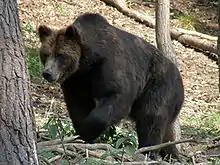
ursus (a bear)
Etymology
Inherited from Proto-Indo-European *h₂ŕ̥tḱos (“bear”). The initial u- is unexpected, and may have arisen as a tabuistic distortion. For the outcome s of original *tḱ compare sinō.
Pronunciation
- (Classical) IPA(key): /ˈur.sus/, [ˈʊrs̠ʊs̠]
- (modern Italianate Ecclesiastical) IPA(key): /ˈur.sus/, [ˈursus]
Declension
Second-declension noun.
| Case | Singular | Plural |
|---|---|---|
| Nominative | ursus | ursī |
| Genitive | ursī | ursōrum |
| Dative | ursō | ursīs |
| Accusative | ursum | ursōs |
| Ablative | ursō | ursīs |
| Vocative | urse | ursī |
Descendants
- Aragonese: onso
- Aromanian: ursu
- Asturian: osu
- Catalan: ós, ors
- Corsican: orsu
- → Esperanto: urso
- Friulian: ors
- Italian: orso
- Ladin: lors
- Ladino: lonso
- Occitan: ors
- Old French: urs
- Old Galician-Portuguese: usso, osso, husso
- Old Spanish: osso
- → Portuguese: urso
- Romanian: urs
- Romansch: urs, uors
- Sardinian: ursu
- Sicilian: ursu
- Translingual: Ursus
- Venetian: ors, orso
- Walloon: oûsse
References
- “ursus”, in Charlton T. Lewis and Charles Short (1879) A Latin Dictionary, Oxford: Clarendon Press
- “ursus”, in Charlton T. Lewis (1891) An Elementary Latin Dictionary, New York: Harper & Brothers
- ursus in Gaffiot, Félix (1934) Dictionnaire illustré latin-français, Hachette
- “ursus”, in Harry Thurston Peck, editor (1898) Harper's Dictionary of Classical Antiquities, New York: Harper & Brothers
- “ursus”, in William Smith, editor (1848) A Dictionary of Greek and Roman Biography and Mythology, London: John Murray
This article is issued from Wiktionary. The text is licensed under Creative Commons - Attribution - Sharealike. Additional terms may apply for the media files.