7

You can see a little background about this on this bitcointalk post by the late Hal Finney.

Beta and lambda are the values on the secp256k1 curve where:

λ^3 (mod N) = 1

β^3 (mod P) = 1

As seen here, in hex, N and P are:

N = FFFFFFFF FFFFFFFF FFFFFFFF FFFFFFFE BAAEDCE6 AF48A03B BFD25E8C D0364141

P = FFFFFFFF FFFFFFFF FFFFFFFF FFFFFFFF FFFFFFFF FFFFFFFF FFFFFFFE FFFFFC2F

The actual values of lambda and beta are easily verifiable and are:

λ = 5363ad4cc05c30e0a5261c028812645a122e22ea20816678df02967c1b23bd72

β = 7ae96a2b657c07106e64479eac3434e99cf0497512f58995c1396c28719501ee

The question for me is, how do you derive this? Can someone show me step-by-step how you can figure out these values?

Also posted to the Cryptography Stack Exchange

Jimmy Song
  • 7,709
  • 16
  • 35
  • You might be more likely to get an answer on the cryptography SE site. – Tyler Feb 02 '15 at 07:03
  • Hal Finney says he found hints about how to compute it in pages 125-129 of the *Guide to Elliptic Curve Cryptography*, by Hankerson, Menezes and Vanstone. He found a PDF on a Russian website. – David Grayson Feb 02 '15 at 23:55
  • I've actually read that book and those particular pages multiple times and couldn't figure it out. – Jimmy Song Feb 02 '15 at 23:57

3 Answers3

4

With a bit of reverse engineering, I think I was able to see how Hal was able to get to these results.

First, it's a pretty well known result of Fermat's little theorem that if p is a prime number and g is a generator for the field Z/pZ, then:

g ^ (p - 1) = 1

Note, don't confuse this abstract generator g with the generator for the secp256k1 group G. Now, given the above equation, it's not a big leap to see that:

(g ^ ((p - 1)/3)^3 = g ^ (p - 1) = 1

Thus, we can find λ and β by first finding generators for Z/NZ and Z/PZ (N and P being the parameters given in the original question), and then raising them to the (N-1)/3 and (P-1)/3 powers, respectively. You can check that both N-1 and P-1 are divisible by 3.

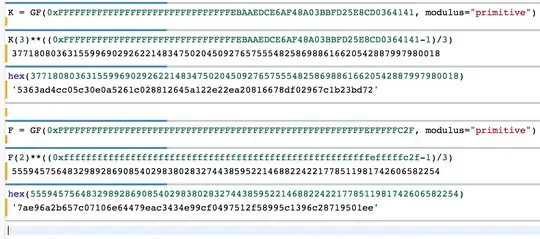
The generator that it seems Hal used for λ is 3, and for β is 2. I'm not sure why he picked those, there are plenty of other good generators to choose from. It was probably on a trial and error basis.

Using sage mathematics notebook, I was able to produce the same values for λ and β.

enter image description here

morsecoder
  • 14,008
  • 2
  • 42
  • 92
  • 1
    lambda and beta are non-trivial cube roots of 1 in the respective fields (mod n for lambda, mod p for beta). There are only two such values. Starting from a generator g and raising to the power (n-1)/3 resp. (p-1)/3 to find them is just one way of doing so. And it doesn't matter which g one starts with, one always finds one of the two valid solutions, or 1 (if the g started from wasn't a generator, but a cube). – Pieter Wuille Aug 18 '22 at 02:14
2

Quoting cryptography.stackexchange.com:

Given that N and P are prime, one obvious way to do this is to select a random value g from [1,N−1], and compute g^((N−1)/3) mod N; assuming that N≡1(mod 3), this resulting value will either be 1, the displayed value of λ, or N−λ−1 (with equal probabilities of each). If N≢1(mod 3), then the only modular cube root of 1 will be 1.

And, to compute β, you do the same with P.


The reason this works is due to Fermat's little theorem which states:

g^(N-1) ≡ 1 (mod N)

which implies

(g^((N-1)/3))^3 ≡ 1 (mod N)

which implies

g^((N-1)/3) is our potential λ. If it's not 1, it'll work for the purposes of endomorphism.

Jimmy Song
  • 7,709
  • 16
  • 35
0

Python code to get beta and lambda values for p and n of secp256k1 curve

Getting beta of p

p = 0xfffffffffffffffffffffffffffffffffffffffffffffffffffffffefffffc2f
print "beta of p = 0x%x" % pow(2, (p-1)/3, p)

beta of p = 0x7ae96a2b657c07106e64479eac3434e99cf0497512f58995c1396c28719501ee

Getting lambda of n

n = 0xfffffffffffffffffffffffffffffffebaaedce6af48a03bbfd25e8cd0364141
print "lambda of n = 0x%x" % pow(3, (n-1)/3 , n)

lambda of n = 0x5363ad4cc05c30e0a5261c028812645a122e22ea20816678df02967c1b23bd72


More info

I experimented further with this by getting beta and lambda for both p and n and discovered that all the results generated become useful for finding the identical values for x or y in the equation y ^ 2 = x ^ 3 + 7 mod p

#beta and lambda for p
p = 0xfffffffffffffffffffffffffffffffffffffffffffffffffffffffefffffc2f
betaOfP = pow(2, (p-1)/3, p)
lambdaOfP = pow(3, (p-1)/3, p)
print "betaOfP \t= 0x%x " % betaOfP 
print "lambdaOfP\t= 0x%x " % lambdaOfP 
print

#beta and lambda for n
n = 0xfffffffffffffffffffffffffffffffebaaedce6af48a03bbfd25e8cd0364141
betaOfN = pow(2, (n-1)/3 , n)
lambdaOfN = pow(3, (n-1)/3 , n)
print "betaOfN \t= 0x%x" % betaOfN
print "lambdaOfN\t= 0x%x" % lambdaOfN

betaOfP = 0x7ae96a2b657c07106e64479eac3434e99cf0497512f58995c1396c28719501ee lambdaOfP = 0x851695d49a83f8ef919bb86153cbcb16630fb68aed0a766a3ec693d68e6afa40

betaOfN = 0xac9c52b33fa3cf1f5ad9e3fd77ed9ba4a880b9fc8ec739c2e0cfc810b51283ce lambdaOfN = 0x5363ad4cc05c30e0a5261c028812645a122e22ea20816678df02967c1b23bd72

Sean Bradley
  • 401
  • 4
  • 5