%252C_deconvolved.pdf.jpg.webp) | |
| Discovery[1] | |
|---|---|
| Discovered by | H. Goldschmidt |
| Discovery date | May 22, 1856 |
| Designations | |
| (41) Daphne | |
| Pronunciation | /ˈdæfni/[2] |
Named after | Daphnē |
| 1949 TG | |
| Main belt | |
| Adjectives | Daphnean /ˈdæfniən/[3] |
| Orbital characteristics[1] | |
| Epoch 31 December 2006 (JD 2454100.5) | |
| Aphelion | 3.517 AU (526.144 Gm) |
| Perihelion | 2.014 AU (301.220 Gm) |
| 2.765 AU (413.682 Gm) | |
| Eccentricity | 0.272 |
| 4.60 a (1,679.618 d) | |
| 247.500° | |
| Inclination | 15.765° |
| 178.159° | |
| 46.239° | |
| Known satellites | Peneius /pɛˈniːəs/ (S/2008 (41) 1) |
| Physical characteristics | |
| Dimensions | c/a = 0.65±0.08[4] 213×160 km[5] 239x183x153 km[6] |
Mean diameter | 187±13 km[4] 205.5±1.9[1] 189 km[7] |
| Mass | (6.1±0.9)×1018 kg[4] ≈ 6.8×10¹⁸ kg[8] |
Mean density | 1.78±0.45 g/cm3[4] ≈ 1.95 g/cm³[6] |
| 5.9 hr[1] | |
| 0.052 (calculated)[4] 0.083[1] | |
| C [1] | |
| 7.12[1] | |
Daphne (minor planet designation: 41 Daphne) is a large asteroid from the asteroid belt.[1] It is a dark-surfaced body 174 km in diameter is probably composed of primitive carbonaceous chondrites. The spectra of the asteroid displays evidence of aqueous alteration.[9] It was discovered by H. Goldschmidt on May 22, 1856, and named after Daphne, the nymph in Greek mythology who was turned into a laurel tree. Incorrect orbital calculations initially resulted in 56 Melete being mistaken for a second sighting of Daphne. Daphne was not sighted again until August 31, 1862.[10]
The orbit of 41 Daphne places it in a 9:22 mean motion resonance with the planet Mars. The computed Lyapunov time for this asteroid is 14,000 years, indicating that it occupies a chaotic orbit that will change randomly over time because of gravitational perturbations of the planets.[11]
In 1999, Daphne occulted three stars, and on July 2, 1999, produced eleven chords indicating an ellipsoid of 213×160 km.[5] Daphnean lightcurves also suggest that the asteroid is irregular in shape. Daphne was observed by Arecibo radar in April 2008.[12][13] Based upon radar data, the near surface solid density of the asteroid is 2.4+0.7
−0.5 g cm−3.[14]
Satellite
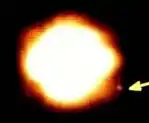 Daphne and Peneius as seen by the W.M. Keck II telescope in 2008 | |
| Designations | |
|---|---|
| (41) Daphne I Peneius | |
| Pronunciation | /pɛˈniːəs/ |
| S/2008 (41) 1 | |
| Adjectives | Peneian /pɛˈniːən/ |
| Orbital characteristics | |
| Inclination | ° |
41 Daphne has at least one satellite, named Peneius (provisionally S/2008 (41) 1).[15][16] It was identified on March 28, 2008, and has a projected separation of 443 km, an orbital period of approximately 1.1 days,[6] and an estimated diameter of less than 2 km. If these preliminary observations hold up, this binary system has the most extreme size ratio known.[17] In Greek myth, Pēneios is the god of the river of that name, and father of Daphne.
References
- 1 2 3 4 5 6 7 8 Yeomans, Donald K., "41 Daphne", JPL Small-Body Database Browser, NASA Jet Propulsion Laboratory, retrieved 7 April 2013.
- ↑ "Daphne". Lexico UK English Dictionary. Oxford University Press. Archived from the original on 31 October 2020.
- ↑ "Daphne". Oxford English Dictionary (Online ed.). Oxford University Press. (Subscription or participating institution membership required.)
- 1 2 3 4 5 P. Vernazza et al. (2021) VLT/SPHERE imaging survey of the largest main-belt asteroids: Final results and synthesis. Astronomy & Astrophysics 54, A56
- 1 2 "1999 European Asteroidal Occultation Results". euraster.net (a website for Asteroidal Occultation Observers in Europe). 9 February 2009. Retrieved 1 December 2008. (1999-Jul-02 Chords)
- 1 2 3 Conrad, Al; Carry, B.; Drummond, J. D.; Merline, W. J.; Dumas, C.; Owen, W. M.; et al. (2008). "Shape and Size of Asteroid (41) Daphne from AO Imaging" (PDF). American Astronomical Society. 40 (28.12): 438. Bibcode:2008DPS....40.2812C. Archived from the original (PDF) on 18 September 2009.
- ↑ Matter, Alexis; Marco Delbo; Sebastiano Ligori; Nicolas Crouzet; Paolo Tanga (2011). "Determination of physical properties of the asteroid (41) Daphne from interferometric observations in the thermal infrared". Icarus. 215 (1): 47–56. arXiv:1108.2616. Bibcode:2011Icar..215...47M. doi:10.1016/j.icarus.2011.07.012.
- ↑ Using the volume of an ellipsoid of 239x183x153km * a density of 1.95 g/cm³ yields a mass (m=d*v) of 6.8E+18 kg
- ↑ Fornasier, S.; et al. (February 1999), "Spectroscopic comparison of aqueous altered asteroids with CM2 carbonaceous chondrite meteorites", Astronomy and Astrophysics Supplement, 135: 65−73, Bibcode:1999A&AS..135...65F, doi:10.1051/aas:1999161.
- ↑ Appletons' annual cyclopaedia and register of important events of the year: 1862. New York: D. Appleton & Company. 1863. p. 173.
- ↑ Šidlichovský, M. (1999), Svoren, J.; Pittich, E. M.; Rickman, H. (eds.), "Resonances and chaos in the asteroid belt", Evolution and source regions of asteroids and comets : proceedings of the 173rd colloquium of the International Astronomical Union, held in Tatranska Lomnica, Slovak Republic, August 24–28, 1998, pp. 297–308, Bibcode:1999esra.conf..297S.
- ↑ Mike Nolan (18 January 2012). "Scheduled Arecibo Radar Asteroid Observations". Planetary Radar at Arecibo Observatory. Retrieved 23 January 2012.
- ↑ "Radar-Detected Asteroids and Comets". NASA/JPL Asteroid Radar Research. Retrieved 23 January 2012.
- ↑ Magri, C.; et al. (December 2001), "Radar constraints on asteroid regolith compositions using 433 Eros as ground truth", Meteoritics & Planetary Science, 36 (12): 1697–1709, Bibcode:2001M&PS...36.1697M, doi:10.1111/j.1945-5100.2001.tb01857.x.
- ↑ "MPEC 2019-E58 : SATELLITE OF (41) Daphne". IAU Minor Planet Center. 6 March 2019. Retrieved 7 March 2019.
- ↑ "IAUC 8930: COMET P/2006 B7 (ODAS); S/2008 (41) 1; 196P; STEREO SPACECRAFT". IAU Central Bureau for Astronomical Telegrams. 31 March 2008. Retrieved 31 March 2008.
- ↑ "Discovery of an Extreme Mass-Ratio Satellite of (41) Daphne in a Close Orbit" (PDF). Lunar and Planetary Institute. 2008. Retrieved 13 October 2011.

External links
- Asteroids with Satellites, Robert Johnston, johnstonsarchive.net
- 41 Daphne at AstDyS-2, Asteroids—Dynamic Site
- 41 Daphne at the JPL Small-Body Database