Baena | |
|---|---|
.jpg.webp) | |
.svg.png.webp) Flag 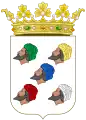 Coat of arms | |
  Baena 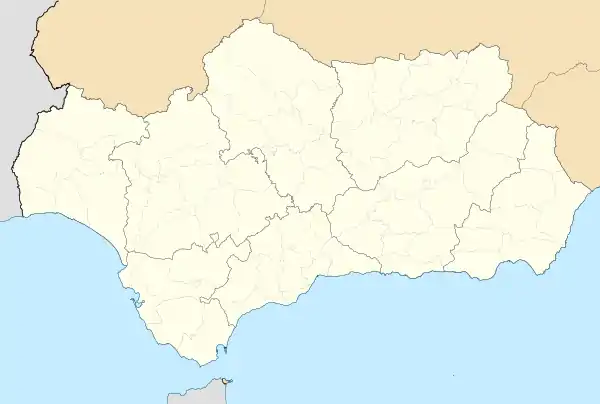 Baena | |
| Coordinates: 37°37′10″N 4°19′34″W / 37.61944°N 4.32611°W | |
| Country | Spain |
| Autonomous community | Andalusia |
| Province | Córdoba |
| Comarca | Campiña de Baena |
| Government | |
| • Mayor | María Jesús Serrano Jiménez (PSOE) |
| Area | |
| • Total | 362.5 km2 (140.0 sq mi) |
| Elevation (AMSL) | 405 m (1,329 ft) |
| Population (2018)[1] | |
| • Total | 19,338 |
| • Density | 53/km2 (140/sq mi) |
| Time zone | UTC+1 (CET) |
| • Summer (DST) | UTC+2 (CEST (GMT +2)) |
| Postal code | 14850 |
| Area code | +34 (Spain) + 957 (Córdoba) |
| Website | Town Hall |
Baena is a town and municipality of Spain located in the province of Córdoba, Andalusia. It is situated near the river Marbella on the slope of a hill 52 kilometres (32 mi) southeast of Córdoba by road. The population of the town is 20,266 (2012).
History
The site of the Roman town (Baniana or Biniana)[2] could still be traced as late as the First World War, with various Roman antiquities excavated from the site.[3] In 1833, a subterranean vault was discovered, containing twelve cinerary urns with inscriptions commemorating members of the Pompeian family.[2]
Following the demise of the Caliphate of Córdoba, the town was ravaged by Berbers, bringing its prosperity to an end.[4]
Once conquered Córdoba, Ferdinand III rapidly acquired a number of towns in the Campiña—including Baena—in 1241, probably meeting no resistance.[5]
The hill is crowned by fortifications. In 1292, Nasrid Granada, ruled by Mahommed II, unsuccessfully besieged the citadel, which was held for Sancho IV;[3] the five Moorish heads in its coat-of-arms commemorates the occasion.[2] The castile was a base for Gonzalo de Cordova and was held in the 19th century by the Altamira family.[2] At that time, it held four parish churches and three schools conducted by sisters of charity. The girls' school held a high reputation in its province, despite not going beyond reading, writing, arithmetic, and religious instruction.[2] Its population was around 12,000 in the 1870s[2] and 15,000 by the turn of the century.[3] Grain and olive oil were the principal articles of commerce in the 19th century;[2] by the time of the First World War, horse-breeding and linen-weaving had also developed, despite the nearest railroad station being at Luque.[3]
At the beginning of the Spanish Civil War the town was the scenario of the Baena Massacre, a ruthless mass-execution of Spanish republicans where about 700 loyalists were murdered by the orders of rebel Colonel Sáenz de Buruaga.[6][7][8] Other estimates mention up to 2,000 victims following the brutal repression in Baena.[9]
High-quality olive oil continues to be the mainstay of the local economy. Sierras Subbéticas Natural Park is located to the south of the town.
Notable residents
References
- Citations
- ↑ Municipal Register of Spain 2018. National Statistics Institute.
- 1 2 3 4 5 6 7 8 9 EB (1878).
- 1 2 3 4 EB (1911).
- ↑ Martín Escudero 2002, p. 44.
- ↑ Martín Escudero 2002, p. 45.
- ↑ Sevilla FC Forum
- ↑ The massacre of Baena Archived 2015-09-24 at the Wayback Machine
- ↑ Paul Preston (2012). The Spanish Holocaust. New York: W. W. Norton & Company. ISBN 0-393-06476-X.
- ↑ No solo corrieron rios de sangre en Badajoz
- Bibliography
- Martín Escudero, Fátima (2002). "Baena en época islámica: fuentes, arqueología, documentos..." Arqueología y Territorio Medieval. Jaén: UJA Editorial. 9: 37–51. doi:10.17561/aytm.v9i0.1571. ISSN 1134-3184.
- Baena at andalucia.com
- Baynes, T. S., ed. (1878), , Encyclopædia Britannica, vol. 3 (9th ed.), New York: Charles Scribner's Sons, p. 229.
- Chisholm, Hugh, ed. (1911), , Encyclopædia Britannica, vol. 3 (11th ed.), Cambridge University Press, p. 191.

37°37′N 4°19′W / 37.617°N 4.317°W