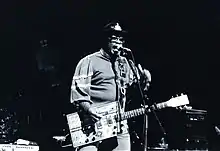
The Bo Diddley beat is a syncopated musical rhythm that is widely used in rock and roll and pop music.[1][2][3] The beat is named after rhythm and blues musician Bo Diddley, who introduced and popularized the beat with his self-titled debut single, "Bo Diddley", in 1955. The beat has been described as essentially the Afro-Cuban clave rhythm[4] or based on the clave[5][6] or a variation thereof.[7][8]
Music educator and author Michael Campbell explains that it "shows the relationship between Afro-Cuban music, Americanized Latin rhythms, and rock rhythm ... [The beats] are more active and complicated than a simple rock rhythm, but less complex than a real Afro-Cuban rhythm.[8]
History and composition

The Bo Diddley beat is a variation of the 3-2 clave, one of the most common bell patterns found in Afro-Cuban music that has been traced to sub-Saharan African music traditions.[10] It is also akin to the rhythmic pattern known as "shave and a haircut, two bits", that has been linked to Yoruba drumming from West Africa.[11] A folk tradition called "hambone", a style used by street performers who play out the beat by slapping and patting their arms, legs, chest, and cheeks while chanting rhymes has also been suggested.[12]
According to musician and author Ned Sublette, "In the context of the time, and especially those maracas [heard on the record], 'Bo Diddley' has to be understood as a Latin-tinged record. A rejected cut recorded at the same session was titled only 'Rhumba' on the track sheets."[13] Bo Diddley employed maracas, a percussion instrument used in Caribbean and Latin music, as a basic component of the sound.[11] Jerome Green was the maraca player on Diddley's early records, initially using the instrument as a more portable alternative to a drum set.[14] When asked how he began to use this rhythm, Bo Diddley gave many different accounts. In a 2005 interview with Rolling Stone magazine, he said that he came up with the beat after listening to gospel music in church when he was twelve years old.[14]
Use by other artists
Prior to Bo Diddley's self-titled song, the rhythm occurred in 13 rhythm and blues songs recorded between 1944 and 1955, including two by Johnny Otis from 1948.[15] In 1944, "Rum and Coca Cola", containing the beat, was recorded by the Andrews Sisters[9] and in 1952, a song with similar syncopation, "Hambone", was recorded by Red Saunders' Orchestra with the Hambone Kids.
Later, the beat was included in many songs composed by artists other than Bo Diddley:
- "I Wish You Would" by Billy Boy Arnold (1955)[11]
- "Not Fade Away" by Buddy Holly (1957)[16][17][18]
- "Cannonball" by Duane Eddy (1958)[11][18][19]
- "Willie and the Hand Jive" by Johnny Otis (1958)[18][20]
- "Hey Little Girl" by Dee Clark (1959)[21]
- "(Marie's the Name) His Latest Flame" by Elvis Presley (1961)[17][18][20]
- "Mickey's Monkey" by the Miracles (1963)[20][19]
- "When the Lovelight Starts Shining Through His Eyes" by the Supremes (1963)[20][19]
- "Rosalyn" by Pretty Things (1964)[19]
- "Don't Doubt Yourself, Babe" by the Byrds (1965)[19]
- "Mystic Eyes" by Them (1965)[9]
- "I Want Candy" by the Strangeloves (1965)[18][20][19]
- "Please Go Home" by the Rolling Stones (1966)[22][19]
- "Bummer in the Summer" by Love (1967)[23]
- "Get Me to the World on Time" by the Electric Prunes (1967)[20]
- "She Has Funny Cars" by Jefferson Airplane (1967)[24]
- "Magic Bus" by the Who (1968)[17][18][20][19]
- "1969" by the Stooges[18][19]
- "Panic in Detroit" by David Bowie (1973)[18][20][19]
- "Shame, Shame, Shame" by Shirley & Company (1974)[20]
- "New York Groove" by Hello (1975)[25]
- "Billy Bones and the White Bird" by Elton John (1975)[26]
- "She's the One" by Bruce Springsteen (1975)[17][18][20][19]
- "Bad Blood" by Neil Sedaka (1975)[19]
- "American Girl" by Tom Petty and the Heartbreakers (1977)[17]
- "Hateful" by the Clash (1979)[20]
- "Cuban Slide" by the Pretenders (1980)[11]
- "What A Blow" by Ian Gomm (1980)
- "Europa and the Pirate Twins" by Thomas Dolby (1981)[20]
- "Don't Let Him Go" by REO Speedwagon (1981)[19]
- "How Soon Is Now?" by the Smiths (1985) (Diddley-style tremolo)[18][27]
- "Mr. Brownstone" by Guns N' Roses (1987)[18][19]
- "Faith" by George Michael (1987)[17][20][19]
- "Ruby Dear" by Talking Heads (1988) [28]
- "Desire" by U2 (1988)[18][20][19]
- "Movin' On Up" by Primal Scream (1991)[29]
- "Tribal Thunder" by Dick Dale and the Del-Tones (1993)[20]
- "No One to Run With" by the Allman Brothers Band (1994)[30]
- "Party at the Leper Colony" by Weird Al Yankovic (2003)[31]
- "That Big 5-0" by Stan Ridgway (2004)[27]
- "Black Horse and the Cherry Tree" by KT Tunstall (2005)[19]
- "If It's Lovin' that You Want" by Rihanna (2005)[19]
- "At the Bottom of the Ocean" by Ezra Furman (2013)[32]
- "Water Fountain" by Tune-Yards (2014)[33]
- "Fool For Love" by Lord Huron (2015)[34]
References
- ↑ Brown, Jonathan (June 3, 2008). "Bo Diddley, Guitarist Who Inspired the Beatles and the Stones, Dies Aged 79". Independent.co.uk. Retrieved April 26, 2012.
- ↑ "Bo Diddley". Rock and Roll Hall of Fame. Retrieved October 27, 2008.
- ↑ "Bo Diddley". Rollingstone.com. 2001. Retrieved April 26, 2012.
- ↑ Thomakos, John (2010). "Bo Diddley Beat". The Drum Set Styles Encyclopedia. Mel Bay Publications. p. 67. ISBN 978-1610652193.
The heart of this [Bo Diddley beat] trademark groove is essentially a 3-2 clave rhythm, played with a strong swing.
- ↑ Martin, Andrew R.; Mihalka, Matthew (2020). Music Around the World: A Global Encyclopedia. Santa Barbara, California: ABC-CLIO. p. 179. ISBN 978-1610694995.
Bo Diddley's 1955 self-titled track featuring the 'Bo Diddley Beat' that was based on the clave rhythm.
- ↑ Roscetti, Ed (2008). Stuff! Good Drummers Should Know: An A to Z Guide to Getting Better. Hal Leonard. p. 16.
the Bo Diddley beat, based on the rumba or clave rhythm
- ↑ Horne, Greg (2000). Intermediate Acoustic Guitar. Alfred Publishing. p. 38. ISBN 0-7390-0426-3.
The Bo Diddley Beat – This is a variation of the clave made famous by Bo Diddley.
- 1 2 Campbell, Michael (2009). Popular Music in America: And the Beat Goes On (3rd ed.). Boston, Massachusetts: Cengage Learning. p. 167. ISBN 978-0-495-50530-3.
- 1 2 3 Hicks, Michael (2000). Sixties Rock. p. 36. ISBN 978-0-252-06915-4.
- ↑ Peñalosa, David (2010). The Clave Matrix; Afro-Cuban Rhythm: Its Principles and African Origins. Redway, California: Bembe Books. p. 244. ISBN 1-886502-80-3.
- 1 2 3 4 5 McDonald, Sam (September 7, 2005). "CHUNKA – CHUNKA – CHUNK A – CHUNK–CHUNK". Dailypress.com. Retrieved December 8, 2015.
- ↑ Roscetti, Ed (2008). Stuff! Good Drummers Should Know. Hal Leonard. p. 16. ISBN 1-4234-2848-X.
- ↑ Sublette, Ned (2007). The Kingsmen and the Cha-Cha-Chá. Duke University Press. p. 83. ISBN 0822340410.
- 1 2 Strauss, Neil (August 25, 2005). "The Indestructible Beat of Bo Diddley". Rollingstone.com. Retrieved December 8, 2015.
- ↑ Tamlyn, Garry Neville (March 1998). The Big Beat: Origins and Development of Snare Backbeat and other Accompanimental Rhythms in Rock'n'Roll (PDF) (Thesis). University of Liverpool. p. 284. Retrieved August 4, 2014.
- ↑ Rosen, Steven (March 16, 2011). "Behind the Song: 'Not Fade Away'". Americansongwriter.com. Retrieved November 22, 2016.
- 1 2 3 4 5 6 Dean, Bill (June 2, 2008). "Rock Pioneer Bo Diddley Dies". Gainesville.com. Retrieved June 17, 2018.
- 1 2 3 4 5 6 7 8 9 10 11 12 Kot, Greg (June 2, 2008). "Bo Diddley Dead at 79". Chicagotribune.com. Retrieved July 14, 2018.
- 1 2 3 4 5 6 7 8 9 10 11 12 13 14 15 16 17 18 Allen, Jim (February 1, 2022). "Tracing the Bo Diddley Beat". Uiscovermusic.com. Retrieved July 29, 2022.
- 1 2 3 4 5 6 7 8 9 10 11 12 13 14 15 Ratliff, Ben (June 3, 2008). "Bo Diddley: The Beat That Will Go On". Nytimes.com. Retrieved August 27, 2017.
- ↑ Aquila, Richard (2016). Let's Rock!: How 1950s America Created Elvis and the Rock and Roll Craze. Lanham, Maryland: Rowman & Littlefield. p. 232. ISBN 978-1442269378.
- ↑ Unterberger, Richie. "The Rolling Stones: Flowers – Review". AllMusic. Retrieved June 17, 2018.
- ↑ Fremer, Michael (December 26, 2021). "Love's 'Forever Changes' Finally Gets Long Deserved First Class Vinyl Reissue". Analogplanet.com. Archived from the original on 2012-12-30. Retrieved May 26, 2021.
- ↑ Greenwald, Matthew. "Jefferson Airplane: 'She Has Funny Cars' – Review". AllMusic. Retrieved June 17, 2018.
- ↑ Barton, Geoff (September 24, 2016). "The Story Behind The Song: Ace Frehley's New York Groove – Classic Rock". Teamrock.com. Retrieved November 22, 2016.
- ↑ Planer, Lindsay. "Elton John: Rock of the Westies – Review". AllMusic. Retrieved April 1, 2021.
- 1 2 Harris, John (2010). Hail! Hail! Rock'n'Roll: The Ultimate Guide to the Music, the Myths and the Madness. Hachette. p. 149. ISBN 0748114866. Retrieved July 5, 2012 – via Google.com.
- ↑ Pareles, Jon. "RECORDINGS; Talking Heads Confronts the Modern World". nytimes.com. Retrieved December 15, 2022.
- ↑ Swanson, Dave. "When Primal Scream Created Their Own World With "Screamadelica"". Diffuser.fm. Retrieved June 30, 2019.
- ↑ Eder, Bruce. "Allman Brothers Band: "Where It All Begins" – Review". AllMusic. Retrieved October 20, 2017.
- ↑ Cunnigham, Jen. "10 Times 'Weird Al' Parodied Pre-1980s Hits (And Was Awesome): 10) 'Party at the Leper Colony' (2003)". Rebeatmag.com. Retrieved February 22, 2022.
- ↑ Jack, Malcolm (February 13, 2014). "Ezra Furman – Review". Theguardian.com. ISSN 0261-3077. Retrieved December 15, 2018.
- ↑ Hann, Michael (March 18, 2014). "Tune-Yards Comes Back with Water Fountain". Theguardian.com. Retrieved January 27, 2021.
- ↑ Block, Melissa. "Lord Huron Wants You to Dance at the Apocalypse". NPR.org. Retrieved April 1, 2021.