Gruta da Furninha | |
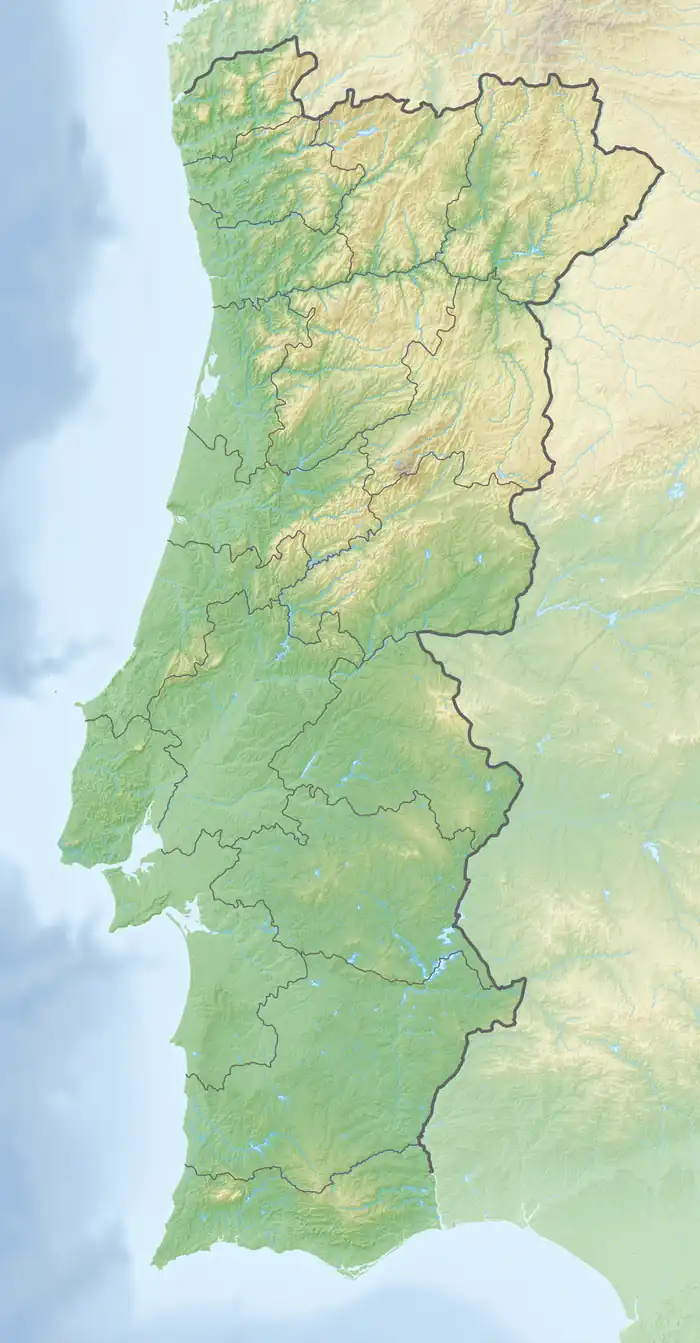 .svg.png.webp) Location in Portugal | |
| Alternative name | Dominique's cave |
|---|---|
| Coordinates | 39°21′21″N 9°24′4″W / 39.35583°N 9.40111°W |
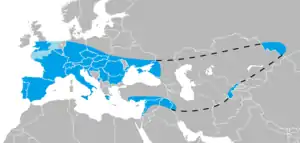
Furninha, also known as Dominique's cave, is a natural cave on the southern slope of the Peniche peninsula in Portugal. The cave is situated on the cliffs between the Peniche Fortress and the Cape Carvoeiro.[1][2][3] [4][5] The cave is located furthest west of any Neanderthal site. Neanderthals became extinct over 40,000 years ago.[6][7][8] The cave was also inhabited by modern humans during the Neolithic.[9][10][11]
History
Furninha was explored by Nery Delgado at the end of the 19th century.[12][13] Delgado demonstrated the caves' history of habitation by Neanderthals.[14] Delgado's excavation revealed the existence of animal occupation during the Lower Paleolithic , Neanderthal presence during the Middle Paleolithic, and the presence of Homo sapiens at the end of Chalcolithic.[15][16] Delgado also reports the practice of anthropophagy by the Neanderthals of Furninha who, despite the proximity of the sea, were mainly hunters.[17][18] The collection of remains gathered by Delgado was deposited in a Lisbon museum.[19]
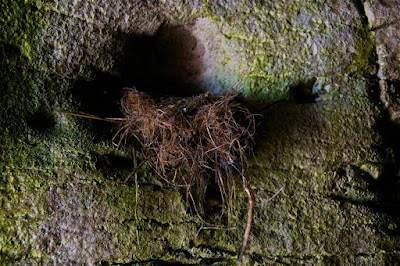
Observation of a number of photographs from Furninha reveals the existence of a thin film of flora. This flora is believed to be in close relation with fungi, and displays intense colors of green, yellow and red zones.[20][21]
The walls of the cave are covered with nutrients generated by the mixing of rain waters dropping through the vent of the vault with droplets of seawater entering the cave. [22]
In popular culture
- As a record of collective memory, the cave is known as the Cave of Dominique. Dominique was supposedly the name of an elusive robber who took refuge in Furninha.
- The Furninha cave is associated with the "Legend of a love in Peniche".[23]
References
- ↑ "Peniche Fortress". www.cm-peniche.pt. Archived from the original on 2017-11-07. Retrieved 2017-11-01.
- ↑ THE EVOLUTION OF THE COASTLINE AT PENICHE AND THE BERLENGAS ISLANDS (PORTUGAL) - STATE OF THE ART – article by Teresa Azevedo and Elisabete Nunes, Geology Center, Faculty of Sciences, Lisbon
- ↑ Portugal, TCP/ARPT Centro de. "Peniche, Portugal's geological paradise! • Centro de Portugal".
- ↑ "Furninha´s cave - Peniche guide". 9 January 2016.
- ↑ Map, The Megalithic Portal and Megalith. "Gruta da Furninha". The Megalithic Portal.
- ↑ The Middle-to-Upper Palaeolithic transition in Cova Gran (Catalunya, Spain) and the extinction of Neanderthals in the Iberian Peninsula – article by Jorge Martıínez-Moreno, Rafael Mora and Ignacio de la Torre at CENTRE D'ESTUDIS DEL PATRIMONI ARQUEOLÒGIC DE LA PREHISTÒRIA, Journal of Human Evolution 58 (2010) 211–226
- ↑ The Neanderthals: Evolution, Palaeoecology, and Extinction – paper by João Zilhão Archived 2020-10-11 at the Wayback Machine – print publication date: April 2014; online publication date: October 2013, DOI: 10.1093/oxfordhb/9780199551224.013.054
- ↑ Neanderthals disappeared from the Iberian Peninsula before than from the rest of Europe – news at Science Daily, February 5, 2015
- ↑ M. Kunst, in: M. Blech - M. Koch - M. Kunst, Denkmäler der Frühzeit, Hispania Antiqua (2001) 475 f. Ill. 205 a-d Pl. Farbtaf. 12 a. b.
- ↑ Gruta da Furninha at Megalithic (UK)
- ↑ Carlos Pimenta, Silvério Figueiredo and Marta Moreno, (pt) Pinguinus impennis (download pt) – read Abstract and see Pinguin and egg (great auk) found in Furninha, destroyed by fire: Pinguin and egg – photograph of a pre-historical emperor penguin found in Furninha by Delgado. This piece was destroyed by a fire in the Bocage Museum (Setúbal)
- ↑ J. E. Nery Delgado, La grotte de Furninha à Peniche, in: Congrès International d'Anthropologie et d'Archéologie Préhistorique, Compte Rendu de la 9ème Session à Lisbonne 1880 (1884) ; Read full text in French
- ↑ Nery Delgado Archived 2017-11-07 at the Wayback Machine biographical note
- ↑ Revista Portuguesa de Arqueologia (download with an appropriate browser) : See reference to Delgado's work in the abstract of the paper on Pinguinus impennis
- ↑ The Complex Carnivore Rich Assemblages from Furninha (Peniche, Portugal): a Multidisciplinary Approach Archived 2017-11-07 at the Wayback Machine, Journal of Taphonomy, VOLUME 10 (ISSUE 3-4), 2012
- ↑ "The Complex Carnivore-rich Assemblages from Furninha (Peniche, Portugal): a Multidisciplinary Approach" (PDF). Journal of Taphonomy.
- ↑ Hunters of the Golden Age – article by João Zilhão Archived 2017-02-02 at the Wayback Machine published by the University of Bristol
- ↑ "João Zilhão - Google Scholar Citations". scholar.google.com.
- ↑ Museu Geológico
- ↑ Picture of an unidentified plant (NOTE: the plant resembles a bunch of leafless gray branches whose roots penetrate into tiny cavities in the rock, as if they were feeding on nutrients concentrated in these small holes)
- ↑ "What Plants Can Live in Caves?". Caveslime.
- ↑ The film Arribas Archived 2017-06-05 at the Wayback Machine highlights the colors of the interior of the cave, the surprising harmony of its natural architecture and enacts aspects of the daily life of Neanderthals in a sequence of about three minutes
- ↑ (pt) Lenda dos Passos de Dona Leonor Archived 2017-11-07 at the Wayback Machine (The Legend of Dona Leonor's steps)
External links
- J. E. Nery Delgado, La grotte de Furninha à Peniche at Archive.org
- The Furninha cave at PhotoArch
- The Furninha cave at Pinturas em Peniche
- Human Origin Sites and the World Heritage Convention in Eurasia – published in 2015 by the United Nations Educational, Scientific and Cultural Organization
- Pleistocene Birds of Gruta da Furninha (Peniche-Portugal) : A Paleontological and Paleoenvironmental Aproach [sic] paper at Research Gate
| Taxonomy (Hominins) |
| ||||||||||||||||||||||||||
|---|---|---|---|---|---|---|---|---|---|---|---|---|---|---|---|---|---|---|---|---|---|---|---|---|---|---|---|
| Ancestors |
| ||||||||||||||||||||||||||
| Models |
| ||||||||||||||||||||||||||
| Timelines |
| ||||||||||||||||||||||||||
| Others |
| ||||||||||||||||||||||||||
| |||||||||||||||||||||||||||