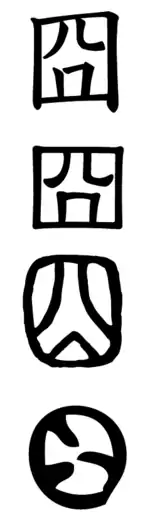
Jiong (Chinese: 囧; pinyin: jiǒng; Jyutping: gwing2) is a once obscure Chinese character meaning a "patterned window".[1] Since 2008, it has become an internet phenomenon and widely used to express embarrassment and gloom, because of the character's resemblance to a sad facial expression.[2]
Original meanings
- Window, according to Xu Shen's 2nd-century dictionary Shuowen Jiezi: “窻牖麗廔闓明” (an open and light window).
- Granary. 米囧 means “put the new rice into a granary”.
- Sacrificial place. Based on Chouli.
- Toponym.
Internet emoticon

The character for jiong is nowadays more widely used on the Internet as an ideographic emoticon representing a range of moods, as it resembles a person's face. It is commonly used to express ideas or feelings such as annoyance, shock, embarrassment, awkwardness, etc.
The use of jiong as an emoticon can be traced to 2005 or earlier; it was referenced on 20 January 2005 in a Chinese-language article on orz.[3] The character is sometimes used in conjunction with orz, OTZ or its other variants to form "囧rz", representing a person on their hands and knees (jiong forming the face, while r and z represent arms and legs respectively) and symbolising despair or failure.
Encoding
The character is included in Unicode at U+56E7 (囧).[4] Unicode also includes U+518F (冏), which is considered a variant.[5]
| Preview | 囧 | 冏 | ||
|---|---|---|---|---|
| Unicode name | CJK UNIFIED IDEOGRAPH-56E7 | CJK UNIFIED IDEOGRAPH-518F | ||
| Encodings | decimal | hex | dec | hex |
| Unicode | 22247 | U+56E7 | 20879 | U+518F |
| UTF-8 | 229 155 167 | E5 9B A7 | 229 134 143 | E5 86 8F |
| Numeric character reference | 囧 | 囧 | 冏 | 冏 |
| Shift JIS[6] | 153 103 | 99 67 | ||
| EUC-JP[7] | 143 182 250 | 8F B6 FA | 209 200 | D1 C8 |
| GBK / GB 18030[8] | 135 229 | 87 E5 | 131 215 | 83 D7 |
| KPS 9566-2011[9] | 200 130 | C8 82 | ||
| Big5[10] | 202 168 | CA A8 | 202 106 | CA 6A |
| EUC-TW[11][12] | 142 162 163 200 | 8E A2 A3 C8 | 142 162 163 172 | 8E A2 A3 AC |
| CCCII / EACC[4][13][14] | 33 115 119 | 21 73 77 | 33 105 110 | 21 69 6E |
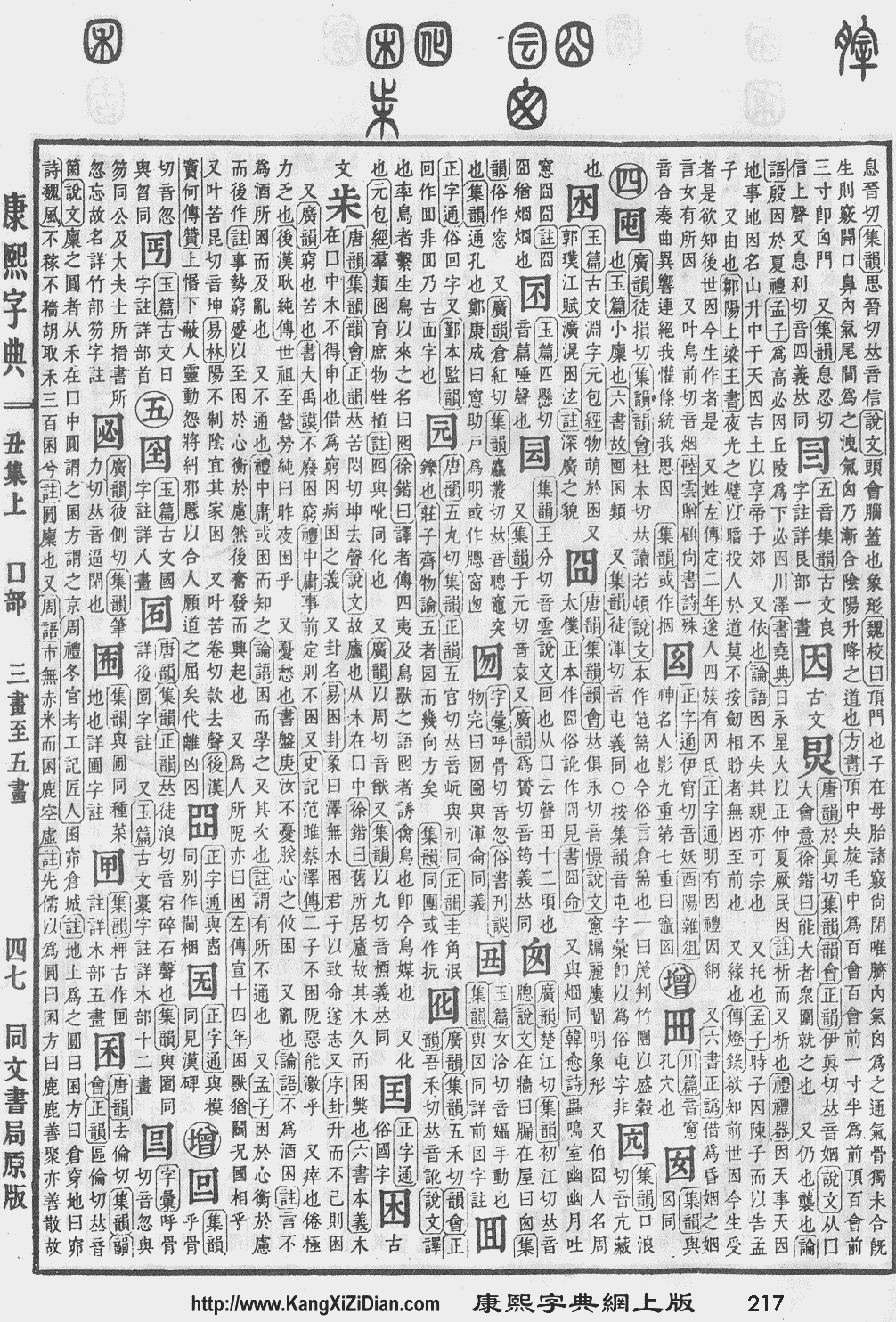
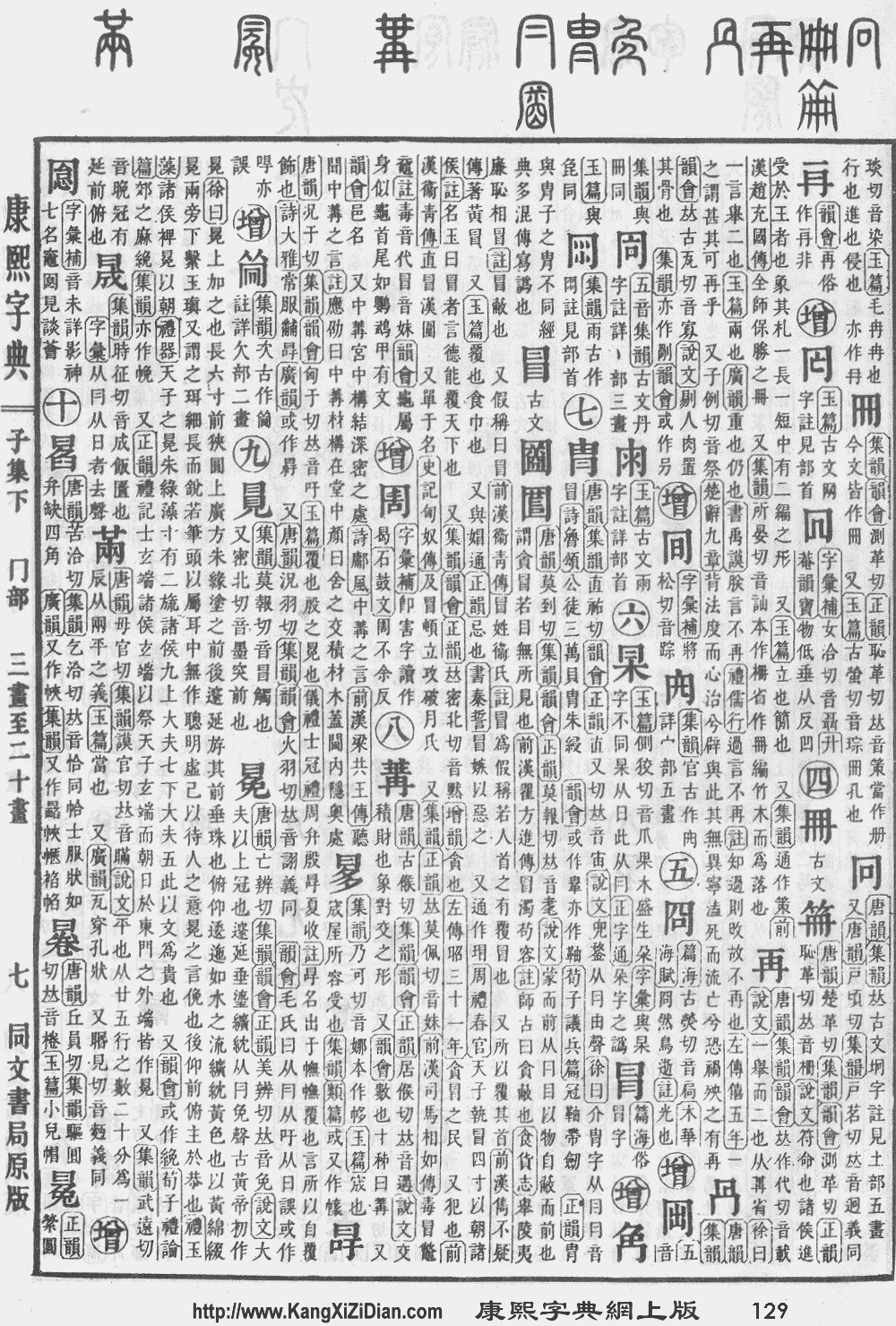
| Kangxi Dictionary reference[15][16] | Page 217, character 10 | Page 129, character 12 | ||
References
- ↑ Li & Li 2014, pp. 252–3.
- ↑ Hammond & Richey 2014, p. 141.
- ↑ "心情很orz嗎? 網路象形文字幽默一下". NOWnews.com. Archived from the original on 2012-11-15. Retrieved 2013-03-14.
- 1 2 "Unihan data for U+56E7". Unicode Consortium.
- ↑ "Unihan data for U+56E7". Unicode Consortium.
kKoreanName 2015:U+518F 冏
- ↑ Unicode Consortium (2015-12-02) [1994-03-08]. "Shift-JIS to Unicode".
- ↑ Unicode Consortium; IBM. "EUC-JP-2007". International Components for Unicode.
- ↑ Standardization Administration of China (SAC) (2005-11-18). GB 18030-2005: Information Technology—Chinese coded character set.
- ↑ Chung, Jaemin (2018-01-05). "Information on the most recent version of KPS 9566 (KPS 9566-2011?)" (PDF). UTC L2/18-011.
- ↑ van Kesteren, Anne. "big5". Encoding Standard. WHATWG.
- ↑ "[囧] 2-2348". CNS 11643 Word Information. National Development Council.
- ↑ "[冏] 2-232C". CNS 11643 Word Information. National Development Council.
- ↑ "Unihan data for U+518F". Unicode Consortium.
- ↑ "EACC to Unicode". Library of Congress.
- ↑ "Page 217". Kangxi Dictionary.
- ↑ "Page 129". Kangxi Dictionary.
Bibliography
- Hammond, Kenneth J.; Richey, Jeffrey L. (3 December 2014). The Sage Returns: Confucian Revival in Contemporary China. SUNY Press. ISBN 978-1-4384-5493-1.
- Li, Yuming; Li, Wei (1 April 2014). The Language Situation in China. De Gruyter. ISBN 978-1-61451-365-0.
- Ru, Xin; Lu, Xueyi; Li, Peilin (25 March 2010). The China Society Yearbook. BRILL. ISBN 978-90-04-18221-9.