| Solar eclipse of October 11, 1931 | |
|---|---|
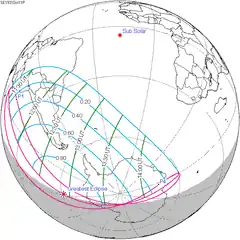 Map | |
| Type of eclipse | |
| Nature | Partial |
| Gamma | −1.0607 |
| Magnitude | 0.9005 |
| Maximum eclipse | |
| Coordinates | 61°12′S 119°30′W / 61.2°S 119.5°W |
| Times (UTC) | |
| Greatest eclipse | 12:55:40 |
| References | |
| Saros | 152 (8 of 70) |
| Catalog # (SE5000) | 9354 |
A partial solar eclipse occurred on October 11, 1931. A solar eclipse occurs when the Moon passes between Earth and the Sun, thereby totally or partly obscuring the image of the Sun for a viewer on Earth. A partial solar eclipse occurs in the polar regions of the Earth when the center of the Moon's shadow misses the Earth. This event was visible as a partial solar eclipse from southern South America, and parts of Antarctica.
Related eclipses
Solar eclipses 1928–1931
This eclipse is a member of a semester series. An eclipse in a semester series of solar eclipses repeats approximately every 177 days and 4 hours (a semester) at alternating nodes of the Moon's orbit.[1]
| Solar eclipse series sets from 1928–1931 | ||||
|---|---|---|---|---|
| Ascending node | Descending node | |||
| 117 | May 19, 1928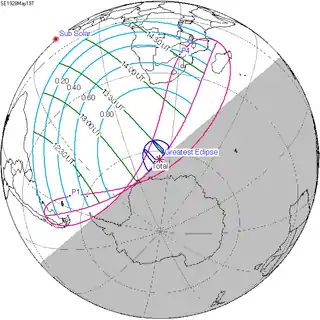 Total (non-central) |
122 | November 12, 1928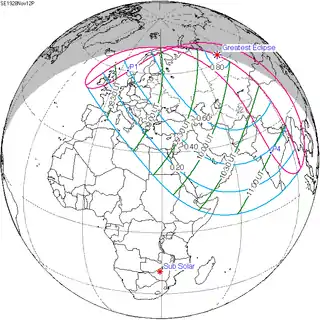 Partial | |
| 127 | May 9, 1929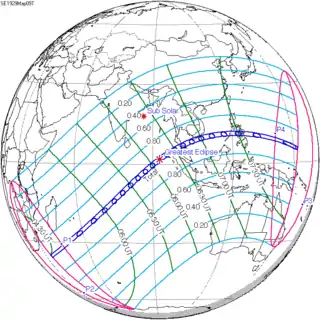 Total |
132 | November 1, 1929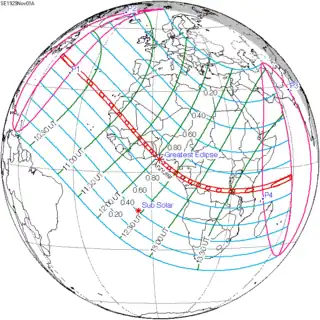 Annular | |
| 137 | April 28, 1930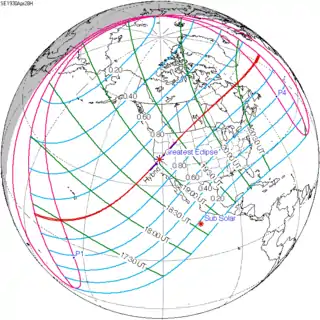 Hybrid |
142 | October 21, 1930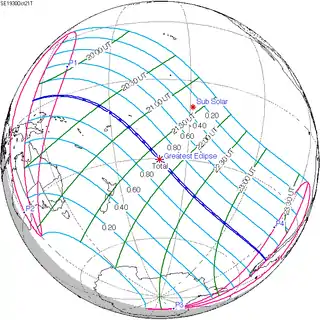 Total | |
| 147 | April 18, 1931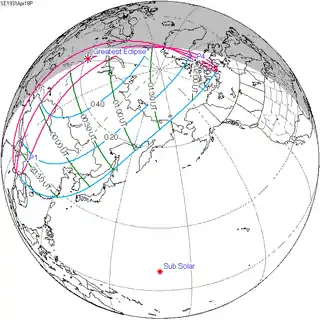 Partial |
152 | October 11, 1931 Partial | |
Notes
- ↑ van Gent, R.H. "Solar- and Lunar-Eclipse Predictions from Antiquity to the Present". A Catalogue of Eclipse Cycles. Utrecht University. Retrieved 6 October 2018.
References
- Earth visibility chart and eclipse statistics Eclipse Predictions by Fred Espenak, NASA/GSFC
External links
.jpg.webp)



This article is issued from Wikipedia. The text is licensed under Creative Commons - Attribution - Sharealike. Additional terms may apply for the media files.