Sthulabhadra | |
|---|---|
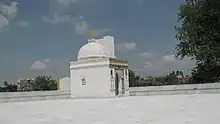 Sthulabhadra Jain temple in Kamaldah, Patna | |
| Personal | |
| Religion | Jainism |
| Parent |
|
| Sect | Shwetambara |
| Part of a series on |
| Jainism |
|---|
 |

Sthulabhadra (297-198 BCE) was the prominent Jain Acharya in third or fourth-century BC. He was a disciple of Bhadrabahu and Sambhutavijaya. His father was Sakatala, a minister in Nanda kingdom before the arrival of Chandragupta Maurya. When his brother became the chief minister of the kingdom, Sthulabhadra became a Jain monk. He is mentioned in the 12th-century Jain text by Hemachandra.
Life
Sthulabhadra was a son of the Dhana Nanda's minister Sakatala and brother of Shrikaya.[1][2] He is traditionally dated in 297 to 198 BCE.[1] He loved and lived with a royal dancer in Dhana Nanda's court named Rupkosa.[1][2] He denied ministry after the death of his father and became a Jain monk.[3] His brother became the chief minister in Nanda empire later.[4][2] He became a disciple of Sambhutavijaya (347-257 BCE) and Bhadrabahu (322-243 BCE).[5][2][6] He led an ascetic life for 12 years.[4] He spent his chaturmas at Rupkosa's home, during which she tried to lure him away from ascetic life but failed.[4] Sthulabhadra in turn gave her vows of a Shravika (Jain laywoman).[4]
He is said to have learned the 14 purvas (pre-canons) from Bhadrabahu and is considered as last Shrut Kevali(all knower of Jain Scriptures) in Svetambara tradition, a claim which is rejected by Digambara tradition.[4] He was succeeded by his disciples Mahagiri and Suhasti.[4][7] Digambara texts state that Sthulabhadra permitted the use loincloth during the 12-year famine, a practice that started the Svetambara order, but is considered as baseless according Shwetambara Sect.[8][9] He is mentioned in the 12th-century Jain text by Hemachandra.[2]
References
Citations
- 1 2 3 Natubhai Shah 2004, p. 42.
- 1 2 3 4 5 Hemacandra 1998, pp. 155, 169, 194–200.
- ↑ Upinder Singh 2016, p. 273.
- 1 2 3 4 5 6 Natubhai Shah 2004, p. 43.
- ↑ Natubhai Shah 2004, pp. 42–43.
- ↑ Arya Sthulibhadra By Vijaya Nityānanda Sūri, Cidānanda Vijaya
- ↑ Jain Dharma ka Maulik Itihas, Acharya Hastimal, 1974, Part 2, p. 383-440
- ↑ "Digambara", britannica.com
- ↑ Sthulabhadra, Ganesh Lalwani, Jain Journal, April 1985, p. 152
Sources
- Hemacandra (1998), The Lives of the Jain Elders, translated by Fynes, Richard, Oxford University Press, ISBN 978-0-19-283227-6
- Shah, Natubhai (2004) [First published in 1998], Jainism: The World of Conquerors, vol. I, Motilal Banarsidass, ISBN 978-81-208-1938-2
- Singh, Upinder (2016), A History of Ancient and Early Medieval India: From the Stone Age to the 12th Century, Pearson PLC, ISBN 978-81-317-1677-9
| Gods | |||||
|---|---|---|---|---|---|
| Philosophy | |||||
| Branches |
| ||||
| Practices | |||||
| Literature | |||||
| Symbols | |||||
| Ascetics | |||||
| Scholars | |||||
| Community | |||||
| Jainism in |
| ||||
| Jainism and | |||||
| Dynasties and empires | |||||
| Related | |||||
| Lists | |||||
| Navboxes |
| ||||