Detarioideae
Detarioideae é uma subfamília de plantas com flor da família Fabaceae (leguminosas), que inclui 84 géneros, com 735 até 771 espécies, a maioria dos quais nativos das regiões tropicais da África e Ásia. Algumas espécies pertencentes a este grupo apresentam elevada importância económica como produtoras de madeira.
| Detarioideae | |||||||||||||||
|---|---|---|---|---|---|---|---|---|---|---|---|---|---|---|---|
| Classificação científica | |||||||||||||||
| |||||||||||||||
| Género-tipo | |||||||||||||||
| Detarium Juss. | |||||||||||||||
| Tribos e géneros | |||||||||||||||
| Ver texto. | |||||||||||||||
| Sinónimos | |||||||||||||||
| |||||||||||||||
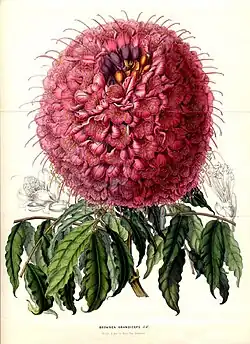

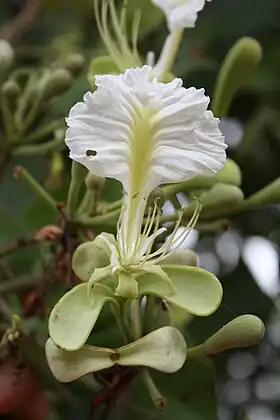
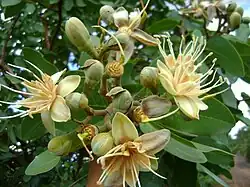
Descrição
A subfamília Detarioideae inclui muitas árvores tropicais, algumas das quais são usadas para produção de madeira ou têm importância ecológica nas florestas da sua região de distribuição natural. A subfamília é composta por 84 géneros, com 735 até 771 espécies, a maioria dos quais são nativos da África e da Ásia.
As espécies Amherstia nobilis e Tamarindus indica (tamarindo) são duas das espécies mais notáveis incluídas em Detarioideae.
A subfamília Detarioideae é circunscrita de acordo com a seguinte definição cladística: «o clado coroa mais inclusivo que contém Goniorrhachis marginata Taub. e Aphanocalyx cynometroides Oliv., mas exclui Cercis canadensis L., Duparquetia orchidacea Baill. ou Bobgunnia fistuloides (Harms) J. H. Kirkbr. & Wiersema».[1]
Taxonomia e filogenia
A posição sistemática do grupo com a presente circunscrição, determinada pelas técnicas da filogenia molecular, sugere a seguinte árvore evolucionária:[2][3][4][5][6][7][8]
| Polygalaceae | |||||||||||||||||||||||||||||||
| Surianaceae | |||||||||||||||||||||||||||||||
| Fabales | |||||||||||||||||||||||||||||||
| Quillajaceae | |||||||||||||||||||||||||||||||
| Cercidoideae | |||||||||||||||||||||||||||||||
| Detarioideae | |||||||||||||||||||||||||||||||
| Fabaceae | |||||||||||||||||||||||||||||||
| Duparquetioideae | |||||||||||||||||||||||||||||||
| Dialioideae | |||||||||||||||||||||||||||||||
| Caesalpinioideae | |||||||||||||||||||||||||||||||
| Faboideae | |||||||||||||||||||||||||||||||
A subfamília Detarioideae compreende as seguintes tribos e géneros:[1][9]
- Tribo Schotieae
- Schotia Jacq.
- Tribo Barnebydendreae
- Barnebydendron J.H.Kirkbr.
- Goniorrhachis Taub.
- Tribo Detarieae
- Augouardia Pellegr.
- Baikiaea Benth.
- Brandzeia Baill.
- Colophospermum J. Kirk ex J. Léonard
- Copaifera L.
- Daniellia Benn.
- Detarium Juss.
- Eperua Aubl.
- Eurypetalum Harms
- Gilletiodendron Vermoesen
- Guibourtia Benn.
- Hardwickia Roxb.
- Hylodendron Taub.
- Hymenaea L.
- Neoapaloxylon Rauschert
- Peltogyne Vogel
- Prioria Griseb.
- Sindora Miq.
- Sindoropsis J. Léonard
- Stemonocoleus Harms
- Tessmannia Harms
- Tribo Saraceae
- Endertia Steenis & de Wit
- Leucostegane Prain
- Lysidice Hance
- Saraca L.
- Tribo Afzelieae
- Afzelia Sm.
- Brodriguesia R.S. Cowan
- Intsia Thouars
- Tribo Amherstieae
- Amherstia Wall.
- Annea Mackinder & Wieringa[10]
- Anthonotha P. Beauv.
- Aphanocalyx Oliver
- Berlinia Sol. ex Hook. f.
- Bikinia Wieringa
- Brachycylix (Harms) R.S. Cowan
- Brachystegia Benth.
- Brownea Jacq.
- Browneopsis Huber
- Crudia Schreb.
- Cryptosepalum Benth.
- Cynometra L.
- Dicymbe Spruce ex Benth. & Hook. f.
- Didelotia Baill.
- Ecuadendron D.A. Neill
- Elizabetha Schomb. ex Benth.
- EnglerodendronHarms
- Gabonius Wieringa & Mackinder[11]
- Gilbertiodendron J. Léonard
- Heterostemon Desf.
- Humboldtia Vahl
- Hymenostegia (Benth.) Harms
- Icuria Wieringa
- Isoberlinia Craib & Stapf ex Holland
- Isomacrolobium Aubrév. & Pellegr.[12]
- Julbernardia Pellegr.
- Lebruniodendron J. Léonard
- Leonardoxa Aubrév.
- Librevillea Hoyle
- Loesenera Harms
- Macrolobium Schreb.
- Maniltoa Scheff.
- Michelsonia Hauman
- Micklethwaitia G.P. Lewis & Schrire
- Microberlinia A. Chev.
- Neochevalierodendron J. Léonard
- Normandiodendron J. Léonard
- Oddoniodendron De Wild.
- Paloue Aubl.
- Paloveopsis R.S. Cowan
- Paramacrolobium J.Léonard
- Plagiosiphon Harms
- Polystemonanthus Harms
- Pseudomacrolobium Hauman
- Scorodophloeus Harms
- Talbotiella Baker f.
- Tamarindus L.
- Tetraberlinia (Harms) Hauman
- Zenkerella Taub.
Detarioideae exibe as seguintes relações filogenéticas:[9][13][14][15][16][17]
| Fabales |
| |||||||||||||||||||||||||||||||||||||||||||||||||||||||||||||||||||||||||||||||||||||||||||||||||||||||||||||||||||||||||||||||||||||||||||||||||||||||||||||||||||||||||||||||||||||||||||||||||||||||||||||||||||||||||||||||||||||||||||||||||||||||||||||||||||||||||||||||||||||||||||||||||||||||||||||||||||||||||||||||||||||||||||||||||||||||||||||||||||||||||||||||||||||||||||||||||||||||||||||||||||||||||||
Referências
- The Legume Phylogeny Working Group (LPWG). (2017). «A new subfamily classification of the Leguminosae based on a taxonomically comprehensive phylogeny». Taxon. 66 (1): 44–77. doi:10.12705/661.3
- Bruneau A; Forest F; Herendeen PS; Klitgaard BB; Lewis GP (2001). «Phylogenetic Relationships in the Caesalpinioideae (Leguminosae) as Inferred from Chloroplast trnL Intron Sequences». Syst Bot. 26 (3): 487–514. doi:10.1043/0363-6445-26.3.487 (inativo 31 de janeiro de 2019)
- Miller JT; Grimes JW; Murphy DJ; Bayer RJ; Ladiges PY (2003). «A phylogenetic analysis of the Acacieae and Ingeae (Mimosoideae: Fabaceae) based on trnK, matK, psbA–trnH, and trnL/trnF sequence data». Syst Bot. 28 (3): 558–566. JSTOR 25063895. doi:10.1043/02-48.1 (inativo 31 de janeiro de 2019)
- Bruneau A; Mercure M; Lewis GP; Herendeen PS (2008). «Phylogenetic patterns and diversification in the caesalpinioid legumes». Botany. 86 (7): 697–718. doi:10.1139/B08-058
- Miller JT; Murphy DJ; Brown GK; Richardson DM; González-Orozco CE (2011). «The evolution and phylogenetic placement of invasive Australian Acacia species». Diversity and Distributions. 17 (5): 848–860. doi:10.1111/j.1472-4642.2011.00780.x
- Manzanilla V; Bruneau A (2012). «Phylogeny reconstruction in the Caesalpinieae grade (Leguminosae) based on duplicated copies of the sucrose synthase gene and plastid markers». Molecular Phylogenetics and Evolution. 65 (1): 149–162. PMID 22699157. doi:10.1016/j.ympev.2012.05.035
- LPWG [Legume Phylogeny Working Group] (2013). «Legume phylogeny and classification in the 21st century: Progress, prospects and lessons for other species-rich clades». Taxon. 62 (2): 217–248. doi:10.12705/622.8. hdl:10566/3455
- Miller JT; Seigler D; Mishler BD (2014). «A phylogenetic solution to the Acacia problem». Taxon. 63 (3): 653–658. doi:10.12705/633.2
- de la Estrella M, Forest F, Klitgård B, Lewis GP, Mackinder BA, de Queiroz LP, Wieringa JJ, Bruneau A. (2018). «A new phylogeny-based tribal classification of subfamily Detarioideae, an early branching clade of florally diverse tropical arborescent legumes». Scientific Reports. 8. 6884 páginas. PMC 5932001
 . doi:10.1038/s41598-018-24687-3
 - Mackinder BA, Wieringa JJ (2013). «Annea gen. nov. (Detarieae, Caesalpinioideae, Leguminosae), a home for two species long misplaced in Hymenostegia sensu lato». Phytotaxa. 142 (1): 1–14. doi:10.11646/phytotaxa.142.1.1
- Wieringa JJ, Mackinder BA, Van Proosdij ASJ (2013). «Gabonius gen. nov.(Leguminosae, Caesalpinioideae, Detarieae), a distant cousin of Hymenostegia endemic to Gabon». Phytotaxa. 142 (1): 15–24. doi:10.11646/phytotaxa.142.1.2
- Breteler FJ (2008). «Anthonotha and Isomacrolobium (Leguminosae, Caesalpinioideae): Two distinct genera». Systematics and Geography of Plants. 78 (2): 137–144. JSTOR 20649759
- Bruneau A, Forest F, Herendeen PS, Klitgaard BB, Lewis GP (2001). «Phylogenetic relationships in the Caesalpinioideae (Leguminosae) as inferred from chloroplast trnL intron sequences». Syst Bot. 26 (3): 487–514. doi:10.1043/0363-6445-26.3.487 (inativo 20 de julho de 2019)
- Bruneau A, Mercure M, Lewis GP, Herendeen PS (2008). «Phylogenetic patterns and diversification in the caesalpinioid legumes». Botany. 86 (7): 697–718. doi:10.1139/B08-058
- Cardoso D, Pennington RT, de Queiroz LP, Boatwright JS, Van Wykd BE, Wojciechowskie MF, Lavin M (2013). «Reconstructing the deep-branching relationships of the papilionoid legumes». S. Afr. J. Bot. 89: 58–75. doi:10.1016/j.sajb.2013.05.001
- de la Estrella M, Wieringa JJ, Mackinder B, van der Burgt X, Devesa JA, Bruneau A (2014). «Phylogenetic analysis of the African genus Gilbertiodendron J. Léonard and related genera (Leguminosae-Caesalpinioideae-Detarieae)». International Journal of Plant Sciences. 175 (9): 975–985. doi:10.1086/677648
- Mackinder BA, Saslis-Lagoudakis H, Wieringa JJ, Devey D, Forest F, Bruneau A (2013). «The tropical African legume Scorodophloeus clade includes two undescribed Hymenostegia segregate genera and Micklethwaitia, a rare, monospecific genus from Mozambique». S. Afr. J. Bot. 89: 156–163. doi:10.1016/j.sajb.2013.07.002
- Redden RM, Herendeen PS (2006). «Morphology and Phylogenetic Analysis of Paloue and Related Genera in the Brownea Clade (Detarieae, Caesalpinioideae)». 167. 167 (6): 1229–1246. doi:10.1086/508065
- Redden KM, Herendeen PS, Wurdack KJ, Bruneau A (2010). «Phylogenetic Relationships of the Northeastern South American Brownea Clade of Tribe Detarieae (Leguminosae: Caesalpinioideae) Based on Morphology and Molecular Data». Syst Bot. 35 (3): 524–533. doi:10.1600/036364410792495863