Bogosort
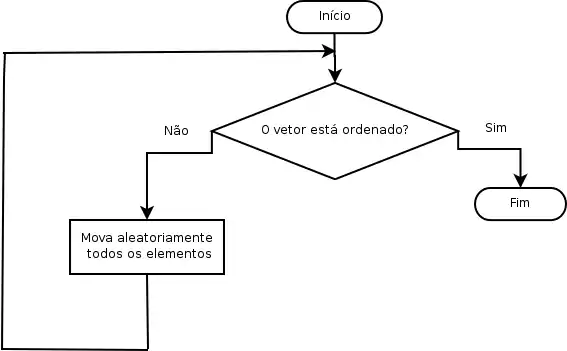
Bogosort (também conhecido como CaseSort ou Estou com Sort), é um algoritmo de ordenação extremamente ineficiente. É baseado na reordenação aleatória dos elementos. Não é utilizado na prática, mas pode ser usado no ensino de algoritmos mais eficientes. Seu nome veio do engraçado termo quantum bogodynamics e, ultimamente, a palavra bogus.
Esse algoritmo é probabilístico por natureza. Se todos os elementos a serem ordenados são distintos, a complexidade esperada é . O tempo exato de execução esperado depende do quantos diferentes valores de elementos ocorrem, e quantas vezes cada um deles ocorre, mas para casos não-triviais o tempo esperado de execução é exponencial ou super-exponencial a . Ele termina pela mesma razão do teorema do macaco infinito; existe alguma probabilidade de que aconteça a permutação correta, dado que em um infinito número de tentativas fatalmente a encontrará.


Deve-se notar que com os algoritmos geradores de números pseudo-aleatórios, que têm um número finito de estados e não são realmente aleatórios, o algoritmo pode nunca terminar para certos conjuntos de valores a serem ordenados.
Bogosort é um algoritmo de ordenação não estável.
Exemplo
Para se ordenar um baralho usando-se este Algoritmo, seria necessário jogar as cartas ao ar, juntá-las aleatoriamente, e então verificar se as mesmas estão ordenadas.
Algoritmo
função bogosort(array)
  enquanto não está_ordenado(array)
    array := permutação_aleatória(array)
Implementações
C
#include <stdio.h>
#include <stdlib.h>
#include <stdbool.h>

bool is_sorted(int *a, int n)
{
  while ( --n >= 1 ) {
    if ( a[n] < a[n-1] ) return false;
  }
  return true;
}

void shuffle(int *a, int n)
{
  int i, t, r;
  for(i=0; i < n; i++) {
    t = a[i];
    r = rand() % n;
    a[i] = a[r];
    a[r] = t;
  }
}

void bogosort(int *a, int n)
{
  while ( is_sorted(a, n) ) shuffle(a, n);
}

int main()
{
  int numbers[] = { 1, 10, 9,  7, 3, 0 };
  int i;

  bogosort(numbers, 6);
  for (i=0; i < 6; i++) printf("%d ", numbers[i]);
  printf("\n");
}
C++
 #include <algorithm>
 #include <vector>

 template<class T>
 void bogosort(std::vector<T>& array)
 {
     while (! is_sorted(array))
         std::random_shuffle(array.begin(), array.end());
 }

 template<class T>
 bool is_sorted(const std::vector<T>& array)
 {
     for (typename std::vector<T>::size_type i = 1; i < array.size(); ++i)
         if (array[i] < array[i-1]) return false;
     return true;
 }
Java
public static void bogoSort(int length, int range) {
	int []array = randomIntArray(length,range);

	while (! isSorted(array))
		array = randomArray(array);

	for (int i = 0; i < array.length; i++) {
		System.out.print(array[i] + " ");
	}

}

private static boolean isSorted(int [] array)
{
    for (int i = 0; i < (array.length - 1); ++i) {
    	if (array[i] > array[i+1])
    		return false;
    }

    return true;
}

private static int [] randomArray(int [] array) {

    int size = array.length;
    int[] indices = new int[size];
    for (int i=0; i<size; i++) {
    	indices[i] = i;
    }

    Random random = new Random();
    for (int i = 0; i < size; i++) {
      boolean unique = false;
      int nRandom = 0;
      while (!unique) {
        unique = true;
        nRandom = random.nextInt(size);
        for (int j = 0; j < i; j++) {
          if (indices[j] == nRandom) {
             unique = false;
             break;
          }
        }
      }

      indices[i] = nRandom;
    }

    int [] result = new int[size];
        for (int k = 0; k < size; k++) {
    result[indices[k]] = array[k];
    }

    return result;
}

private static int[] randomIntArray(int length, int n)
{
  int[] a = new int[length];
  Random generator = new Random();
  for (int i = 0; i < a.length; i++)
  {
      a[i] = generator.nextInt(n);
  }
  return a;
}
Pascal
 program bogosort (input, output);
 const max=10;   {*Tamanho do vetor *}
 type vetor=array[1..max] of integer;
 var lista, lista1: vetor;
     i: integer;
     j: boolean;
     pos: integer;

 	 function teste(var proto: vetor): boolean;     {*Verifica se o vetor NÃO está ordenado.*}
 	 var i: integer;
 	 begin
 		 teste:=true;
 		 for i:=2 to max do
 			 if (proto[i]<proto[i-1]) then
 				 break;
 		 if (i=max) and (proto[max]>=proto[max-1]) then
 			 teste:=false;
 	 end;

 begin
 	 randomize;    {*Inicializa o gerador de numeros aleatórios *}
 	 writeln('Escreva abaixo os ', max,' elementos do vetor:');
 	 for i:=1 to max do
 	 begin
 		 read(lista[i]);
 		 lista1[i]:=lista[i];
 	 end;
 	 for i:=1 to max do           {*Escreve o vetor recebido *}
 		 write(lista1[i],' ');
 	 writeln;
 	 while teste(lista1) do    {*Enquanto o vetor nao esta ordenado...*}
 	 begin
 		 j:=true;
 		 for i:=1 to max do     {*Inicializa o vetor auxiliar *}
 			 lista1[i]:=0;
 		 for i:=1 to max do   {* Este loop preenche aleatoriamente o vetor auxiliar *}
 		 begin
 			 j:=true;
 			 while j do {* Este while garante que nenhum dado será sobrescrito *}
 			 begin
 				 pos:= random(max)+1;    {* Gera posição aleatória *}
 				 if lista1[pos]=0 then     {*Garante que a posição não está ocupada *}
 				 begin
 	 				 lista1[pos]:=lista[i];
 					 j:=false;
 				 end;
 			 end;
 		 end;
 		 for i:=1 to max do	{* Imprime na tela a tentativa *}
 			 write(lista1[i],' ');
 		 writeln;
 	 end;
 	 write('A LISTA FOI ORDENADA!');
 end.
Perl
 use List::Util qw(shuffle);

 sub bogosort {
    my @a = @_;
    my @sorted = sort @a;
    while("@a" ne "@sorted") {
       @a = shuffle(@a);
    }
    return @a;
 }
Python
import random

def bogosort(nums):
    def isSorted(nums):
        if len(nums) < 2:
            return True
        for i in range(len(nums) - 1):
            if nums[i] > nums[i + 1]:
                return False
        return True

    while not isSorted(nums):
        random.shuffle(nums)
    return nums
num1 = input('Input  comma separated numbers:\n').strip()
nums = [int(item) for item in num1.split(',')]
print(bogosort(nums))
Ruby
def bogosort(seq)
 seq.shuffle! while not seq.each_cons(2).all? {|a,b| a <= b}
end
Ver também
Referências
- «Python Data Structures and Algorithms: Sort a list of elements using Bogosort sort». w3resource (em inglês). Consultado em 24 de setembro de 2021
Ligações externas
| Teoria |  | |
|---|---|---|
| Exchange sorts | ||
| Selection sorts | ||
| Insertion sorts | ||
| Merge sorts | ||
| Outros | Topological sorting | Sorting network | Bitonic sorter | Batcher odd-even mergesort | Pancake sorting | |
| Ordenações ineficientes/humorísticas | ||