Campanários da Bélgica e da França
Um conjunto de 56 campanários foi adicionado à lista de Patrimônio Mundial da UNESCO, em reconhecimento da manifestação arquitetônica na Flandres e nas regiões vizinhas, de influências feudais e religiosas, levando a um grau de democracia local de grande significado na história da humanidade.
Campanários da Bélgica e França ★
 | |
|---|---|
 Localização dos campanários | |
| Tipo | Cultural |
| Critérios | ii, iv |
| Referência | 943 |
| Região ♦ | Europa e América do Norte |
| Países | .svg.png.webp) Bélgica e Bélgica e  França França |
| Histórico de inscrição | |
| Inscrição | 1999 |
★ Nome usado na lista do Património Mundial ♦ Região segundo a classificação pela UNESCO | |
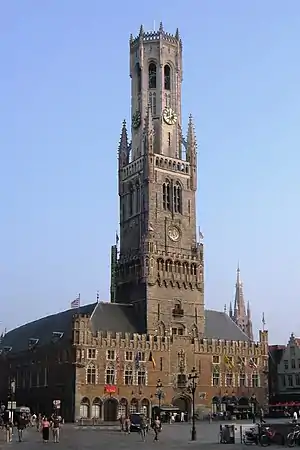
Campanário de Bruges.
.jpg.webp)
Catedral de Nossa Senhora, Antuérpia.
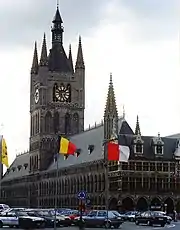
Cloth Hall, Ypres
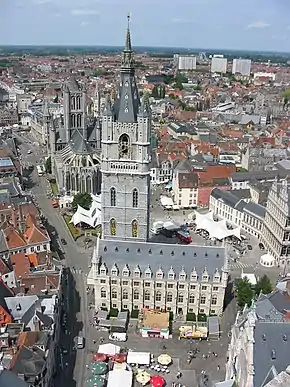
Campanário de Ghent.
Bélgica
Os números ID correspondem à ordem na lista completa ID 943/943bis da UNESCO, vejaLigações externas
Antuérpia
| ID 943-002 | Antuérpia | Catedral de Nossa Senhora |
| ID 943-003 | Antuérpia | Prefeitura [1] |
| ID 943-009 | Herentals | Cidade antiga e 'Laken'(Cloth) Hall |
| ID 943-013 | Lier | Prefeitura e campanário |
| ID 943-016 | Mechelen | Catedral de São Rumboldo [2] |
| ID 943-015 | Mechelen | Velho Cloth Hall com campanário, parte mais antiga [3] |
Oeste da Flandres
| ID 943-004 | Bruges | Halletoren |
| ID 943-006 | Diksmuide | Prefeitura e campanário |
| ID 943-011 | Kortrijk | Halletoren [4] |
| ID 943-014 | Lo-Reninge | Antiga prefeitura com campanário, um hotel hoje em dia |
| ID 943-017 | Menen | Prefeitura e campanário |
| ID 943-018 | Nieuwpoort | Stadshalle com campanário |
| ID 943-020 | Roeselare | Prefeitura, Mercado e campanário |
| ID 943-022 | Tielt | Hallentoren, Cloth Hall e Câmara de Aldermen[5] |
| ID 943-025 | Veurne | Landhuis e campanário[6] |
| ID 943-010 | Ypres | Cloth Hall com campanário |
Leste da Flandres
| ID 943-001 | Aalst | Schepenhuis |
| ID 943-005 | Dendermonde | Prefeitura com campanário |
| ID 943-007 | Eeklo | Prefeitura com campanário |
| ID 943-008 | Ghent | Campanário, Cloth Hall e Mammelokker [7] |
| ID 943-019 | Oudenaarde | Prefeitura com campanário |
Brabante flamengo
| ID 943-012 | Leuven | Igreja de São Pedro e torre |
| ID 943-023 | Tienen | Igreja de São Germano com Stadstoren |
| ID 943-026 | Zoutleeuw | Igreja de São Leonardo |
Limburgo
| ID 943-021 | Sint-Truiden | Prefeitura e torre |
| ID 943-024 | Tongeren | Basílica de Nossa Senhora e Stadstoren |
Hainaut
| ID 943-027 | Binche | Campanário da prefeitura |
| ID 943-028 | Charleroi | Campanário da prefeitura |
| ID 943-029 | Mons | Campanário |
| ID 943-031 | Thuin | Campanário |
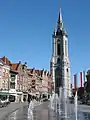
| ID 943-032 | Tournai | Campanário de Tournai |
França
Nord-Pas de Calais
Norte
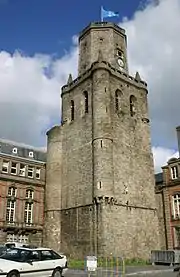
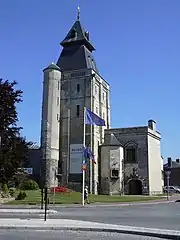
| ID 943-033 | Armentières | Campanário da prefeitura | 🌍 |
| ID 943-034 | Bailleul | Campanário da prefeitura | 🌍 |
| ID 943-035 | Bergues | Campanário | 🌍 |
| ID 943-036 | Cambrai | Campanário da Igreja de São Martinho | 🌍 |
| ID 943-037 | Comines | Campanário da prefeitura | 🌍 |
| ID 943-038 | Douai | Campanário da prefeitura | 🌍 |
| ID 943-040 | Dunkirk | Campanário da prefeitura[8] | 🌍 |
| ID 943-039 | Dunkirk | Campanário da Igreja de Santo Elígio[8] | 🌍 |
| ID 943-041 | Gravelines | Campanário | 🌍 |
| ID 943-042 | Lille | Campanário da prefeitura | 🌍 |
| ID 943-043 | Loos | Campanário da prefeitura | 🌍 |
Pas-de-Calais
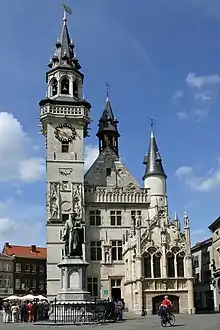
| ID 943-044 | Aire-sur-la-Lys | Campanário da prefeitura | 🌍 |
| ID 943-045 | Arras | Campanário da prefeitura | 🌍 |
| ID 943-046 | Béthune | Campanário | 🌍 |
| ID 943-047 | Boulogne-sur-Mer | Campanário da prefeitura | 🌍 |
| ID 943-048 | Calais | Campanário da prefeitura | 🌍 |
| ID 943-049 | Hesdin | Campanário da prefeitura | 🌍 |
Picardia
Somme
| ID 943-050 | Abbeville | Campanário | 🌍 |
| ID 943-051 | Amiens | Campanário | 🌍 |
| ID 943-052 | Doullens | Campanário da ex-prefeitura | 🌍 |
| ID 943-053 | Lucheux | Campanário nas ruínas do portão da cidade | 🌍 |
| ID 943-054 | Rue | Campanário | 🌍 |
| ID 943-055 | Saint-Riquier | Campanário | 🌍 |
Referências
- Citação de Detailed argumentation for list ID 943/943bis, UNESCO Website: "The Hôtel de Ville in Antwerpen (1564) is an excellent example of the transposition of Renaissance principles in the central risalith with superposed diminishing registers flanked by obelisks and scrollwork and finished with a pediment, reiterating the theme of the central belfry." – Hôtel de Ville is French for 'City Hall', Antwerpen is the native name of 'Antwerp' in Dutch.
- UNESCO states, inappropriately in French: ID 943-016 Tour de Saint-Rombaut ; in native Dutch language this is Sint-Romboutstoren which is the main tower of the cathedral, once also used as a watchtower against fires.
- UNESCO states, inappropriately in French: ID 943-015 Ancienne Halle avec Beffroi ; in native Dutch language this is Oude [or: Voormalige] Halle met Belfort. This 14th century Cloth Hall with never to its designed height built Belfry – both hardly ever used for the intended purposes – with more recent adjacent buildings, constitute the present-day City Hall.
- The belfry is known as Halletoren, because of an adjacent Cloth Hall that no longer exists; the tower is now free-standing.
- The belfry is known as Hallentoren or Tower of the Halls, plural: of the two adjacent wings or halls, only one remains, hence Cloth Hall, singular.
- The city centre's Landhuis (literally: 'country-house') was once the seat of the kasselrij or burggraafschap (viscounty) Veurne-Ambacht, serving the countryside; here as opposed to the adjacent Stadhuis (literally: 'city-house' though always meaning the City Hall) serving the city. The Landhuis later became the Court of Justice and recently a place for cultural purposes, e.g. exhibitions, dance acts, concerts, etc.
- The name Mammelokker (assumedly: 'Allurer of breasts') for the guard house at the part of the Cloth Hall that once served as a prison, refers to the story of a prisoner.
- UNESCO states: ID 943-040 Beffroi de l’Hôtel de Ville, ID 943-039 Beffroi de l'église Saint-Eloi – further reading from other source: (em francês) Monuments in Dunkirk
Ligações externas
- UNESCO
- Detalhamento dos campanários - UNESCO
- A lista completa - UNESCO
- Artigos sobre os campanários
- (em francês) Os campanários franceses
- (em francês) Lista dos campanários franceses
.jpg.webp)

This article is issued from Wikipedia. The text is licensed under Creative Commons - Attribution - Sharealike. Additional terms may apply for the media files.