Rhinella
Rhinella, comumente conhecido como sapo-cururo, é um gênero de sapos verdadeiros nativos das partes neotropicais do México e da América Central e do Sul. Além disso, o sapo-cururu foi introduzido na Austrália, no Caribe, nas Filipinas e em outros lugares.
| Rhinella | |
|---|---|
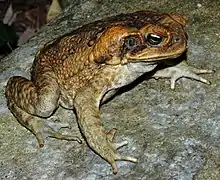 | |
| Sapo-curcuru (Rhinella marina) | |
Classificação científica  | |
| Domínio: | Eukaryota |
| Reino: | Animalia |
| Filo: | Chordata |
| Classe: | Amphibia |
| Ordem: | Anura |
| Família: | Bufonidae |
| Gênero: | Rhinella Fitzinger, 1826 |
| Espécie-tipo | |
| Rhinella proboscidea Spix, 1824 | |
| Espécies | |
|
Ver tabela | |
| Sinónimos | |
| |
Originalmente, todas as espécies do gênero Rhinella foram incluídas no gênero Bufo, depois foram divididas nos gêneros Chaunus e Rhamphophryne . No entanto, Chaunus e Rhamphophryne são agora considerados sinônimos de Rhinella.[1]
Etimologia
- Rhinella significa 'nariz pequeno', de ῥῑνο- (ῥῑνο- ), a forma de combinação do grego antigo rhis (ῥίς , 'nariz') e o sufixo diminutivo latino -ella.[2]
- Chaunus é a forma latinizada do grego antigo chaûnos (χαῦνος , 'poroso, esponjoso').[3][4]
- Rhamphophryne, que significa “sapo de bico”, é de rhamphos (ῥάµϕος , 'bico') [5] e phrunē ( φρύνη , 'Sapo').[2]
Espécies
As seguintes espécies são reconhecidas no gênero Rhinella : [6]
| Nome binomial e autor | Nome comum |
|---|---|
| Rhinella abei (Baldissera, Caramaschi & Haddad, 2004) | |
| Rhinella achalensis (Cei, 1972) | Sapo-Cordoba |
| Rhinella achavali (Maneyro, Arrieta, & de Sá, 2004) | |
| Rhinella acrolopha (Trueb, 1971) | |
| Rhinella acutirostris (Spix, 1824) | |
| Rhinella alata (Thominot, 1884) | |
| Rhinella amabilis (Pramuk and Kadivar, 2003) | |
| Rhinella amboroensis (Harvey & Smith, 1993) | Sapo-cochabamba |
| Rhinella arborescandens (Duellman & Schulte, 1992) | |
| Rhinella arenarum (Hensel, 1867) | Sapo comum; Sapo argentino |
| Rhinella arequipensis (Vellard, 1959) | Sapo rio Chili |
| Rhinella arunco (Molina, 1782) | Arunco |
| Rhinella atacamensis (Cei, 1962) | Sapo vallenar; Sapo Atacama |
| Rhinella azarai (Gallardo, 1965) | |
| Rhinella beebei (Gallardo, 1965) | |
| Rhinella bergi (Céspedez, 2000) | |
| Rhinella bernardoi Sanabria, Quiroga, Arias, and Cortez, 2010 | |
| Rhinella casconi Roberto, Brito, and Thomé, 2014 | |
| Rhinella castaneotica (Caldwell, 1991) | |
| Rhinella centralis Narvaes and Rodrigues, 2009 | |
| Rhinella ceratophrys (Boulenger, 1882) | |
| Rhinella cerradensis Maciel, Brandão, Campos, and Sebben, 2007 | |
| Rhinella chavin (Lehr, Köhler, Aguilar & Ponce, 2001) | |
| Rhinella chrysophora (McCranie, Wilson & Williams, 1989) | Sapo Rio Viejo |
| Rhinella chullachaki (2021) | |
| Rhinella cristinae (Vélez-Rodriguez & Ruiz-Carranza, 2002) | |
| Rhinella crucifer (Wied-Neuwied, 1821) | Sapo-amarelo; cururu-pequeno |
| Rhinella dapsilis (Myers & Carvalho, 1945) | Sapo-Bom-Jardim |
| Rhinella diptycha (Cope, 1862) | Sapo-boi; sapo-cururu |
| Rhinella dorbignyi (Duméril & Bibron, 1841) | Sapo Dorbigny |
| Rhinella exostosica Ferrão, Lima, Ron, dos Santos & Hanken, 2020[7] | |
| Rhinella fernandezae (Gallardo, 1957) | Sapo Bella Vista |
| Rhinella festae (Peracca, 1904) | |
| Rhinella fissipes (Boulenger, 1903) | Sapo-carabaya |
| Rhinella gallardoi (Carrizo, 1992) | Sapo Gallardo |
| Rhinella gildae Vaz-Silva, Maciel, Bastos, and Pombal, 2015 | |
| Rhinella gnustae (Gallardo, 1967) | Sapo Rio Grande |
| Rhinella granulosa (Spix, 1824) | Sapo comum menor |
| Rhinella henseli (Lutz, 1934) | |
| Rhinella hoogmoedi (Caramaschi & Pombal, 2006) | |
| Rhinella horribilis (Wiegmann, 1833) | |
| Rhinella humboldti (Gallardo, 1965) | Sapo Rivero |
| Rhinella icterica (Spix, 1824) | Sapo-cururu; Sapo-boi |
| Rhinella inca (Stejneger, 1913) | Sapo Inca |
| Rhinella inopina Vaz-Silva, Valdujo, and Pombal, 2012 | |
| Rhinella iserni (Jiménez de la Espada, 1875) | Sapo Rio Perene |
| Rhinella jimi (Stevaux, 2002) | Sapo-cururu |
| Rhinella justinianoi (Harvey & Smith, 1994) | Sapo El Chape |
| Rhinella leptoscelis (Boulenger, 1912) | |
| Rhinella lescurei Fouquet, Gaucher, Blanc and Velez-Rodriguez, 2007 | |
| Rhinella lilyrodriguezae Cusi, Moravec, Lehr, and Gvoždík, 2017 | |
| Rhinella limensis (Werner, 1901) | |
| Rhinella lindae (Rivero & Castaño, 1990) | |
| †Rhinella loba Pérez-Ben, Gómez & Báez, 2019[8] | |
| Rhinella macrorhina (Trueb, 1971) | |
| Rhinella magnussoni Lima, Menin, and Araújo, 2007 | |
| Rhinella major (Müller and Hellmich, 1936) | |
| Rhinella manu Chaparro, Pramuk, and Gluesenkamp, 2007 | |
| Rhinella margaritifera (Laurenti, 1768) | |
| Rhinella marina (Linnaeus, 1758) | Sapo-cururu; Sapo-boi |
| Rhinella martyi Fouquet, Gaucher, Blanc and Velez-Rodriguez, 2007 | |
| Rhinella merianae (Gallardo, 1965) | |
| Rhinella mirandaribeiroi (Gallardo, 1965) | |
| Rhinella multiverrucosa (Lehr, Pramuk & Lundberg, 2005) | |
| Rhinella nattereri (Bokermann, 1967) | |
| Rhinella nesiotes (Duellman & Toft, 1979) | Sapo Laguna |
| Rhinella nicefori (Cochran & Goin, 1970) | |
| Rhinella ocellata (Günther, 1858) | |
| Rhinella ornata Spix, 1824 | |
| Rhinella paraguas Grant and Bolívar-Garcías, 2014 | |
| Rhinella paraguayensis Ávila, Pansonato, and Strüssmann, 2010 | |
| Rhinella poeppigii (Tschudi, 1845) | Sapo-cinzento |
| Rhinella proboscidea (Spix, 1824) | |
| Rhinella pygmaea (Myers & Carvalho, 1952) | Sapo Rio Parahyba |
| Rhinella quechua (Gallardo, 1961) | Sapo Incachaca |
| Rhinella roqueana (Melin, 1941) | |
| Rhinella rostrata (Noble, 1920) | |
| Rhinella rubescens (Lutz, 1925) | |
| Rhinella rubropunctata (Guichenot, 1848) | |
| Rhinella ruizi (Grant, 2000) | |
| Rhinella rumbolli (Carrizo, 1992) | Sapo salta |
| Rhinella scitula (Caramaschi & de Niemeyer, 2003) | |
| Rhinella sclerocephala (Mijares-Urrutia & Arends-R., 2001) | |
| Rhinella sebbeni Vaz-Silva, Maciel, Bastos, and Pombal, 2015 | |
| Rhinella spinulosa (Wiegmann, 1834) | |
| Rhinella stanlaii (Lötters & Köhler, 2000) | |
| Rhinella sternosignata (Günther, 1858) | |
| Rhinella tacana (Padial, Reichle, McDiarmid, & De la Riva, 2006) | |
| Rhinella tenrec (Lynch & Renjifo, 1990) | |
| Rhinella truebae (Lynch & Renjifo, 1990) | |
| Rhinella vellardi (Leviton & Duellman, 1978) | Sapo Alto Maranon |
| Rhinella veraguensis (Schmidt, 1857) | Sapo Veragua |
| Rhinella veredas (Brandão, Maciel, and Sebben, 2007) | |
| Rhinella yanachaga Lehr, Pramuk, Hedges, and Córdova, 2007 | |
| Rhinella yunga (Mordavec, Lehr, 2014) |
Notas
- Chaparro, Juan Carlos, Jennifer B. Pramuk and Andrew G. Gluesenkamp. 2007. A new species of arboreal Rhinella (Anura: Bufonidae) from a cloud forest of southeastern Peru. Herpetologica. 63 (2): 203-212.
- Dodd, C. Kenneth (2013). Frogs of the United States and Canada. 1. [S.l.]: The Johns Hopkins University Press. ISBN 978-1-4214-0633-6
- d'Orbigny, Charles (1845). Dictionnaire universel d'histoire naturelle (em francês). 3. [S.l.]: Bureau Principal de l'Éditeurs
- χαῦνος. Liddell, Henry George; Scott, Robert; A Greek–English Lexicon no Perseus Project
- «rhamphoid»
 . Oxford University Press Online ed. Oxford English Dictionary
 - «Rhinella Fitzinger, 1826 | Amphibian Species of the World». research.amnh.org. Consultado em 26 de outubro de 2019
- Ferrão, Miquéias; Lima, Albertina Pimentel; Ron, Santiago; Santos, Sueny Paloma dos; Hanken, James (28 de dezembro de 2020). «New Species of Leaf-litter Toad of the Rhinella margaritifera Species Group (Anura: Bufonidae) from Amazonia». Copeia. 108 (4): 967–986. ISSN 0045-8511. doi:10.1643/CH2020043

- Pérez-Ben, Celeste M.; Gómez, Raúl O.; Báez, Ana M. (4 de abril de 2019). «A new Pliocene true toad (Anura: Bufonidae): first record of an extinct species from South America». Journal of Vertebrate Paleontology (em inglês). 39: e1576183. ISSN 0272-4634. doi:10.1080/02724634.2019.1576183
Referências
- Frost, Darrel (2006). "The Amphibian Tree of Life". Bulletin of the American Museum of Natural History 297: 1–371.
Ligações externas
 Dados relacionados com Rhinella no Wikispecies
- Frost, Darrel R. 2007. Amphibian Species of the World: an Online Reference. Version 5.1 (10 October 2007). Rhinella. Electronic Database accessible at http://research.amnh.org/herpetology/amphibia/index.php. American Museum of Natural History, New York. (Consultado: 7 Maio 2008).
This article is issued from Wikipedia. The text is licensed under Creative Commons - Attribution - Sharealike. Additional terms may apply for the media files.