Tuarangisaurus
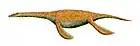
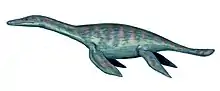
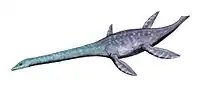
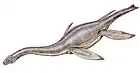
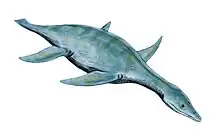
Tuarangisaurus é um gênero extinto de elasmosauróide conhecido da Nova Zelândia. O tipo e única espécie conhecida é Tuarangisaurus keyesi, nomeado por Wiffen e Moisley em 1986.[1][2]
| Tuarangisaurus | |
|---|---|
.jpg.webp) | |
Classificação científica  | |
| Domínio: | Eukaryota |
| Reino: | Animalia |
| Filo: | Chordata |
| Classe: | Reptilia |
| Superordem: | †Sauropterygia |
| Ordem: | †Plesiosauria |
| Família: | †Elasmosauridae |
| Gênero: | †Tuarangisaurus Wiffen & Moisley, 1986 |
| Espécies: | †T. keyesi |
| Nome binomial | |
| †Tuarangisaurus keyesi Wiffen & Moisley, 1986 | |
Descrição
O comprimento estimado de Tuarangisaurus é de cerca de 8 metros.[3] Pode ser distinguido de todos os outros elasmosaurídeos conhecidos por uma combinação única de características, bem como dois traços desconhecidos: o ectopterygoid tem um longo processo direcionado para trás, e um grande chefe de osso por baixo. Um estribo está presente no holótipo; este osso foi previamente pensado para estar ausente de elasmosaurídeos.[2][4]
Referências
- Wiffen, J.; Moisley, W.L. (1986). «Late Cretaceous reptiles (Families Elasmosauridae and Pliosauridae) from the Mangahouanga Stream, North Island, New Zealand». New Zealand Journal of Geology and Geophysics. 29 (2): 205–252. doi:10.1080/00288306.1986.10427535
- O'Gorman, J.P.; Otero, R.A.; Hiller, N.; Simes, J.; Terezow, M. (2016). «Redescription of Tuarangisaurus keyesi (Sauropterygia; Elasmosauridae), a key species from the uppermost Cretaceous of the Weddellian Province: Internal skull anatomy and phylogenetic position». Cretaceous Research. 71: 118–136. doi:10.1016/j.cretres.2016.11.014
- Sachs, S. (2005). «Tuarangisaurus australis sp. nov. (Plesiosauria: Elasmosauridae) from the Lower Cretaceous of northeastern Queensland, with additional notes on the phylogeny of the Elasmosauridae» (PDF). Memoirs of the Queensland Museum. 50 (2): 425–440. Arquivado do original (PDF) em 28 de setembro de 2011
- Carpenter, K. (1999). «Revision of North American elasmosaurs from the Cretaceous of the western interior». Paludicola. 2: 148–173
| |||||||||||||||||||||||||||||||||||||||||||||||||||||||
| |||||||||||||||||||||||||||||||||||||||||||||||||||||||
| |||||||||||||||||||||||||||||||||||||||||||||||||||||||
| |||||||||||||||||||||||||||||||||||||||||||||||||||||||
| |||||||||||||||||||||||||||||||||||||||||||||||||||||||
.png.webp)
This article is issued from Wikipedia. The text is licensed under Creative Commons - Attribution - Sharealike. Additional terms may apply for the media files.