Upsilon Andromedae d
Upsilon Andromedae d, nomeado como Majriti,[1][2][3][4] é um exoplaneta que órbita uma estrela como o Sol chamada "Upsilon Andromedae".[5][6][7] Foi descoberto em abril de 1999 por Geoffrey Marcy e R. Paul Butler.[8][9][10] Trata-se de um gigante gasoso, que é o terceiro planeta conhecido em ordem de distância à sua estrela e o mais externo nesse sistema sistema planetário. Está situado na chamada "zona habitável", mas como é um gigante gasoso não pode conter vida, porém uma lua pode ter características semelhantes à da Terra, podendo até mesmo suportar vida.
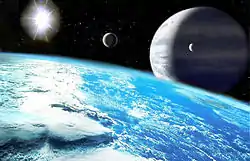
Impressão artística de Upsilon Andromedae d vista de uma hipotética lua com características semelhantes à da Terra. Podem ser vistos à frente outras luas desse planeta e ao fundo a sua estrela.
Referências
- NameExoWorlds: An IAU Worldwide Contest to Name Exoplanets and their Host Stars. IAU.org. 9 July 2014
- NameExoWorlds The Process
- Final Results of NameExoWorlds Public Vote Released, International Astronomical Union, 15 December 2015.
- NameExoWorlds The Approved Names
- Butler, R. P.; et al. (2006). «Catalog of Nearby Exoplanets». The Astrophysical Journal. 646 (1): 505–522. Bibcode:2006ApJ...646..505B. arXiv:astro-ph/0607493
 . doi:10.1086/504701 (web version)
 - Ford, Eric B.; et al. (2005). «Planet-planet scattering in the upsilon Andromedae system». Nature. 434 (7035): 873–876. Bibcode:2005Natur.434..873F. PMID 15829958. arXiv:astro-ph/0502441. doi:10.1038/nature03427
- Rory Barnes; Richard Greenberg (2008). «Extrasolar Planet Interactions». arXiv:0801.3226v1 [astro-ph]
- Butler, R. Paul; et al. (1999). «Evidence for Multiple Companions to υ Andromedae». The Astrophysical Journal. 526 (2): 916–927. Bibcode:1999ApJ...526..916B. doi:10.1086/308035
- Han, Inwoo; et al. (2001). «Preliminary Astrometric Masses for Proposed Extrasolar Planetary Companions». The Astrophysical Journal. 548 (1): L57–L60. Bibcode:2001ApJ...548L..57H. doi:10.1086/318927
- Pourbaix, D. & Arenou, F. (2001). «Screening the Hipparcos-based astrometric orbits of sub-stellar objects». Astronomy and Astrophysics. 372 (3): 935–944. Bibcode:2001A&A...372..935P. arXiv:astro-ph/0104412. doi:10.1051/0004-6361:20010597
 | |

This article is issued from Wikipedia. The text is licensed under Creative Commons - Attribution - Sharealike. Additional terms may apply for the media files.