壇
| ||||||||
Translingual
| Stroke order | |||
|---|---|---|---|
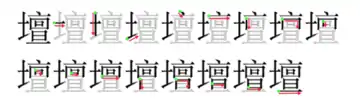 | |||
Han character
壇 (Kangxi radical 32, 土+13, 16 strokes, cangjie input 土卜田一 (GYWM), four-corner 40116, composition ⿰土亶)
References
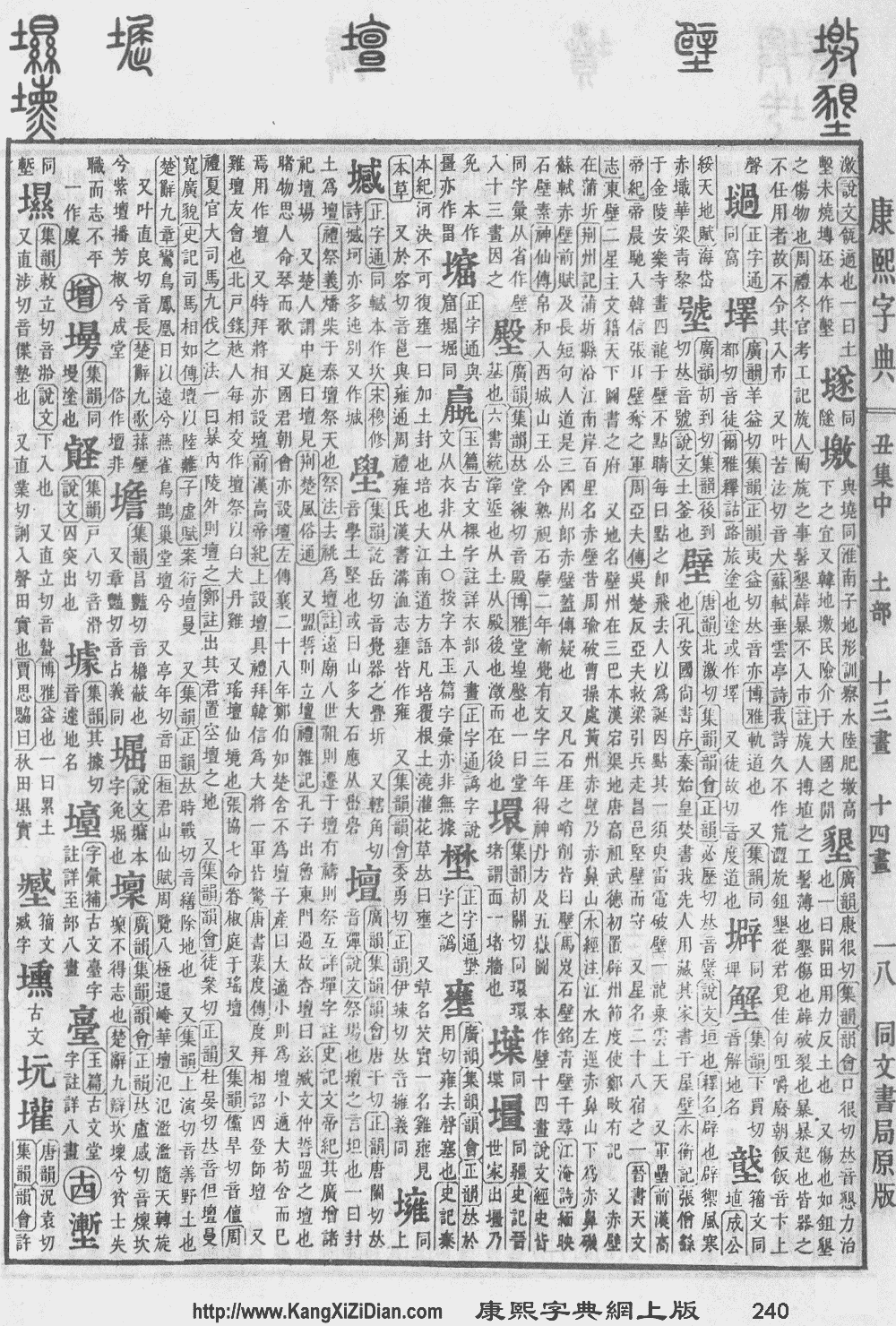
- Kangxi Dictionary: page 240, character 22
- Dai Kanwa Jiten: character 5528
- Dae Jaweon: page 480, character 8
- Hanyu Da Zidian (first edition): volume 1, page 492, character 12
- Unihan data for U+58C7
Chinese
Lua error in Module:utilities at line 142: attempt to perform arithmetic on local 'h' (a nil value)
Glyph origin
Characters in the same phonetic series (旦) (Zhengzhang, 2003)
| Old Chinese | |
|---|---|
| 皽 | *tjaʀ, *tanʔ, *tjanʔ |
| 担 | *taːnʔ |
| 胆 | *daːn, *daːn |
| 疸 | *taːnʔ, *taːns |
| 觛 | *taːnʔ, *taːns, *daːnʔ |
| 亶 | *taːnʔ |
| 嬗 | *taːnʔ, *tʰaːn, *djans |
| 笪 | *taːnʔ, *taːns, *taːd |
| 狚 | *taːnʔ, *taːns, *taːd |
| 旦 | *taːns |
| 鴠 | *taːns |
| 譠 | *tʰaːn, *rteːn |
| 坦 | *tʰaːnʔ |
| 但 | *daːn, *daːnʔ, *daːns |
| 檀 | *daːn |
| 壇 | *daːn |
| 儃 | *daːn, *djan |
| 驙 | *daːn, *tan |
| 袒 | *daːnʔ, *rdeːns |
| 襢 | *daːnʔ, *tanʔ, *tans |
| 繵 | *daːnʔ |
| 膻 | *daːnʔ |
| 澶 | *daːns, *djan |
| 邅 | *tan, *danʔ, *dans |
| 鱣 | *tan |
| 饘 | *tjan, *tjanʔ |
| 旜 | *tjan |
| 氈 | *tjan |
| 鸇 | *tjan |
| 顫 | *tjans |
| 蟺 | *djanʔ |
| 擅 | *djans |
| 羶 | *hljan |
| 呾 | *taːd, *ʔraːd |
| 怛 | *taːd |
| 妲 | *taːd |
| 靼 | *taːd, *tjad |
| 炟 | *taːd |
Phono-semantic compound (形聲/形声, OC *daːn) : semantic 土 + phonetic 亶 (OC *taːnʔ).
Pronunciation
Definitions
壇
- altar (Classifier: 座)
- 中華世紀壇/中华世纪坛 ― zhōnghuá shìjì tán ― China Millennium Monument
- 北宮奢為衛靈公賦斂以為鐘,為壇乎國門之外,三月而成上下之縣。 [Classical Chinese, trad.]
- From: Zhuangzi, circa 3rd – 2nd centuries BCE
- Běigōng Shē wèi Wèi Línggōng fùliǎn yǐ wèi zhōng, wèi tán hū guómén zhī wài, sān yuè ér chéng shàngxià zhī xiàn. [Pinyin]
- Beigong She was collecting taxes for Duke Ling of Wei in order to make a set of bells. He built a platform outside the gate of the outer wall, and in the space of three months the bells were completed, both the upper and lower tiers.
北宫奢为卫灵公赋敛以为钟,为坛乎国门之外,三月而成上下之县。 [Classical Chinese, simp.]
- raised plot of land for planting flowers, etc.
- forum; place for giving lectures or speeches
- circles
- (Cantonese) Classifier for affairs or matters.
Compounds
- 七星壇/七星坛
- 乩壇/乩坛
- 仙壇/仙坛
- 六祖壇經/六祖坛经 (Liùzǔ Tánjīng)
- 名壇/名坛
- 吟壇/吟坛
- 壇兆/坛兆
- 壇坫/坛坫
- 壇坫週旋/坛坫周旋
- 壇場/坛场 (tánchǎng)
- 壇宇/坛宇
- 天壇/天坛 (Tiāntán)
- 尼壇/尼坛
- 影壇/影坛 (yǐngtán)
- 戒壇/戒坛
- 打沒頭壇/打没头坛 (dǎmòtóután)
- 政壇/政坛 (zhèngtán)
- 文壇/文坛 (wéntán)
- 杏壇/杏坛 (xìngtán)
- 棒壇/棒坛
- 榕壇問業/榕坛问业
- 樂壇/乐坛 (yuètán)
- 模網論壇/模网论坛
- 歌壇/歌坛 (gētán)
- 泳壇/泳坛 (yǒngtán)
- 泰壇/泰坛
- 法壇/法坛
- 海壇/海坛 (Hǎitán)
- 畫壇/画坛 (huàtán)
- 登壇/登坛 (dēngtán)
- 登壇拜將/登坛拜将
- 碑壇/碑坛
- 神壇/神坛 (shéntán)
- 神農壇/神农坛 (Shénnóngtán)
- 祭壇/祭坛 (jìtán)
- 築壇/筑坛
- 築壇拜將/筑坛拜将
- 籃壇/篮坛 (lántán)
- 經壇/经坛
- 網路論壇/网路论坛
- 線上論壇/线上论坛
- 花壇/花坛 (huātán)
- 花壇鄉/花坛乡
- 菊壇/菊坛
- 藝壇/艺坛 (yìtán)
- 詩壇/诗坛
- 論壇/论坛 (lùntán)
- 論壇區/论坛区
- 講壇/讲坛 (jiǎngtán)
- 議壇/议坛
- 趙玄壇/赵玄坛
- 郊壇/郊坛
- 郊壇下窯/郊坛下窑
- 醮壇/醮坛
- 雩壇/雩坛
- 電子論壇/电子论坛
- 韓信登壇/韩信登坛
- 體壇/体坛 (tǐtán)
- 齋壇/斋坛
Descendants
Sino-Xenic (壇):
- → Japanese: Lua error in Module:utilities at line 142: attempt to perform arithmetic on local 'h' (a nil value)
- → Korean: 단(壇) (dan)
References
- “壇”, in 漢語多功能字庫 (Multi-function Chinese Character Database), 香港中文大學 (the Chinese University of Hong Kong), 2014–
Japanese
| Shinjitai | 壇 | |
| Kyūjitai [1] |
壇󠄂 壇+ 󠄂?(Hanyo-Denshi) (Moji_Joho) |
 |
| The displayed kanji may be different from the image due to your environment. See here for details. | ||
Readings
Lua error in Module:utilities at line 142: attempt to perform arithmetic on local 'h' (a nil value)
Korean
Etymology
(This etymology is missing or incomplete. Please add to it, or discuss it at the Etymology scriptorium. Particularly: “Middle Korean readings, if any”)
Pronunciation
- (SK Standard/Seoul) IPA(key): [ta̠n]
- Phonetic hangul: [단]
Vietnamese
This article is issued from Wiktionary. The text is licensed under Creative Commons - Attribution - Sharealike. Additional terms may apply for the media files.