桂花
Chinese
Lua error in Module:utilities at line 142: attempt to perform arithmetic on local 'h' (a nil value)
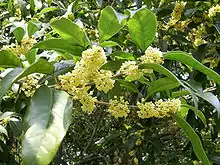
Etymology
Adaptation of 桂 (guì) to distinguish the osmanthus from the 肉桂 (ròuguì, “cassia; Chinese cinnamon”).
Pronunciation
Synonyms
- 木樨 (mùxī)
Japanese
| Kanji in this term | |
|---|---|
| 桂 | 花 |
| けい Jinmeiyō |
か Grade: 1 |
| on’yomi | |
.jpg.webp)
Pronunciation
- IPA(key): [ke̞ːka̠]
Alternative forms
- 桂華 (rare)
Etymology 1
*/kweːkwa/ → /keːkwa/ → /keːka/
From Middle Chinese compound Lua error in Module:utilities at line 142: attempt to perform arithmetic on local 'h' (a nil value). Compare modern Min Nan reading kùi-hoe.
Usage notes
The term 桂花 is generally reserved for compounds. The tree and the flowers are usually distinguished within Japan between the white-blossoming 銀木犀 (ginmokusei, “silver osmanthus”) and the orange-blossoming 金木犀 (kinmokusei, “gold osmanthus”), with the latter being more popular.
Synonyms
Derived terms
Etymology 2
From a Chinese legend that the phases of the moon were caused by kei trees (桂, general name for Lauraceae and other fragrant trees), which would bud, blossom, then drop their flowers and leaves again as if in accelerated seasons. Literally, “kei flower”, likening the phases of the moon to the budding and blooming of the trees.[1]
References
- 1988, 国語大辞典(新装版) (Kokugo Dai Jiten, Revised Edition) (in Japanese), Tōkyō: Shogakukan